
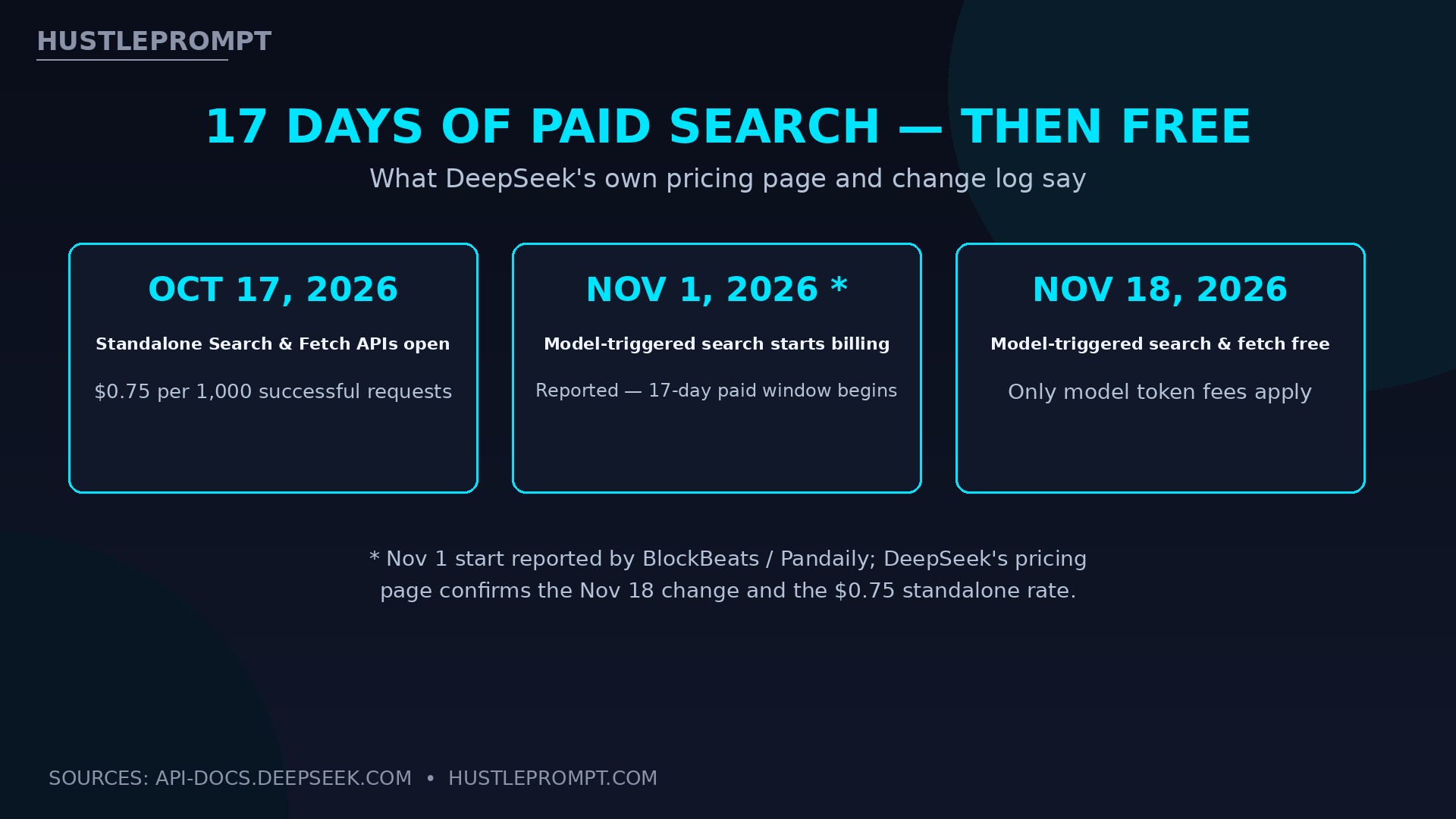
Seventeen days. That is how long DeepSeek charged developers for web search triggered inside a model call — and then, on November 18, 2026, it stopped. The company’s own pricing page now says server-side search and web fetch calls triggered when calling the model are no longer billed at all. You pay only for the model tokens the search results consume.
For anyone building research agents, monitoring tools or content pipelines, that is a real cost line disappearing. A web search that used to carry its own fee now rides free inside DeepSeek’s cheapest model, deepseek-flash, which costs $0.30 per million input tokens at peak hours. This is what changed, what still costs money, and how to turn the free search into income.
What exactly changed on November 18
DeepSeek’s pricing page states the change plainly, with a time stamp: starting at 12:00 on November 18, 2026 (Beijing Time, UTC+8), “the server-side search and web fetch tool calls triggered when calling the model are no longer billed; the results they return are appended to the model context and billed as model token usage.”
Three routes trigger that free server-side search:
- DeepSeek’s own web tools — the
deepseek_web_searchanddeepseek_read_urltools in the Messages, Responses and Chat Completions APIs. - The
web_searchtool in the Anthropic API — the route Claude Code uses when pointed at DeepSeek’s Anthropic-compatible endpoint. - The
web_searchtool in the Responses API — the OpenAI-compatible route for agent frameworks.
The change arrived five days after DeepSeek opened its full suite of application APIs on November 13, 2026, bringing web search, image search, deep thinking search, file input and URL reading from the DeepSeek app to developers. It came about a month after the standalone Search and Fetch APIs launched on October 17, 2026. Those standalone APIs still cost money — and that is the catch to understand before you build.
One date in this story is reported, not official. Multiple outlets, citing BlockBeats and Pandaily, report that model-triggered search started billing on November 1, 2026, which makes the paid window 17 days. DeepSeek’s own documentation confirms the November 18 change and the prices; it does not publish a November 1 start date, so treat that date as reported.
The price table: what changed
| What you call | Nov 1–17, 2026 (reported) | From Nov 18, 2026 (official) |
|---|---|---|
| Model-triggered web search | Billed per use | $0 — only token fees |
| Model-triggered image search | Billed per use | $0 — only token fees |
| Model-triggered web fetch / URL reading | Billed per use | $0 — only token fees |
| Standalone Search API (text) | $0.75 per 1,000 successful requests | $0.75 per 1,000 successful requests |
| Standalone Fetch API | $0.75 per 1,000 successful requests | $0.75 per 1,000 successful requests |
| Model tokens (deepseek-flash) | Billed per token | Billed per token — unchanged |
The token side of the bill is where the real cost now lives. DeepSeek’s current model is DeepSeek-V4.1-Flash-1017, sold as deepseek-flash, with a 1-million-token context window and up to 384,000 output tokens. At peak hours it costs $0.30 per million input tokens (cache miss) and $1.20 per million output tokens. Off-peak rates are half that, and cached input costs just $0.006 per million tokens at peak. Peak hours are 01:00–04:00 and 06:00–10:00 UTC, Monday to Friday, excluding Chinese public holidays.
Search results are appended to the model context, so a heavy research session still costs tokens. But the search itself no longer has a meter of its own.
How DeepSeek’s free search stacks up
| Provider | Model-triggered web search fee | Model tokens (input / output, per 1M) |
|---|---|---|
| DeepSeek deepseek-flash | $0 from Nov 18, 2026 | $0.30 / $1.20 peak |
| DeepSeek deepseek-v4-pro | $0 from Nov 18, 2026 | $1.32 / $3.96 peak |
| OpenAI web search tool | $10.00 per 1,000 calls + search content tokens | Depends on model |
| DeepSeek standalone Search API | $0.75 per 1,000 successful requests | Not applicable — no model call needed |
The gap is the story. OpenAI’s official pricing page lists its web search tool at $10.00 per 1,000 calls, plus the search content tokens at model rates. DeepSeek’s standalone Search API is $0.75 per 1,000 successful requests — and the model-triggered version is now $0. A research agent that runs 1,000 searches a day pays $10 a day in tool fees on OpenAI’s web search, and nothing in tool fees on DeepSeek.
Cheap only matters if the search is good. DeepSeek says its in-house search engine “reliably handles hundreds of millions of search requests from around the world every day” and “indexes hundreds of billions of web pages.” The engine filters SEO spam, GEO manipulation and low-quality AI-generated content, according to the company’s October 17 change log entry. Those are DeepSeek’s own claims, not independent tests — but the scale explains why the company can afford to give the tool away.
The model behind the search is no lightweight either. The October 17 update lists DeepSeek-V4.1-Flash-1017 at 42.6 on HLE without tools, 42.3 on Terminal-Bench 4.0 and 77.0 on DeepSWE v1.1 — scores DeepSeek publishes for its own model, tested in its own harness.
How the free search actually works
The flow is simple because DeepSeek does the tool calls server-side. You enable a tool, the model decides when to search, and the results come back as context.
ASK → SEARCH → FETCH → ANSWER
1. ASK
Send a question to deepseek-flash with the deepseek_web_search tool enabled.
2. SEARCH
The model searches the web or images and picks sources, answering with citations.
3. FETCH
It reads the links itself with deepseek_read_url — no separate Fetch call needed.
4. ANSWER
Results join the context. You pay only the model tokens — the search fee is $0.
Two modes matter. With thinking disabled, the model runs web or image searches as the question requires and answers with citations. With thinking enabled, deep thinking search runs over multiple reasoning steps — the model searches, reads links and reasons about what it found before answering.
The same free search reaches the tools developers already use. Claude Code pointed at DeepSeek’s Anthropic-compatible endpoint (api.deepseek.com/anthropic) gets the web_search tool free, and DeepSeek Harness, which calls the same API, rides on the same change.
Watch: Runpod shows how to run Claude Code with any model, including through DeepSeek’s Anthropic-compatible endpoint. (Runpod’s official YouTube channel — DeepSeek publishes its announcements on its docs site rather than YouTube, so no DeepSeek-official video fits this story.)
How to profit from free DeepSeek search: 5 moves
Free search removes the meter that made research agents expensive to run. The margin now sits between DeepSeek’s token cost and whatever a client will pay for answers.
- Sell daily research briefings. Offer a niche briefing — competitor prices, regulation changes, funding news — delivered every morning. The agent searches, reads and summarizes. At peak Flash rates, a briefing using roughly 40,000 input tokens and 4,000 output tokens costs about $0.017 in tokens. Charge $49–$99 a month per client; the search itself adds $0.
- Sell monitoring as a service. Small businesses will pay to know the moment a competitor changes a price, a review turns nasty, or a new regulation lands. Build one DeepSeek-powered monitor, clone it per client, and charge per watchlist.
- Offer a “research agent in a box.” Set up Claude Code with DeepSeek’s Anthropic endpoint for a client, with web search on and a daily budget cap. Charge a setup fee plus a monthly retainer for prompt tuning.
- Migrate search-heavy agents off per-call billing. Audit a client’s existing agent: every 1,000 OpenAI web searches costs $10 in tool fees alone. Moving the research step to DeepSeek’s model-triggered search removes that line — quote the saving, keep part of it as your fee.
- Charge for the judgment, not the search. Search is now free; knowing which sources to trust is not. Sell the curation: verified sources, citations checked, and a human sign-off before anything reaches the client.
What to watch before you build on it
- Free is not $0. Search results are appended to the model context and billed as tokens. A research session that pulls in long pages can still run up a token bill — schedule heavy jobs off-peak, when rates halve.
- Do not call the standalone APIs by habit. If the model can trigger the search, let it. Calling the standalone Search or Fetch API directly still costs $0.75 per 1,000 successful requests.
- Prices can change. DeepSeek’s own pricing page says product prices may vary and the company reserves the right to adjust them. The 17-day reversal is proof it will.
- The November 1 date is reported. DeepSeek’s docs confirm the November 18 change. The start of charging is reported by BlockBeats and Pandaily, not announced by DeepSeek.
- The free app has limits. The DeepSeek app and web chat are free, but daily quotas apply on the free tier.
What to watch next
- Whether the free window holds — and whether OpenAI or Google answer with cheaper search of their own.
- Harness adoption. DeepSeek recommends Harness 0.2.1-rc.1 or later for the new model, and the harness is where its agent benchmarks are run.
- Whether free search spreads to more models. The application APIs are built on deepseek-flash today; deepseek-v4-pro keeps the same free model-triggered search, at higher token rates.
The bottom line is simple. DeepSeek tried charging for model-triggered web search, and 17 days later it gave it up. Whatever the reason — competition, adoption, or a pricing experiment that did not land — the result is the same: the cheapest serious research-agent stack on the market just lost its search meter. Build on it while it lasts, and keep an eye on the pricing page.
Frequently asked questions
Is DeepSeek web search really free now?
Yes, for model-triggered search. From 12:00 on November 18, 2026 (Beijing Time), server-side search and web fetch calls triggered when calling the model carry no separate fee, according to DeepSeek’s official pricing page. You still pay for the model tokens the search results consume. Direct calls to the standalone Search and Fetch APIs still cost $0.75 per 1,000 successful requests.
What still costs money when I use DeepSeek search?
Model tokens are still billed: deepseek-flash costs $0.30 per million input tokens and $1.20 per million output tokens at peak hours (cache miss), half that off-peak. The standalone Search and Fetch APIs still cost $0.75 per 1,000 successful requests each, and file parsing, OCR, speech-to-text and text-to-speech remain billed separately.
What does “model-triggered” mean?
It means the search or fetch is initiated by the model during an API call — through DeepSeek’s web tools, the web_search tool in the Anthropic API, or the web_search tool in the Responses API. Calling the standalone Search or Fetch API directly from your own code is not model-triggered, and it is still billed per use.
How do I turn on web search in the DeepSeek API?
Enable the deepseek_web_search tool on the deepseek-flash model in the Messages, Responses or Chat Completions API. With thinking disabled, the model runs web or image searches and answers with citations; with thinking enabled, deep thinking search runs over multiple reasoning steps. Enable deepseek_read_url to let the model fetch pages itself.
Can I use it with Claude Code?
Yes. Point Claude Code at DeepSeek’s Anthropic-compatible endpoint, api.deepseek.com/anthropic, and the web_search tool is covered by the same free change. DeepSeek Harness, which calls the same API, benefits the same way.
How does DeepSeek compare with OpenAI’s web search pricing?
OpenAI’s official pricing page lists its web search tool at $10.00 per 1,000 calls, plus search content tokens at model rates. DeepSeek’s model-triggered web search is now $0 in tool fees, and its standalone Search API is $0.75 per 1,000 successful requests. The token rates differ too: DeepSeek’s deepseek-flash is $0.30 per million input tokens at peak, against OpenAI’s model rates.
Did DeepSeek really charge for only 17 days?
That is what multiple outlets report. BlockBeats and Pandaily report that model-triggered search started billing on November 1, 2026, and DeepSeek’s own pricing page confirms it stopped on November 18, 2026 — a 17-day window. DeepSeek’s documentation does not publish the November 1 start date, so the start date is reported, not official.
Keep Reading
Sources: DeepSeek, “Models & Pricing”; DeepSeek, “Change Log” (Nov 13 and Oct 17, 2026); OpenAI, “Pricing” (web search tool). The November 1, 2026 charging start is reported by BlockBeats and Pandaily, via KuCoin and AIAffairs.