
On August 31, 2026, the European Union did something no regulator had ever done: it legally classified ChatGPT as a search engine. A search engine, in the same legal category as Google and Bing, with one billion weekly users behind it.
That ruling was the starting gun for the biggest land grab in digital marketing since SEO itself. The new discipline is GEO — generative engine optimization: getting your brand cited inside AI-generated answers instead of ranked on a results page.
What’s trending: the citation economy just went mainstream
The EU’s designation puts a regulatory stamp on what users already do: 71.5% of Americans have used AI tools for search (Search Engine Land data via Onely), and ChatGPT processes roughly 12% of Google’s search volume.
Meanwhile, the economics of classic search are collapsing. 60% of Google searches now end in zero clicks — no website visited at all. On queries with Google’s AI Overviews, organic click-through rates have fallen 61%, from 1.76% to 0.61% (Seer Interactive data via Onely). Zero-click is no longer an edge case. It is the majority.
Sources: Azoma / EU Commission designation, Aug 31 2026; Onely GEO guide; Authoricy GEO Services Guide
Follow the money: the global GEO services market hit $1.09 billion in 2026 at a 40.6% annual growth rate (Dimension Market Research). Brands aren’t buying out of curiosity — 89% of B2B buyers use AI for vendor research (Forrester, 2026, 18,000 respondents), and AI-referred traffic converts at 4.4x the rate of organic search (Ahrefs, 2026).
Why ranking #1 no longer means being seen
The stat that ends the “SEO is fine” argument. Ahrefs found that 28.3% of ChatGPT’s most-cited pages have zero organic visibility in Google — they don’t rank at all, yet AI assistants cite them constantly. Fewer than 10% of sources cited in ChatGPT, Gemini, and Copilot rank in Google’s top 10 for the same query (Erlin, 2026).
The reason is structural. AI assistants retrieve candidate documents, rank passages for clarity and authority, then synthesize one answer with citations. Google’s ranking position has less than 4% correlation with AI citation rates (Digital Applied, 2026), and 88% of Google AI Mode citations come from pages outside the organic top 10 (SuperteamAI).
Source: Onely, “What is GEO (Generative Engine Optimization)” — onely.com
There is a second shock in the data: each assistant cites differently. Azoma’s Q2 2026 analysis of millions of shopping-agent citations found no two AI platforms share the same source mix — ChatGPT leans on earned media (41%), Gemini on retailers (41%). One-size-fits-all GEO doesn’t exist; brands need per-platform tracking.
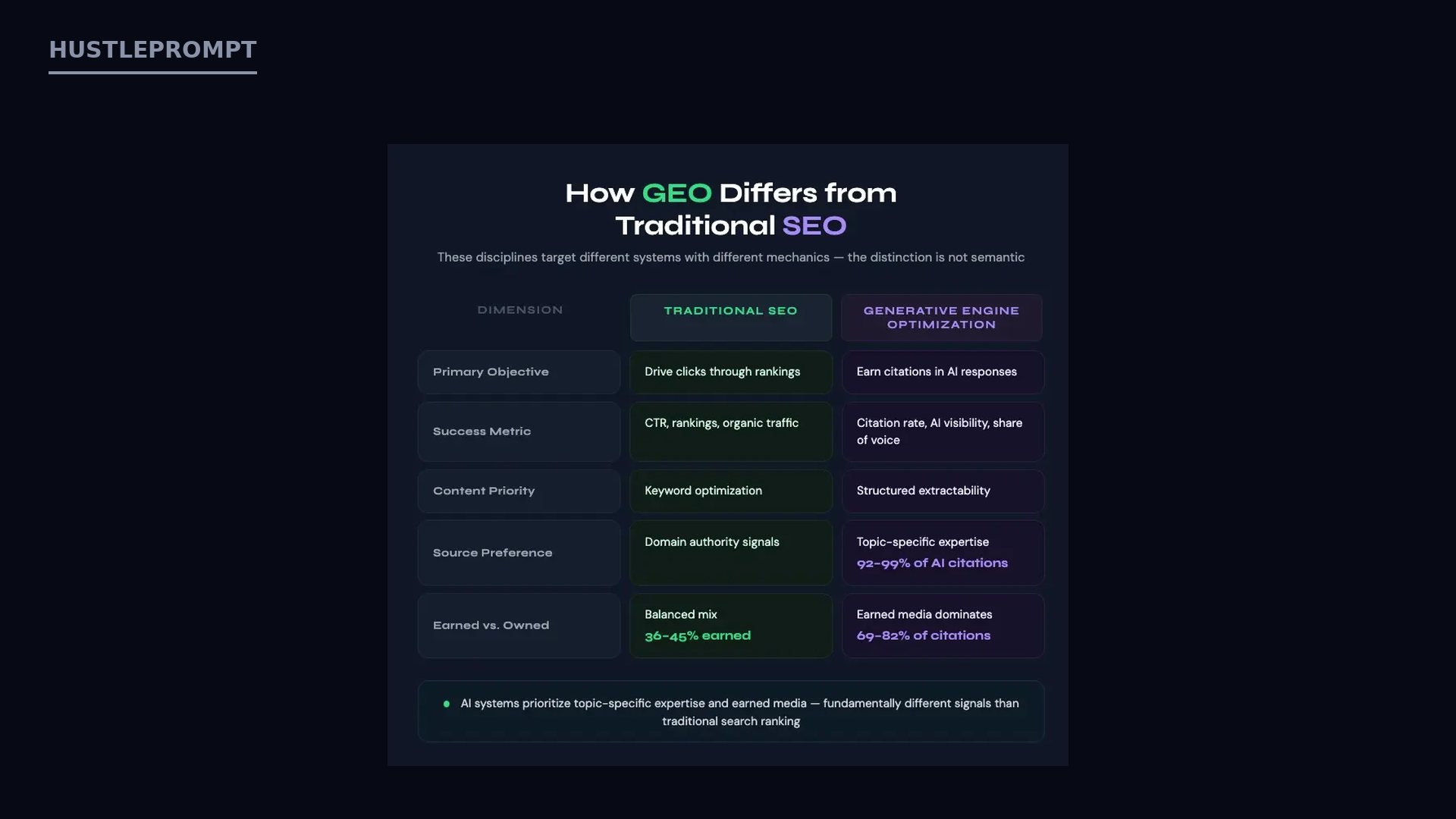
The deepest cut: your own website is the weakest citation source. AI search cites earned media — reviews, press, Reddit threads, analyst reports — at 69-82% of citations (peer-reviewed research cited by Onely). Erlin’s 2026 data: 68% of AI citations come from third parties, only 32% from brand-owned sites. The brand that wins is the one other people talk about.
SEO vs GEO: the two games side by side
GEO was formalized in peer-reviewed research (Princeton, Georgia Tech, the Allen Institute, IIT Delhi; KDD 2024) — not a rebrand of SEO, but a different system:
Source: Onely; topic-specific citation data via Getmentioned (~1M prompts), earned-media rates via peer-reviewed research.
How an AI answer cites your brand
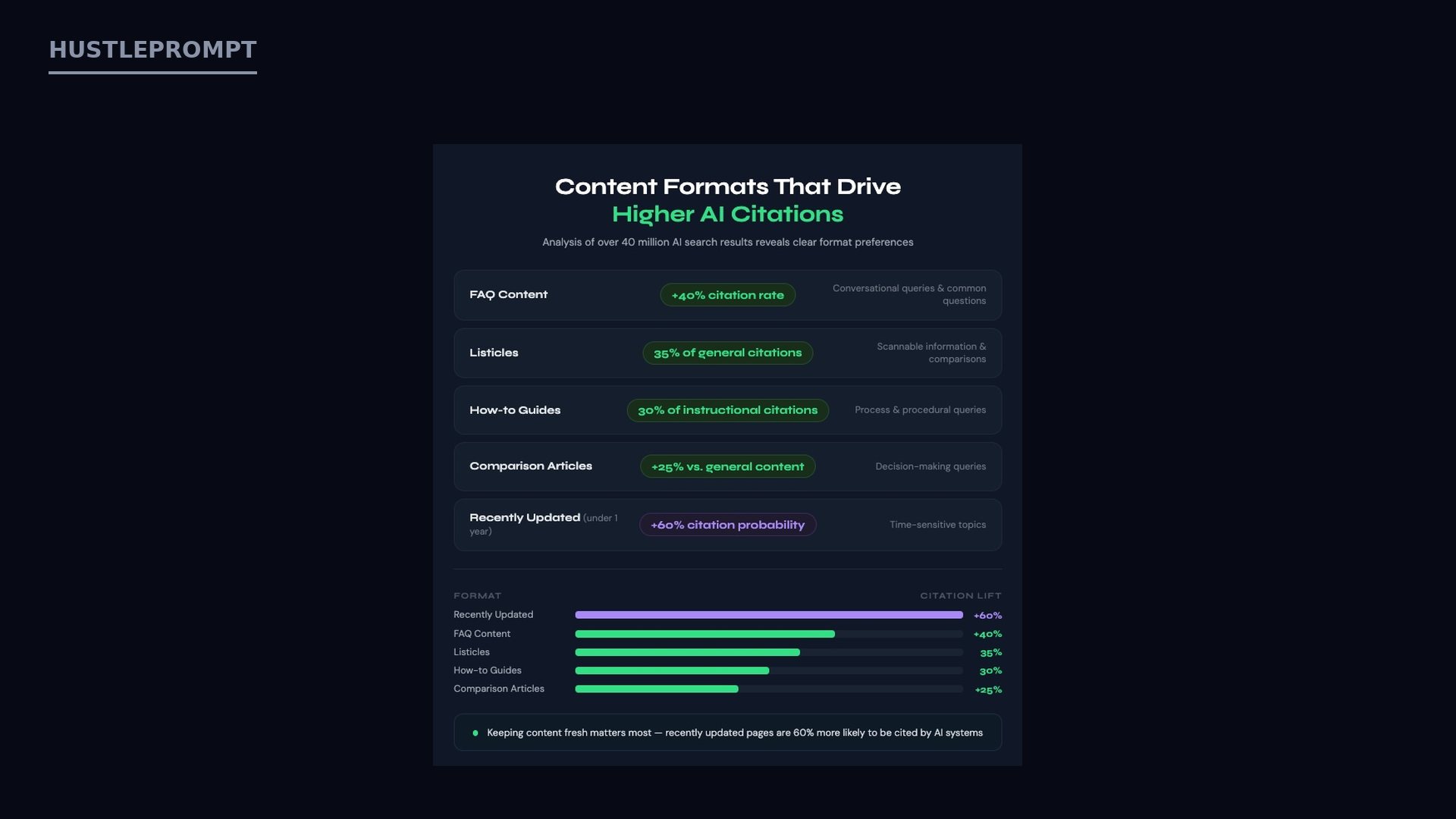
Notice what the flow rewards. The Princeton/Georgia Tech research tested 10,000 queries: quotation addition boosted visibility 41%, statistics improved it 30-40%, and full GEO optimization lifted visibility up to 40%. Keyword stuffing barely moved the needle. GEO is an underdog game — pages ranked 5th in Google saw 115% visibility gains.
Source: Onely, “What is GEO (Generative Engine Optimization)” — onely.com
How to profit from the GEO gold rush
This is a classic gold-rush market: the miners (brands) are desperate, and the pick-and-shovel sellers are scarce. Only 16% of brands track AI search performance (Erlin, 2026) — the rest are flying blind into the biggest visibility shift in a decade. Here’s how to sell them the map.
1. Sell AI-visibility audits ($500-$2,500 entry)
Agencies charge $1,500-$5,000 per GEO audit (Authoricy, 2026). Freelancers can enter at $500-$2,500 with a templated deliverable:
- Baseline citation matrix: run 40-100 category prompts across ChatGPT, Perplexity, and Gemini; record where the brand appears and competitors appear instead.
- Technical pass: robots.txt and AI-crawler access (73% of B2B sites block at least one AI crawler), schema markup, an llms.txt file (+32% coverage lift, Erlin), and prioritized recommendations.
2. Stack monthly GEO retainers
Agencies charge $3,000-$25,000/month. The freelance wedge is the $500-$2,000/month SMB tier: weekly citation tracking, one restructured page per week, FAQ schema, review-platform work. Citation rates swing 40-60% monthly (Data-Mania) — monitoring is the product.
3. Package “GEO starter kits” for local businesses
Start with local businesses: dentists, lawyers, plumbers. Their buyers already ask AI “best dentist near me” — and the top quartile of B2B SaaS earns 31 AI citations per month versus 3.7 for the bottom quartile (Data-Mania). A $997 one-time starter kit — llms.txt, FAQ schema, review-platform cleanup, and a 20-prompt baseline — is an easy yes for businesses already spending that on ads.
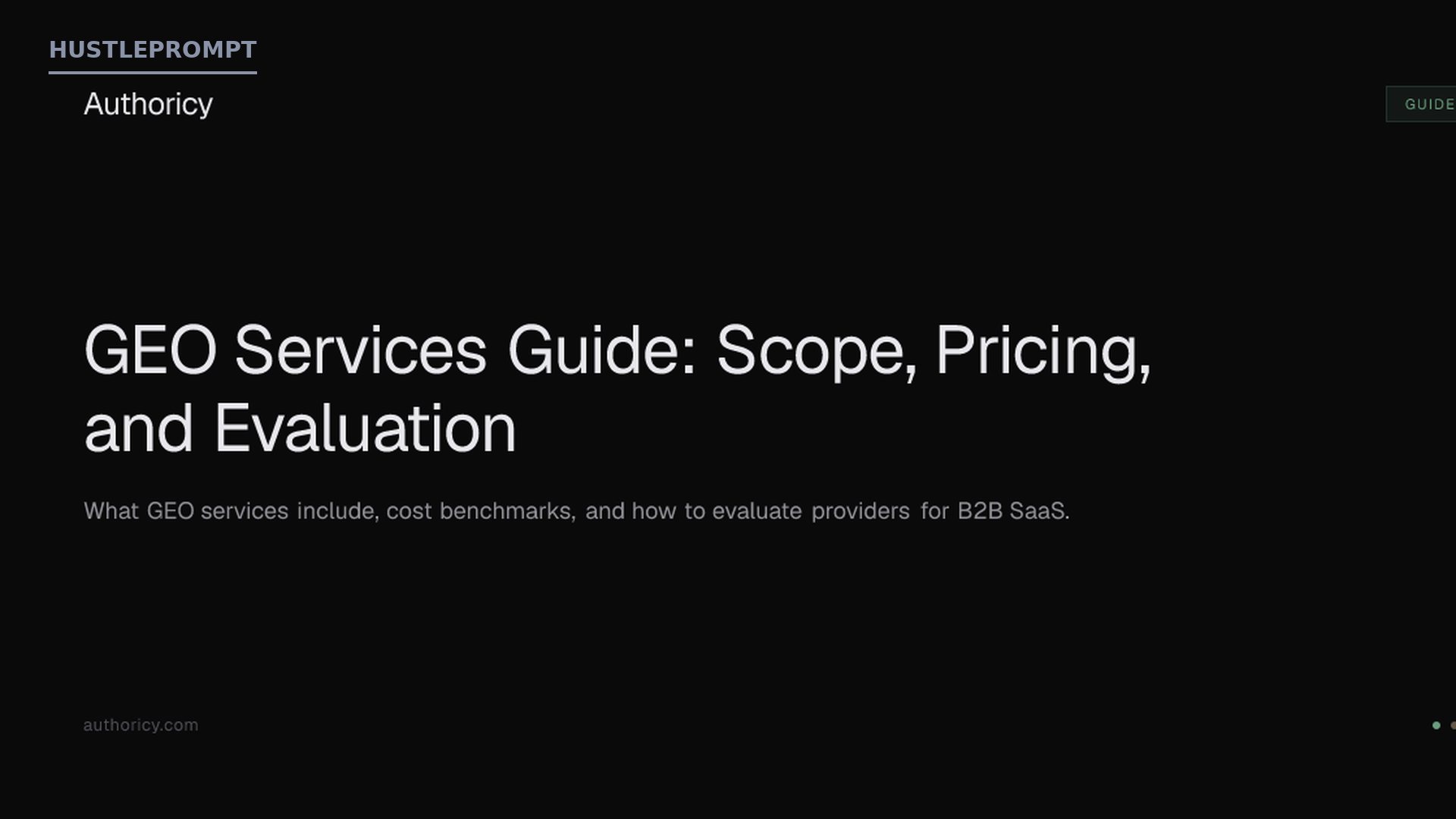
Source: agency benchmarks via Authoricy GEO Services Guide (2026); freelance tiers are positioning estimates below agency rates.
Source: Authoricy, “GEO Services Guide: Scope, Pricing, and Evaluation” — authoricy.com
What to do now
- Baseline your category. Run 20 prompts about your niche in ChatGPT, Perplexity, and Gemini. Count who gets cited.
- Unblock the crawlers. Check robots.txt and llms.txt. Most B2B sites block at least one AI crawler.
- Structure one page for extraction. Add FAQ schema (+28% coverage lift), a comparison table (+34%), and a “last updated” timestamp.
- Build third-party proof. Earned media drives 69-82% of citations. Reviews, Reddit, YouTube, and press outrank your own blog.
Where this is heading
The citation gap compounds. LLMs show citation bias — they favor sources they already cite. Early winners widen their lead every month; the gap between AI-visibility winners and losers is already 9x (Erlin). Start now, not perfectly later.
“GEO auditor” becomes a job category. Expect GEO audits as a standard freelance category on Upwork and Fiverr within a year — the same way “SEO audit” became one. Claim the positioning while the label is still cheap.
Zero-click keeps eating clicks. AI Overviews already trigger on roughly 48% of tracked queries (BrightEdge). As organic traffic thins, being cited inside the answer becomes the only free visibility left — and GEO pricing rises with the desperation.
Watch
Keep Reading
- ChatGPT Visual Ads Are Coming: How to Profit From Them
- The AI Orchestrator: Why Freelancers Now Earn 34% More
- The Freelancer’s Guide to Pricing AI-Powered Services
FAQ
Is GEO replacing SEO?
No — it layers on top. Google AI Overviews still pull 92% of citations from top-10 organic domains, so weak SEO hurts GEO. Yet 28.3% of ChatGPT’s most-cited pages have zero Google presence.
How long does GEO take to work?
Benchmarks: 5-15 percentage points of citation-rate improvement in 61-90 days for low-competition terms, compounding through months 4-6. One documented B2B SaaS case moved from 8% to 24% citation rate in 90 days (Discovered Labs, 2026).
What is llms.txt and do I need one?
llms.txt is a plain-text file at your site’s root summarizing what your site is about in AI-readable form — robots.txt for language models. Erlin’s 2026 testing measured a +32% AI-coverage lift from adding one. A 30-minute task with outsized impact.
How much do GEO services cost?
Agency benchmarks (Authoricy, 2026): $1,500-$5,000 for a one-time audit, $3,000-$25,000/month retainers, $5,000-$50,000 project engagements. Freelancers can enter below those rates — $500-$2,500 audits and $500-$2,000/month retainers for SMBs.