
Muse Spark Open is Meta’s biggest open-weights release ever — an 816-billion-parameter AI model you can download free today and, remarkably, run on two desktop Macs. Meta calls it “the most capable US open-weight model to date,” and it landed October 15, in the fiercest model-release week of the year.
One clarification: “Muse” is Meta’s AI assistant brand (launched in September), and Muse Spark is the model family behind it. Muse Spark Open is the open-weights version developers can download and run. Here’s what changed today, what it costs to run, and how to turn it into revenue.
What Meta actually released
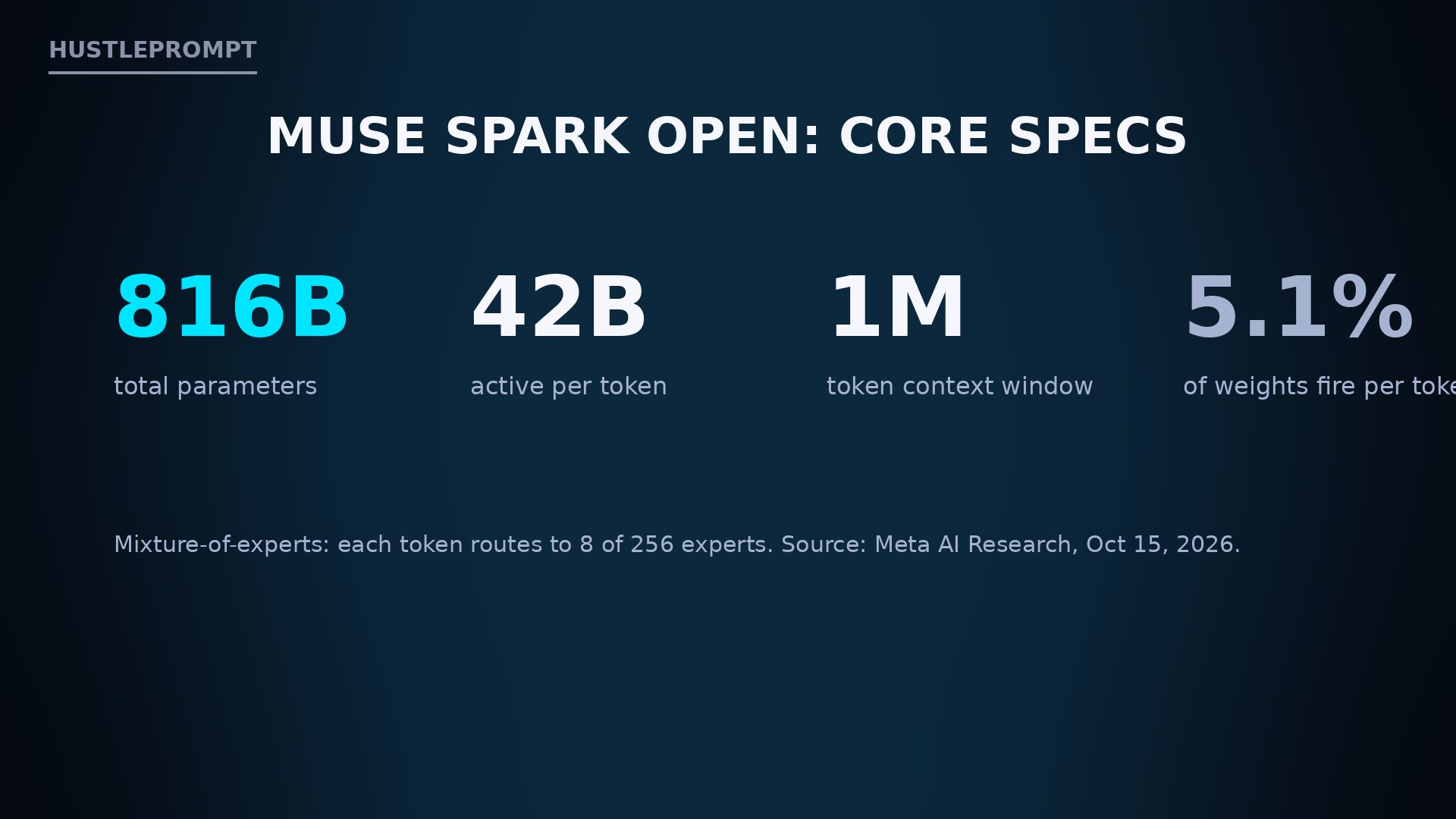
Meta published the release through its AI research blog on October 15, 2026. The headline numbers are all verified from Meta’s own announcement:
| Spec | Muse Spark Open | Source |
|---|---|---|
| Total parameters | 816 billion (mixture-of-experts) | Meta AI Research |
| Active per token | 42 billion (8 of 256 experts) | NVIDIA developer blog |
| Context window | 1 million tokens | Meta AI Research |
| Input modalities | Text, image, document, audio, video | AWS / Meta |
| Output | Text | Meta AI Research |
| Weight formats | BF16 (~1.6 TB), NVFP4 (~530 GB) | Meta / NVIDIA |
| Built for | Coding + long-horizon agentic work | Meta AI Research |
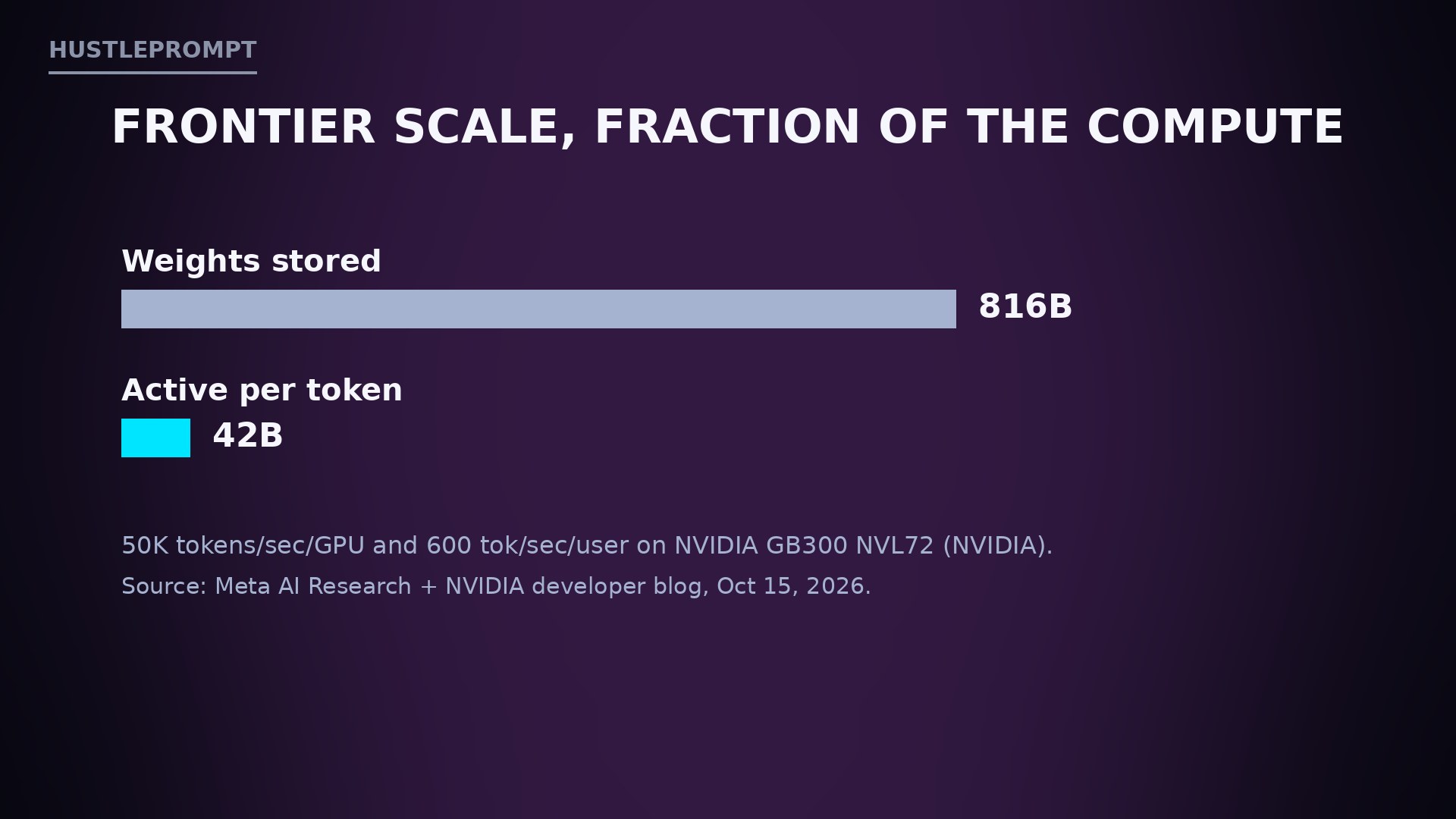
The architecture is the whole trick. Only 42 billion of the 816 billion parameters fire on each token — about 5% of the model. Each token routes to just 8 of 256 expert sub-networks, which is why something this large can run outside a datacenter at all. And the 1-million-token context window means it can hold an entire codebase — dependencies, legacy code, thousands of files — in a single session without chopping tasks into pieces.
This is also Meta’s open answer to a crowded week. The release lands three days after Meta’s own closed frontier model, Muse Wonder, and days after Google’s public rollout of Gemini 4 Argon — Meta is now fighting on both fronts at once: closed flagship and open weights.
The Apple twist: two Macs, one supercomputer
The detail everyone is talking about is the desktop story. Meta worked directly with Apple so the model runs on two Apple M5 Ultra Mac Studios using Apple’s MLX framework. Meta’s explanation: each M5 Ultra’s unified memory architecture lets its integrated GPU address up to 512 GB per machine, so two machines behave “like one supercomputer with a terabyte of unified memory,” with 1.2 TB/s of memory bandwidth moving the small slice of weights each token needs.
Meta CEO Mark Zuckerberg announced it on X, crediting Apple’s new chief executive John Ternus for the collaboration. Meta demonstrated the setup doing real work through Muse Code — modifying Ice Cubes, an open-source Mastodon client — and analyzing video frame-by-frame in DaVinci Resolve to prep vertical cuts.
One reality check from MacRumors: the 512 GB Mac Studio hasn’t shipped yet — it’s expected later this month — and the 256 GB configuration is already priced over $10,000. Two maxed-out machines is a five-figure hardware bill. The desktop dream is real, but it isn’t cheap.
Three ways to actually use it
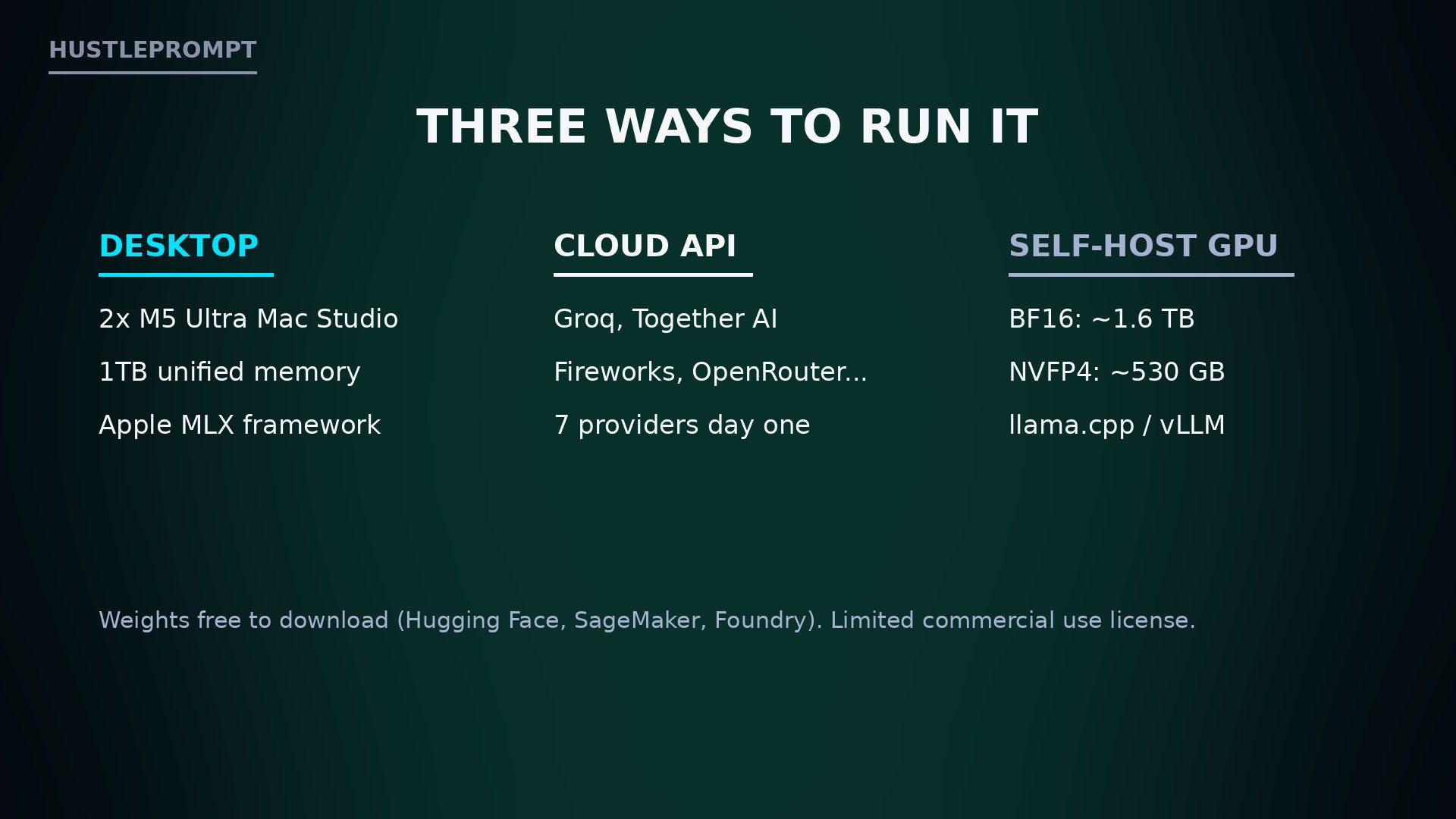
You don’t need the Mac Studios. Meta shipped day-one support across the whole inference ecosystem:
| Route | What it takes | Best for |
|---|---|---|
| Desktop | 2× M5 Ultra Mac Studios (512 GB each), Apple MLX | Private, offline, on-premise work |
| Cloud API | Baseten, Fireworks AI, Groq, Modal, Nebius, OpenRouter, Together AI | Shipping products this week |
| Self-hosted GPU | BF16 (~1.6 TB) or NVFP4 (~530 GB); SGLang, vLLM, TensorRT-LLM, llama.cpp | Full control, custom stacks |
Weights are downloadable from Hugging Face, Amazon SageMaker AI, Google Cloud Model Garden, and Microsoft Foundry Models. NVIDIA published its own deployment guide: on GB300 NVL72 Blackwell Ultra racks, Meta’s model hits 50,000 tokens per second per GPU and 600 tokens per second per user on agentic workloads — the kind of throughput that makes large-parameter models viable in production.
Your first-week checklist
- Start on a cloud API, not hardware. Groq, Together AI, and Fireworks AI all serve it day one with an OpenAI-compatible endpoint — build the product before buying the Macs.
- Design for the 1M context. The killer feature is holding a whole repo in context. Build agents that read the entire codebase first, then act — that’s the workflow closed models charge a premium for.
- Read the license before you ship. The Muse Model License allows limited commercial use. Fine-tuning and redistribution are reportedly permitted, but check the Usage Policy against your business model.
- Watch the benchmarks, not the marketing. “Most capable US open-weight model” is Meta’s claim. Independent leaderboard results will land within days — build on the API first so you can switch if the numbers disappoint.
The honest catches
Three things to keep in perspective. First, the license: free to download does not mean unrestricted — commercial use is limited under the Muse Model License, so enterprise deployments need legal review. Second, true self-hosting means a five-figure dual-Mac setup or a multi-GPU server, which is exactly why the cloud API route exists. Third, “most capable” is Meta’s claim — Google’s Gemini 4 Argon launched a day earlier with strong community benchmarks, so the open-weights crown will be decided on leaderboards, not press releases.
Still, the direction is unmistakable: frontier-scale models are escaping the datacenter. Between Muse Spark Open on the desktop and NVIDIA’s GB300 throughput numbers, the cost of running serious AI keeps falling — and every drop creates a new margin for whoever builds on top.
Watch: official NVIDIA demo
NVIDIA’s developer team published an official demo of the open-weight model diagnosing a bug from a screen recording:
FAQ
What is Muse Spark Open?
Meta’s open-weights AI model released October 15, 2026 — the downloadable version of the Muse Spark model family behind Meta’s AI assistant. Meta calls it the most capable US open-weight model to date.
How many parameters does Muse Spark Open have?
816 billion total parameters in a mixture-of-experts architecture, with only 42 billion active per token (each token routes to 8 of 256 experts). It has a 1-million-token context window.
Can Muse Spark Open really run on a Mac?
Yes — Meta worked with Apple so it runs on two Apple M5 Ultra Mac Studios (512 GB each, 1 TB combined unified memory) via the MLX framework. Note the 512 GB Mac Studio hasn’t shipped yet (expected later this month), and it’s a five-figure setup.
Is Muse Spark Open free for commercial use?
It’s free to download under the Muse Model License, which allows limited commercial use, plus the Muse Spark Usage Policy. Fine-tuning and redistribution are reportedly permitted — review the license terms for your use case.
Where can I download or use Muse Spark Open?
Weights: Hugging Face, Amazon SageMaker AI, Google Cloud Model Garden, Microsoft Foundry Models. APIs (day one): Baseten, Fireworks AI, Groq, Modal, Nebius, OpenRouter, Together AI. Inference engines: SGLang, vLLM, TensorRT-LLM, llama.cpp, Apple MLX, Unsloth.
Is “Muse” the same as Meta’s AI assistant?
Related but different: “Muse” is Meta’s AI assistant brand (launched September 2026); Muse Spark is the model family powering it, and Muse Spark Open is the open-weights release developers can download and run.
How does it compare to Gemini 4 Argon?
Too early for independent verdicts. Argon launched a day earlier with strong community benchmarks and aggressive pricing; Meta claims the open-weights crown for Muse Spark Open. Watch the leaderboards over the next two weeks.
Keep Reading
Sources
- Meta AI Research: Introducing Muse Spark Open, the most capable US open-weight model to date
- NVIDIA developer blog: scaling agentic coding workflows with Muse Spark Open on GB300 NVL72
- AWS Machine Learning blog: Muse Spark Open now available in SageMaker JumpStart
- MacRumors: Meta and Apple bring Muse Spark Open to Mac Studio (Oct 15, 2026)