
A brand-new AI model category went from zero to every major cloud in 31 days. Microsoft’s entry — Decision-1, unveiled October 9 — scores yes-or-no calls in about 85 milliseconds for a fraction of a cent, and Microsoft says it beat every rival decision model across 36 benchmarks covering nearly 150,000 questions.
But the model is not the story. The story is the layer it creates: a decision economy where AI stops chatting and starts picking — and the people who build the gates get paid.
What just happened: a category in 31 days
On October 9, Microsoft unveiled Microsoft-Decision-1 on its Command Line blog — a post by Achint Srivastava, VP of Software Engineering in the Office of the CTO — amplified the same day by CEO Satya Nadella on X.
It is a 9-billion-parameter model post-trained from Alibaba’s open-weight Qwen3.5-9B, and it does not generate text. Hand it a situation plus a fixed list of options (yes/no, multiple choice, numeric ratings, rubric grading), and it returns a calibrated probability per option in a single forward pass. Future versions will be rebased onto Microsoft’s own MAI and OpenAI models.
| Milestone | Date | What shipped |
|---|---|---|
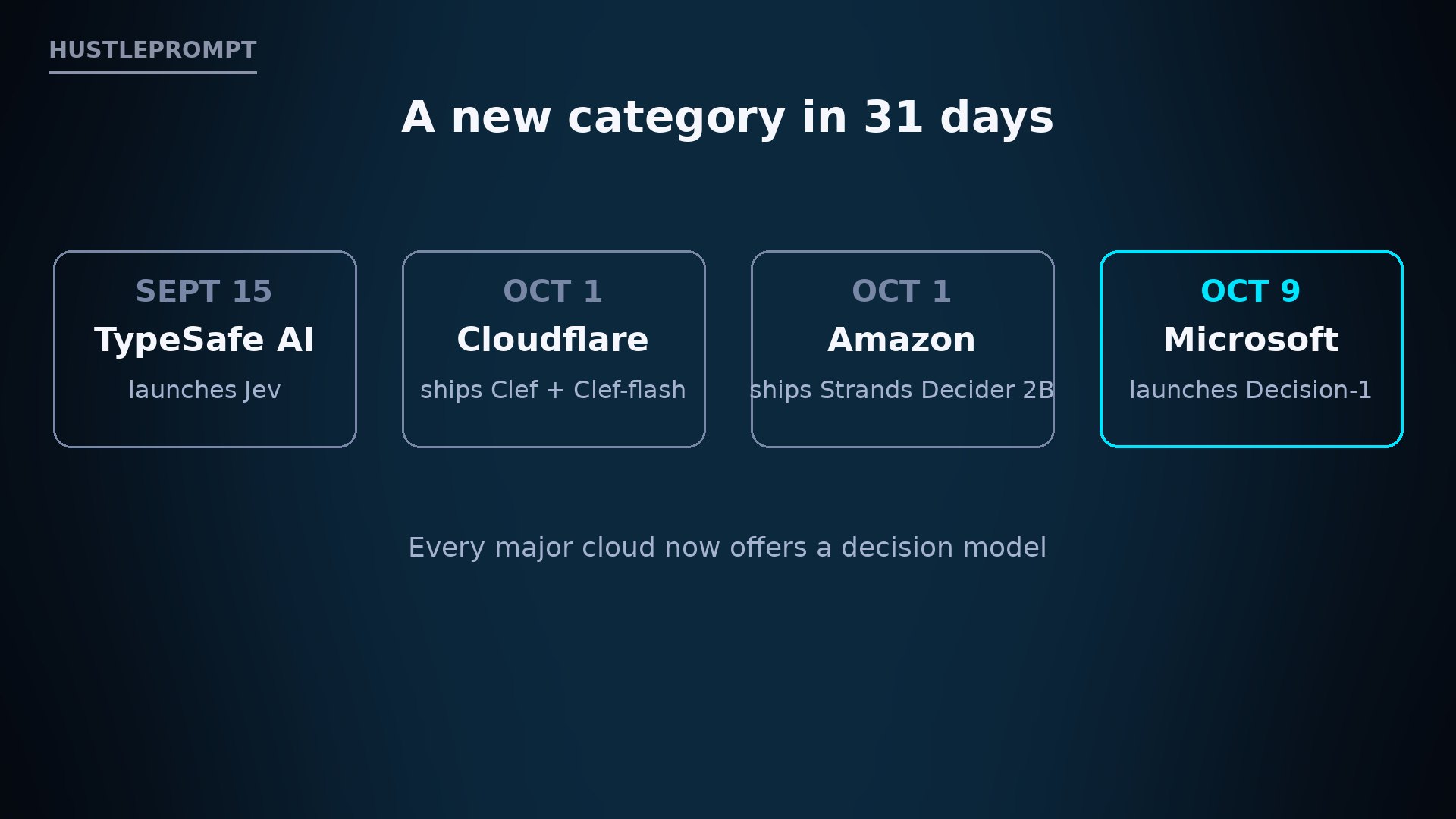
| TypeSafe AI launches Jev | Sept 15, 2026 | First hosted decision model; 150k+ waitlist signups in 24h claimed (unverified) |
| Cloudflare ships Clef + Clef-flash | Oct 1, 2026 | 27B + 9B open-weight, Apache 2.0, self-hostable |
| Amazon ships Strands Decider 2B | Oct 1, 2026 | 2B scorer that swaps the language-model head for a tiny scoring head |
| OpenAI’s Decisions API goes GA | Early Oct 2026 | Powered by GPT-6 Luna; ~10x faster than the Responses API |
| Microsoft launches Decision-1 | Oct 9, 2026 | Qwen3.5-9B-based, Foundry + OpenRouter, $0.042/M input, output free |
One caveat: all figures are Microsoft’s own.
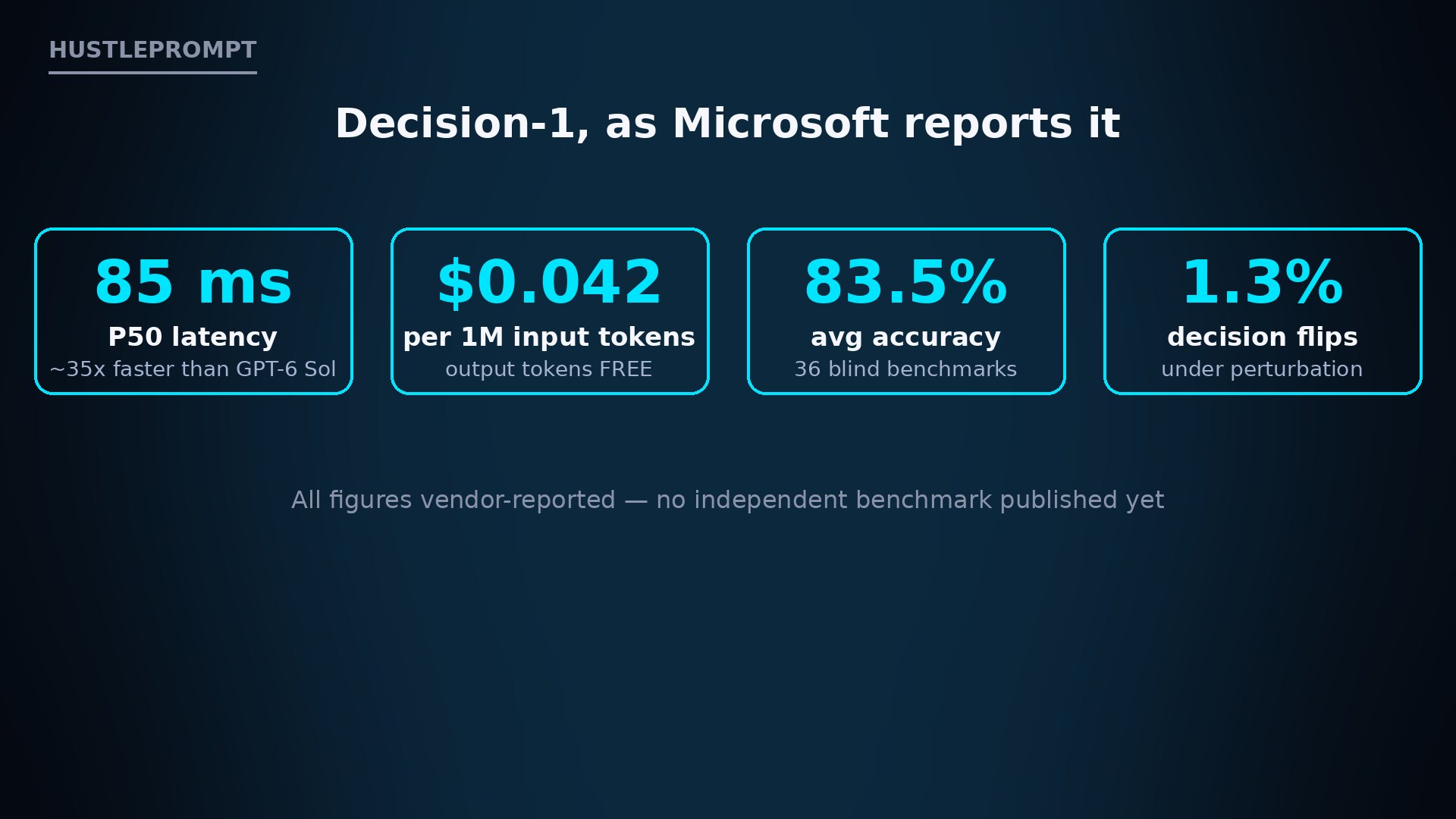
Decision-1, as Microsoft reports it (Tech Times, TestingCatalog, Neowin):
- 85 ms median latency — 35x faster than GPT-6 Sol, ~100x faster than GPT-5.6 Luna on grading
- 83.5% average accuracy across 36 blind benchmarks
- 92.2/100 calibration — 0.9 confidence should mean right ~90% of the time
- 1.3% decision flips under perturbation; zero on paraphrased/reordered options
- $0.042 per million input tokens; output tokens free
Microsoft is dogfooding it: Xbox Research classified 10,000+ open-ended player feedback pieces at GPT-6 Sol-competitive quality — 14x+ faster, ~200x cheaper. The Copilot team graded agent responses at GPT-5.6 Luna competitiveness with ~100x the speed.
Microsoft Discovery got 46x more consistent scoring. Vendor-reported — but it shows where Microsoft thinks the money goes.
Why it exists: the bottleneck moved from generation to governance
For two years, every hard AI problem was a generation problem: write better, reason longer. Agents changed that.
An agent runs a loop — propose, check, act, verify, repeat — and every step needs a governor. One workflow can chain 20+ sequential micro-decisions: which specialist takes this ticket, did the draft meet the rubric, is this tool call safe?
Until last month, the default governor was a frontier LLM asked to output JSON — like hiring a senior partner to stamp parking validations. In Microsoft’s own deployment math, that is 100–200x overkill on cost.
The waste is architectural: a chat model generates one token per forward pass, so a yes/no answer needing a 30-token explanation burns 30+ sequential passes. A decision model does one parallelizable pass, then scores the options directly — no decoding, no output tokens, no parsing failures.
Why this trend is structural, not hype:
- Calibration made it trustworthy. TypeSafe’s RLCD training produces probabilities honest enough for code to act on — 0.9 triggers automation, 0.55 routes to a human. Thresholds, not vibes.
- The API shape finally exists. A decision call is not a chat completion: you send a state plus typed questions and get numbers back. OpenAI, Liquid, and Microsoft have converged on this shape.
- Race to the bottom and the top at once. Frontier models keep getting bigger and pricier; the decision layer is being commoditized at $0.042 per million tokens.
- Whoever owns the gate owns the stack. The decision model determines what reaches the expensive frontier model. Microsoft selling the router on Foundry is a claim on the chokepoint of enterprise AI.
The decision layer inside an agent loop
1. Agent proposes
Drafts an answer, picks a tool call, plans the next step
2. Decision-model gate
Scores approve / retry / escalate in ~85 ms. Output: probabilities, not prose
Approve — execute automatically
Retry — send back with rubric feedback
Escalate — frontier LLM or human decides
The frontier model only sees what the gate cannot resolve.
The money angle: four ways to get paid
A 500-token decision call costs $0.000021 — roughly 47,600 decisions per dollar. A support desk scoring 200,000 inbound messages a month at ~500 tokens each spends $4.20/month on tokens. Checks once skipped for cost reasons can now run on every message — that delta is your margin.
1. Decision-layer arbitrage for SMBs
Thousands of small businesses classify, route, or grade with frontier models — paying dollars where cents would do. Audit a pipeline, swap the classifier calls for a decision model, cut the AI bill 50–100x. Charge a $500–$2,000/month retainer or 20–30% of savings.
2. Micro-decision products
Package one decision as a product: ticket triage, lead scoring, review classification, content moderation, AI-output QA. Sell $49–$499/month subscriptions at ~95%+ margin on model cost. The moat is the rubric and the labeled data you accumulate per vertical, not the model.
3. AI-judge services for agencies
Agencies ship agent workflows with no rigorous way to grade them. Sell judge-as-a-service: rubric-based scoring of every agent output before it reaches the client. Agencies pay $1,000–$5,000/month for the quality infrastructure that lets them guarantee outputs.
4. Model-routing consultancy
Every company building agents needs the gate from the diagram above: logic sending easy work to cheap models and hard work to frontier ones, with thresholds and human escalation. That is a $2,500–$10,000 project engagement per client — in a category with no incumbents yet.
| Play | Pricing to aim for | Why it works now |
|---|---|---|
| Arbitrage audit + retainer | $750–$2,500 one-time, then $500–$2k/mo | 100x cost delta funds your fee |
| Micro-decision product | $49–$499/mo per client | ~$0.000021 per call; your rubric is the moat |
| AI-judge service for agencies | $1,000–$5,000/mo | Agencies ship agents with zero grading infrastructure |
| Routing consultancy | $2,500–$10,000 per project | No incumbents, enterprise budgets |
What to do this week
- Run your own eval first. Microsoft itself recommends testing on your own data. One independent tester found Decision-1 ~2.4x faster than GPT-6 Sol over the network — not 35x — and ranked it 6th of 14 on accuracy.
- Learn the decision API shape. It is not chat completions: send a state plus typed questions, get probabilities back. Build one toy ticket-triage router this weekend.
- Pick one vertical and own its rubric. A specialist with labeled data for dental-clinic review triage beats generic “AI consulting”. The model is a commodity; your rubric is the asset.
- Sell the savings, not the tech. Find one SMB drowning in LLM classification costs and offer a 30-day pilot on a savings share.
Where this is heading
The decision layer becomes invisible plumbing. In 18 months nobody will brag about their decision model — it gets bundled, priced toward zero, and assumed, which is exactly when the services built on top get valuable.
Open weights eat the low end — and the base model stops mattering. Cloudflare’s Clef models are Apache-licensed and self-hostable; the vLLM team’s Decision 3.0 family spans 0.6B to 27B. Decision-1 runs on Alibaba’s Qwen3.5-9B today, with MAI and OpenAI bases promised.
When the same decision API runs on swappable bases, buyers choose on calibration data and price. Great for builders, brutal for vendors.
Watch
Keep Reading
- Enterprises Are Buying AI Agents, Not AI Tools
- The AI Orchestrator: Why Freelancers Now Earn 34% More
- The GEO Gold Rush: Getting Cited in ChatGPT Beats SEO
FAQ
What exactly is a decision model?
A model that scores a fixed set of options — yes/no, multiple choice, a rating scale — instead of generating text. One forward pass returns a calibrated probability per option; your code sets the threshold.
How is it different from a classifier I fine-tune?
A fine-tuned classifier needs retraining every time your labels change. A decision model takes the options at inference time — redefine categories per request, no retraining — with confidence scores trained to match real accuracy.
Why not just ask a frontier LLM to output JSON?
Cost (100–200x more per call in Microsoft’s deployments), latency (sequential decoding vs. one pass), and reliability (LLMs can silently deviate from your schema, and their “confidence” is not calibrated).
Is the “35x faster than GPT-6 Sol” claim real?
Microsoft’s claim from Microsoft’s benchmarks — a ceiling, not a promise. An independent tester measuring over the network saw ~2.4x and ranked it 6th of 14 on accuracy.
How much does one decision cost?
At $0.042 per million input tokens with free output, a 500-token call costs about $0.000021 — roughly 47,600 decisions per dollar.