
Meta has now promised to spend $825 billion — roughly the GDP of Switzerland — mostly on AI infrastructure. Wall Street’s verdict landed within hours: META shares fell more than 5% to $657.65, erasing about $100 billion of market value, while the cost of insuring Meta’s debt against default hit an all-time high. That reaction to a company spending more on AI is the story.
The numbers surfaced Thursday, October 22, 2026, in Meta’s quarterly 10-Q filing with the SEC, as reported by Bloomberg’s report on Meta’s 10-Q filing. Here is what the filing actually says, why the bond market panicked, and what it means if you make money with AI.
What the 10-Q filing actually says
The $825 billion is not one check being written. It is two buckets of future obligations plus a conditional cloud purchase:
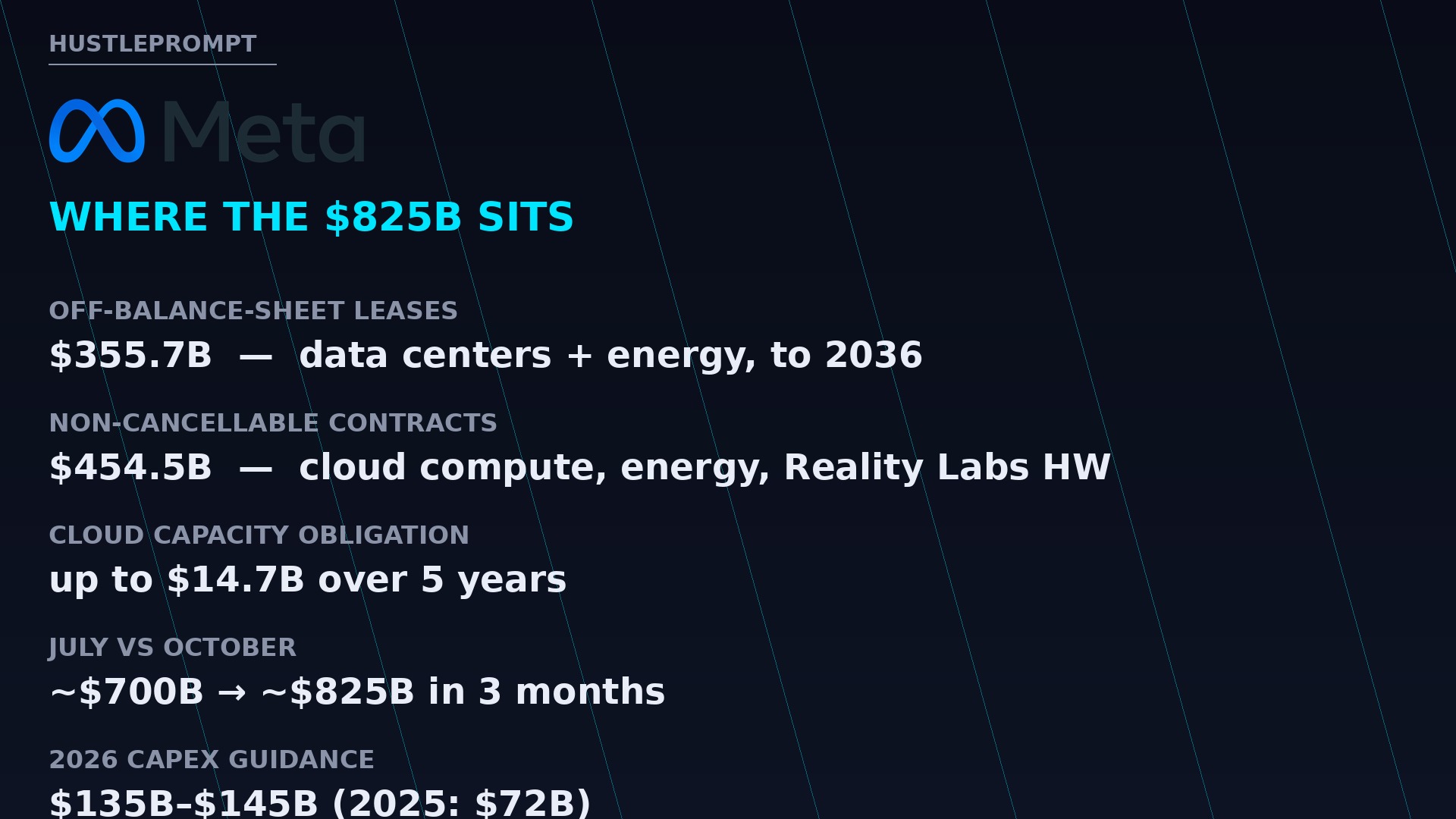
| Obligation | Amount | What it covers |
|---|---|---|
| Off-balance-sheet leases | $355.7B | Data centers and energy infrastructure; terms start late 2026 and run through 2036 |
| Non-cancellable contracts (as of Sept 30) | $454.5B | Third-party cloud computing power, data-center energy agreements, Reality Labs hardware |
| Cloud capacity obligation | Up to $14.7B over 5 years | Can shrink if the cloud provider resells the capacity to others |
The lease figure is the eye-catcher: $355.7 billion in operating and finance leases not yet on Meta’s balance sheet — the largest off-balance-sheet lease position any tech company has ever disclosed, mostly data-center and power deals that haven’t started billing yet.
From $700B to $825B in three months
Three months ago, in its July filing, Meta disclosed future commitments of almost $700 billion. The tab has grown by roughly $125 billion — an 18% jump — in a single quarter. And the filing sits on top of an already enormous capital expenditure plan:
- 2026 capex guidance narrowed to $135–145 billion (up from the prior $130–145B range) — against $72 billion of capex in 2025.
- 2027 consensus capex is roughly $194 billion, with some desks watching for $200B+.
- Anthropic, heading for a November IPO, disclosed $518 billion in future compute commitments in its draft S-1.
Why the market panicked
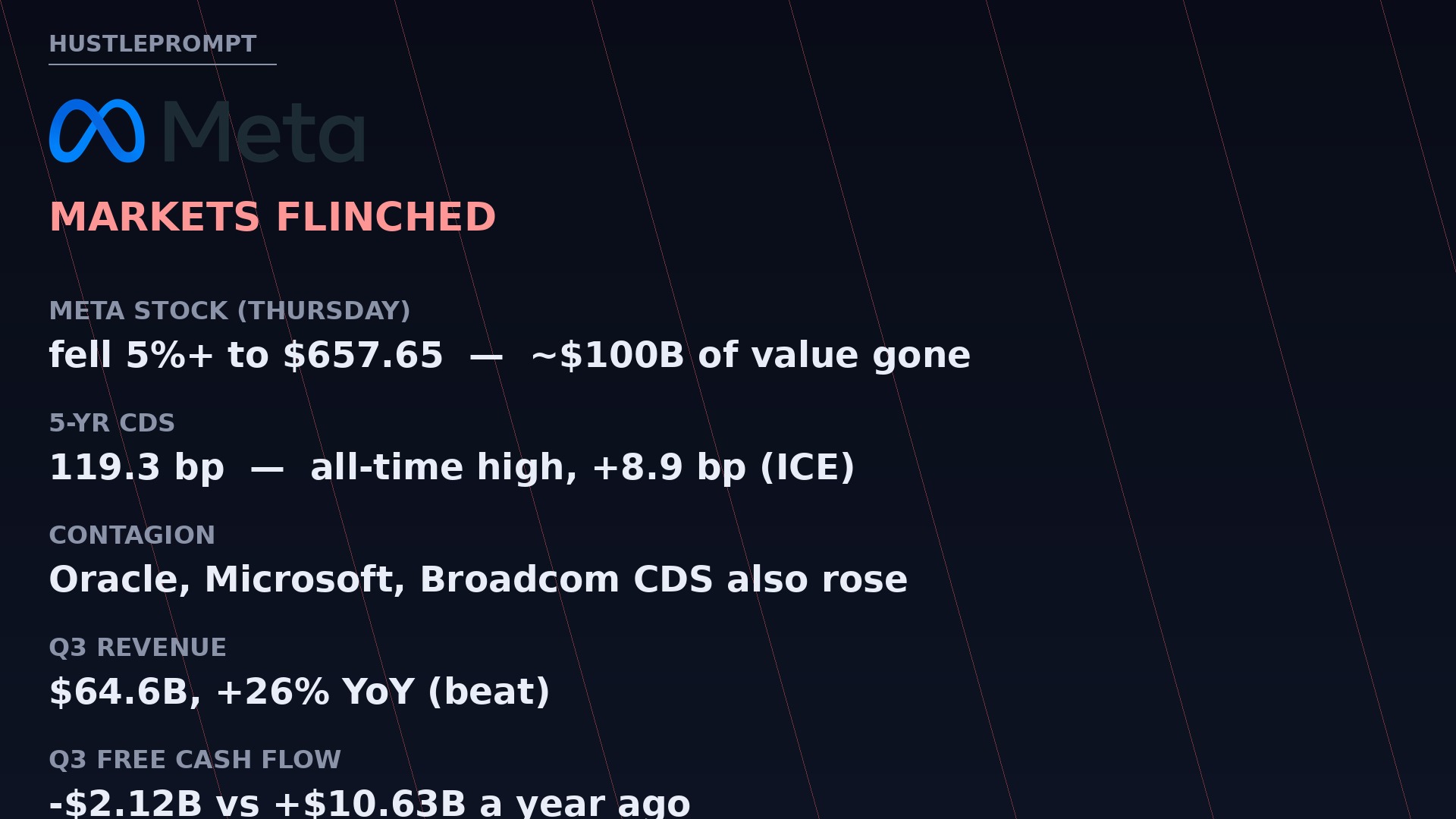
Meta had reported strong Q3 numbers the day before: $64.6 billion in revenue, up 26% year over year, beating consensus. But three signals in the filing spooked investors:
- The stock tanked. META fell more than 5% Thursday to $657.65, erasing roughly $100 billion of market value.
- Credit markets flinched. Five-year credit default swaps — insurance against Meta failing to pay its debts — rose as much as 8.9 basis points to about 119.3 basis points, the highest since the contracts began trading actively, per ICE Data Services.
- It spread. CDS costs also rose for Oracle, Microsoft, and Broadcom — investors are treating the debt-funded AI build-out as an industry-wide risk, not a Meta-specific one.
The fear is cash flow. Meta’s free cash flow fell 91% year over year by Q2, and Q3 free cash flow was negative $2.12 billion versus positive $10.63 billion a year earlier. To help fund the commitments, Meta also announced a new class of non-voting stock via a 2-for-1 dividend, expected to begin trading in late January 2027.
How the $825B breaks down
Meta’s future obligations by category
Data centers + energy infrastructure, late 2026 through 2036
Cloud compute, data-center energy, Reality Labs hardware
Conditional; can shrink if the provider resells capacity
What Meta is actually buying
Strip out the accounting and the money goes to three physical things: compute — Meta just confirmed its AI runs in production on Google TPUs (see Meta Runs Its AI on Google TPUs: Production Confirmed); energy — data-center power deals stretching a decade out, because the bottleneck is no longer just chips; and distribution — Reality Labs hardware plus Meta Muse, the personal AI agent past 10 million users, the commerce surface Meta hopes will eventually pay for all of this.
How to profit: read the $825B like an operator
Commitments this large are a weather forecast. Four concrete moves:
- Bet on cheaper inference. When the biggest buyers pre-commit $825B of demand, suppliers expand capacity — and token prices keep falling. Build businesses whose margins improve as AI gets cheaper.
- Sell shovels into the capex wave. Data-center power management, GPU/TPU utilization tooling, energy reporting for AI estates — the stack around the build-out is buying now.
- Watch credit spreads. Equity markets react in days; CDS and bond spreads move first. If hyperscaler CDS keeps widening, debt-funded AI spending is getting harder — which eventually changes pricing. ICE and Bloomberg track these weekly.
- Energy is the bottleneck trade. Meta’s leases are heavily energy-weighted. If you run compute-heavy workloads, lock in power or colo terms now — the hyperscalers are absorbing the grid’s spare capacity for a decade.
Keep Reading
FAQ
What did Meta disclose in its 10-Q filing?
About $825 billion in future spending commitments: $355.7 billion in off-balance-sheet leases (data centers and energy infrastructure through 2036) plus $454.5 billion in non-cancellable contracts as of September 30, 2026 — and an obligation to buy up to $14.7 billion of cloud capacity over five years.
Is $825B money Meta has already spent?
No — these are future commitments stretching over years. But they are largely non-cancellable, which is exactly why credit markets took notice.
Why did Meta’s stock fall on the news?
Investors worried about shrinking free cash flow and rising debt risk. META fell more than 5% Thursday to $657.65, erasing roughly $100 billion of market value — despite Q3 revenue of $64.6 billion, up 26% year over year.
What is a CDS and why did Meta’s hit a record?
A credit default swap is insurance against a company failing to pay its debts. Meta’s five-year CDS rose to about 119.3 basis points — an all-time high per ICE Data Services — as traders priced in the debt behind the AI build-out.
How does Meta’s $825B compare to other AI labs?
It dwarfs them. Anthropic disclosed about $518 billion in future compute commitments in its draft S-1 ahead of a November IPO. Meta’s 2026 capex guidance of $135–145 billion is nearly double its 2025 spend of $72 billion.
What does this mean for AI prices?
Short term, it confirms capacity is expanding aggressively — which historically pushes inference and cloud prices down. Watch hyperscaler credit spreads: if they keep widening, the debt-funded build-out could slow.
Sources
- Bloomberg (via Moneyweb): Meta reports $825bn in future spending commitments
- TipRanks: Meta stock drops as tech giant locks in $825 billion for AI buildout
- BigGo Finance: Meta credit default swap hits record high on $825 billion spending pledge
- StockAnalysis: Meta reports $64.6B in Q3 revenue; announces non-voting Class C shares