
A single overheating GPU can stall a million-dollar training run. NVIDIA Minerva, launched today at GTC Berlin, is NVIDIA’s answer: an AIOps platform that watches hundreds of thousands of GPUs at once and flags trouble before it costs you money.
NVIDIA calls these massive GPU clusters AI factories — and says they are “among the most complex operations in the world.” With Minerva, the company is selling the pickaxes for the gold rush: the software that keeps those factories productive.
What NVIDIA Minerva Actually Does
Minerva is an AIOps platform (AI for IT operations) built specifically for AI infrastructure. It brings together telemetry from infrastructure and AI workloads, then applies purpose-built AI models to turn that flood of data into timely, actionable insight.
Here is the problem it solves. Traditional monitoring tools split the data center into separate views: the networking team, the compute team, the site-reliability team, and the machine-learning team each see only their own slice. When a training job slows down, nobody has the full picture.
Minerva connects those signals across NVIDIA GPUs, networking, storage, job schedulers, and workloads — one unified view, according to NVIDIA’s official announcement.
The 4 Metrics of “AI Factory Yield”
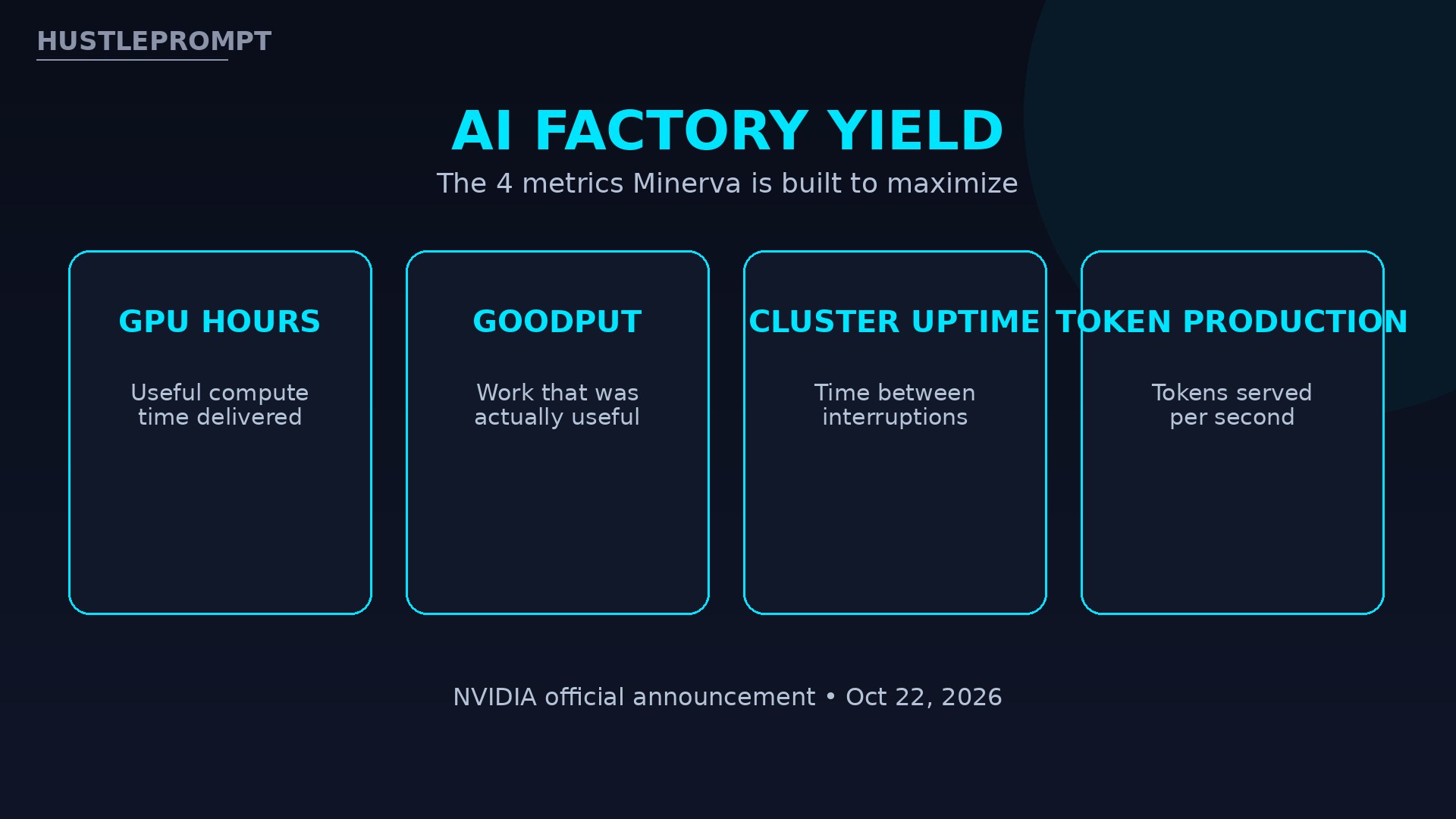
NVIDIA frames Minerva around one concept: AI factory yield — the useful work infrastructure produces. If you run or invest in GPU infrastructure, these are the four numbers that decide whether you make money:
| Metric | What it measures | Why it matters for money |
|---|---|---|
| GPU hours | Raw compute time delivered | Every idle GPU hour is revenue left on the table |
| Goodput | Work that was actually useful — stripping out retries and failed jobs | Throughput lies; goodput tells you what customers paid for |
| Cluster uptime | Time between interruptions | Interruptions restart expensive training runs from checkpoints |
| Token production | Tokens served per unit of time | Directly sets inference revenue capacity |
How Minerva Works: From Telemetry to Action
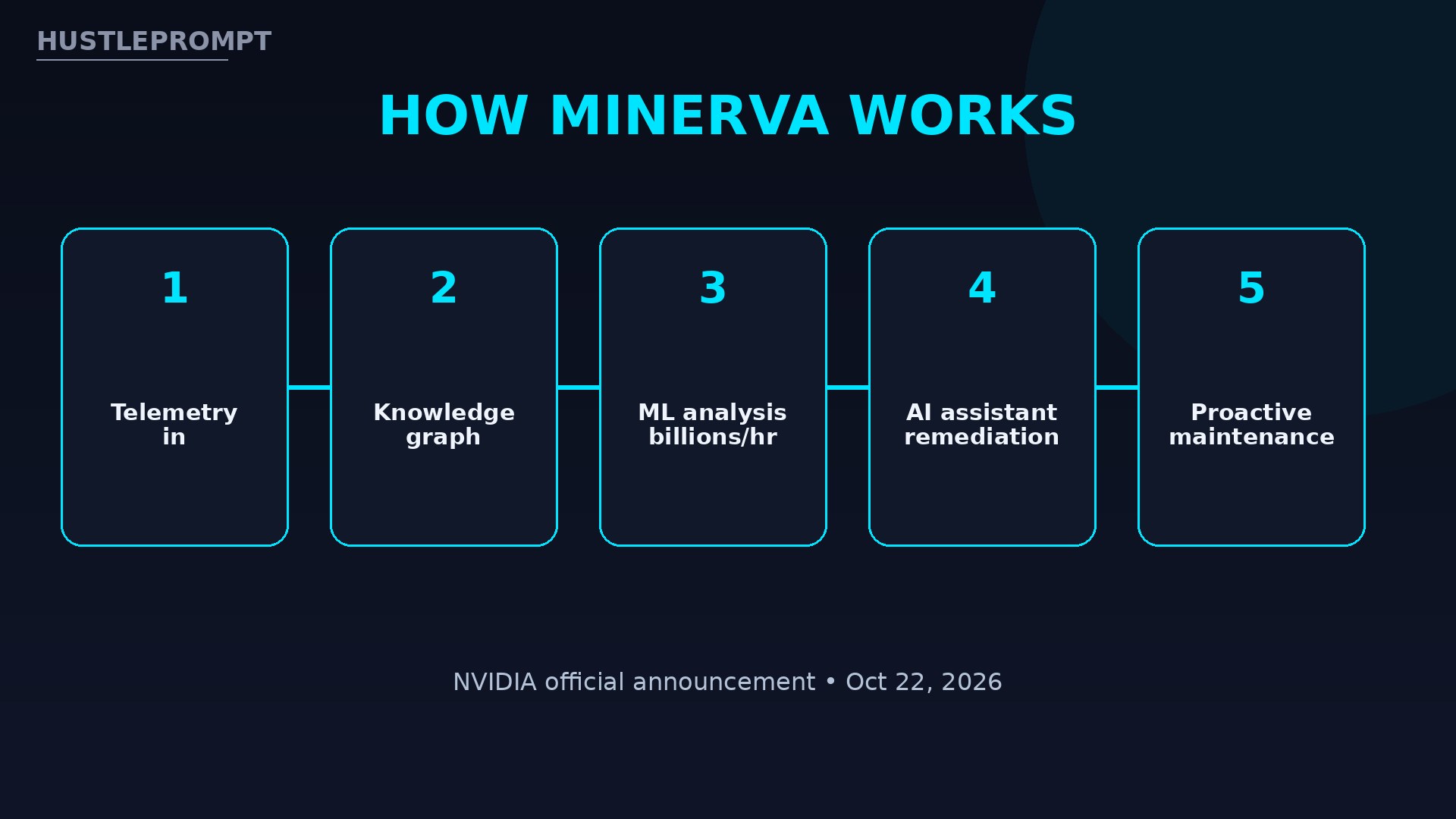
Connect signals
Telemetry from GPUs, networking, storage, schedulers, and workloads — no more siloed views
Build knowledge graph
Dynamic map of GPUs, SuperNICs, switches, cables, and the jobs running on them
Analyze with ML
Billions of data points per hour; learns normal behavior, spots unseen anomalies, predicts failures
Focus incidents
Correlates related events by topology; turns an alert storm into one incident with a likely root cause
Act with AI assistant
Natural-language queries on cluster health, recommended fixes — manual or automated via API
The payoff NVIDIA promises is concrete:
- Longer time between interruptions — Minerva spots trouble before it happens, so jobs run longer without incident.
- Faster time to repair — when something does break, Minerva pinpoints the problem for a significantly quicker fix.
- Greater insight — it filters the data flood down to the handful of alerts that actually matter.
Who’s Already On Board
Minerva is not vaporware. IREN, the Bitcoin-miner-turned-AI-cloud operator, is already using it to optimize its AI factories. Its CTO, Denis Skrinnikoff, said:
“As we scale our AI factories, the key to providing the best service for our customers is maximizing the productivity of our GPUs. NVIDIA Minerva gives our operations team one view across the network, the GPUs and the jobs running on them, so we focus more on proactive maintenance rather than troubleshooting.”
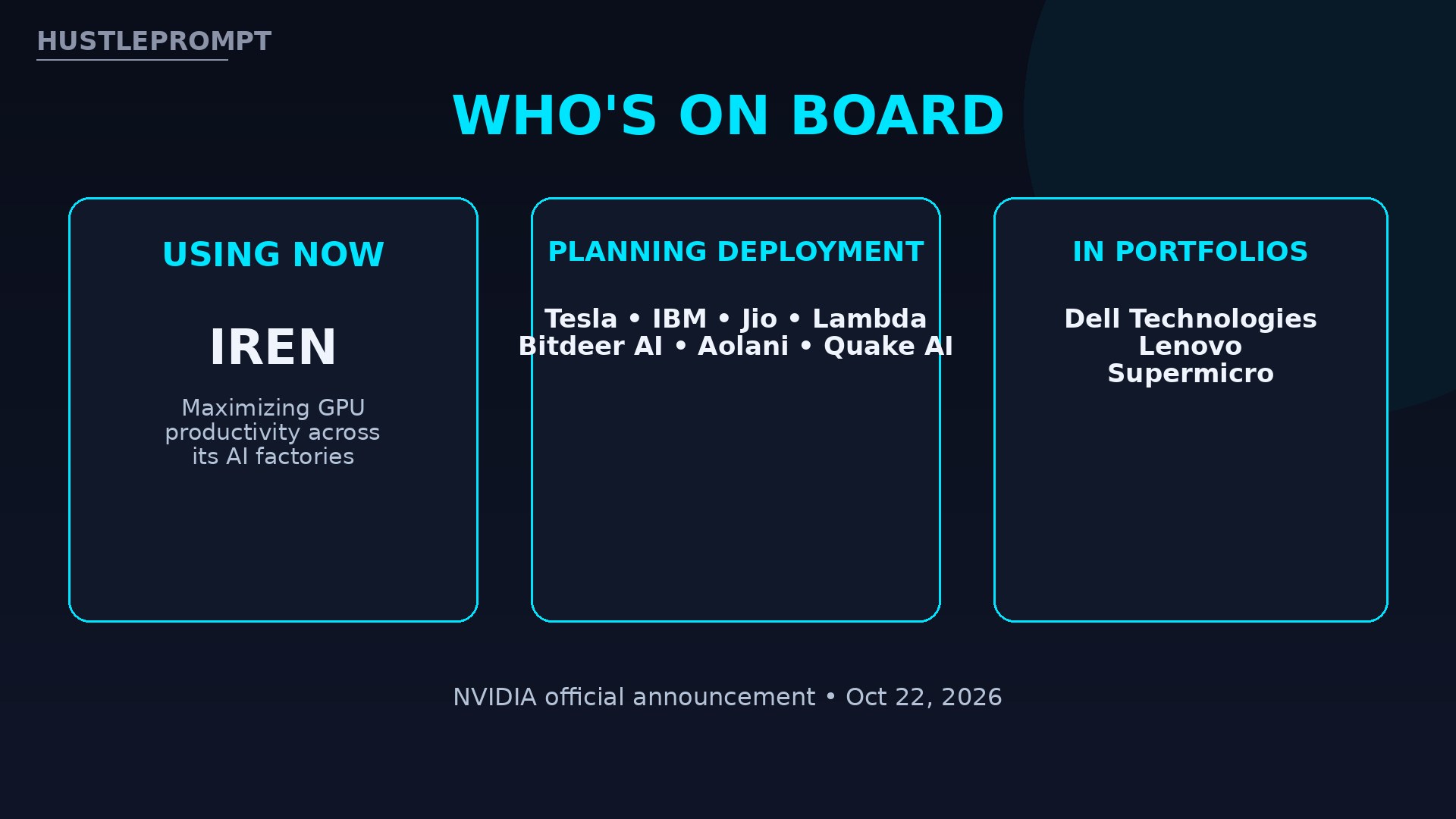
| Status | Companies |
|---|---|
| Using now | IREN |
| Planning deployment | Tesla, IBM, Jio, Lambda, Bitdeer AI, Aolani, Quake AI |
| Offering in AI factory portfolios | Dell Technologies, Lenovo, Supermicro |
What This Means for Your Money
Here is the practical take. GPU infrastructure is brutally expensive — and the margin is in uptime, not hardware. A neocloud or AI startup that keeps 95% of its GPUs doing useful work beats one at 80%, every single time. Observability is the lever.
Concrete steps to take from this news:
- Run GPU infrastructure? Talk to your NVIDIA rep or your OEM (Dell, Lenovo, Supermicro) about Minerva availability — early operational wins compound fast.
- Sell AI services? Bake “proactive observability” into your pitch. Clients will pay for guaranteed uptime once competitors start advertising it.
- Investor? Watch IREN and the neocloud cohort. The winners will be whoever squeezes the most goodput per GPU — and NVIDIA’s software moat just got deeper.
- Job seeker? AIOps for GPU clusters is about to become a hiring category. “AI factory operations” is the keyword to watch.
Frequently Asked Questions
What is NVIDIA Minerva?
NVIDIA Minerva is an AIOps platform launched on October 22, 2026, that provides end-to-end observability for AI factories — massive GPU clusters used to train and serve AI models. It combines infrastructure and workload telemetry and applies AI models to predict failures early.
When was NVIDIA Minerva launched?
NVIDIA announced Minerva on October 22, 2026, at GTC Berlin, via its official blog.
What is AI factory yield?
AI factory yield is NVIDIA’s term for the useful work AI infrastructure produces, measured through GPU hours, goodput (actually useful work), cluster uptime, and token production.
What is goodput?
Goodput measures how much of a system’s work was actually useful, stripping out retries, failed jobs, and wasted cycles — as opposed to throughput, which counts all processed work.
Who is using NVIDIA Minerva?
IREN is already using Minerva. Tesla, IBM, Jio, Lambda, Bitdeer AI, Aolani, and Quake AI plan to deploy it, and Dell Technologies, Lenovo, and Supermicro will offer it in their AI factory operations portfolios.
How is Minerva different from existing monitoring tools?
Traditional tools split the data center into separate views per team. Minerva unifies telemetry across GPUs, networking, storage, schedulers, and workloads into a dynamic knowledge graph, analyzes billions of data points per hour with ML, and adds a natural-language AI assistant for incident investigation.
How much does NVIDIA Minerva cost?
NVIDIA has not disclosed pricing for Minerva. Availability details are expected through NVIDIA and its OEM partners (Dell, Lenovo, Supermicro).