
The first wave of AI gave every employee a chatbot. The next wave, says ThoughtSpot, gives the whole company an AI workforce — and it does not bill you per token. AgentSpot, launched October 22, 2026, is ThoughtSpot’s “multiplayer AI” platform: business users describe what they need in plain language, and AgentSpot builds agents, automates workflows, and creates interactive apps grounded in governed company data — with pricing based on outcomes delivered, not tokens burned.
For small businesses, pricing is the story: token bills are unpredictable, but AgentSpot charges per delivered outcome — and building/testing is free. Here is what launched, what it costs, and how a small team can use it.
What AgentSpot actually is
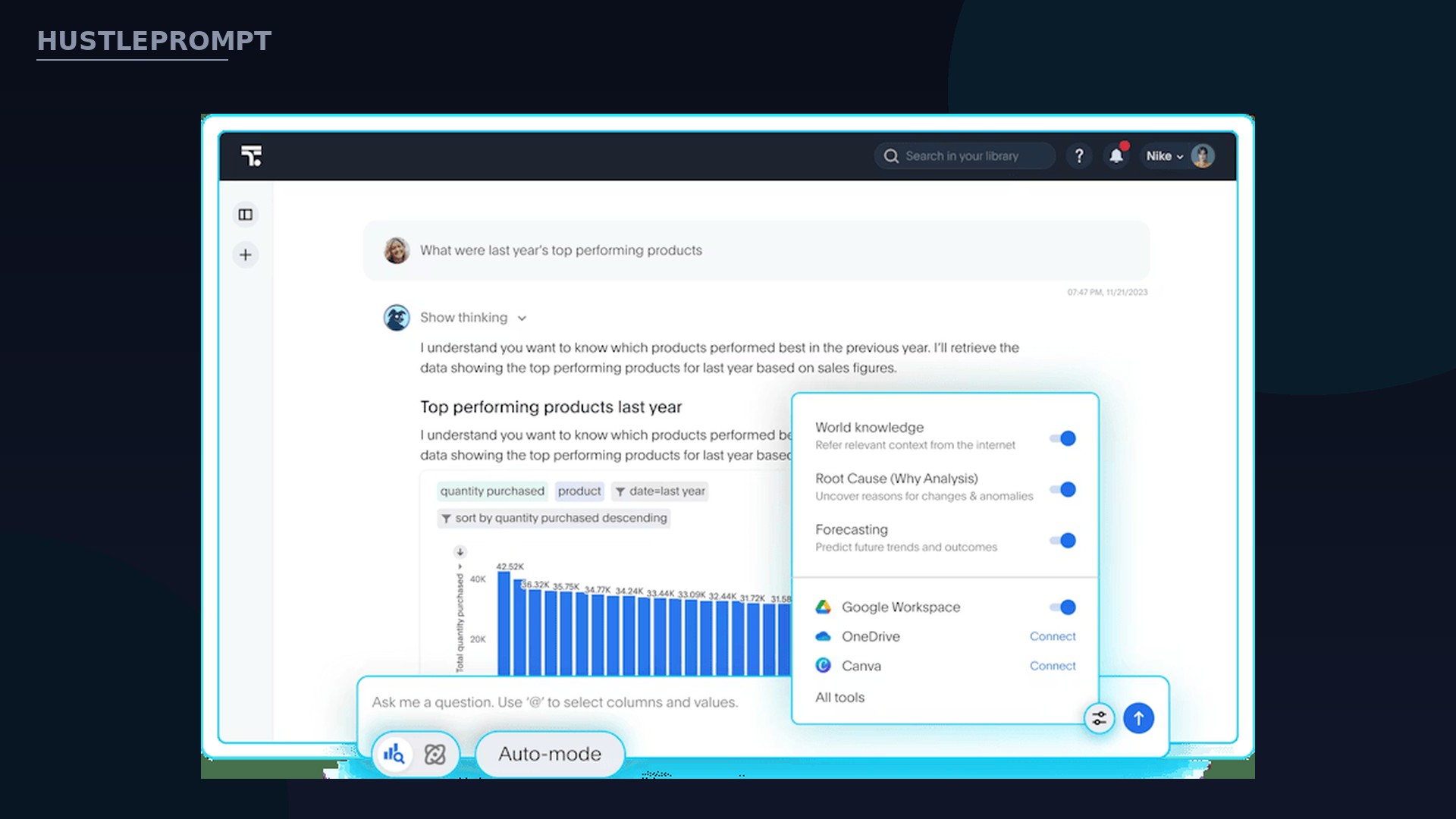
AgentSpot lets people and goal-based agents work side by side as a trusted AI workforce. Anyone can build agents, automate workflows, and create interactive apps from plain language — no code — on shared memory, trusted business context, and enterprise governance (official announcement, Oct 22, 2026).
The “multiplayer” framing is deliberate: real work lives in teams and processes, not chat windows. In AgentSpot, what one person builds becomes a reusable capability for the whole company instead of dying in someone’s chat history.
Three building blocks, four memory layers
Per the official AgentSpot product page, the platform has three pieces:
- Agents — describe the job; AgentSpot builds the agent with instructions, context, and tools.
- Workflows — routine tasks on a schedule or trigger: sales forecasts, financial monitoring, onboarding.
- Live Apps — interactive apps built from a prompt, combining connected data with agent-powered actions.
Memory works at four layers: company memory (admins set the key facts), agent memory (creator refinements reach every user of the agent), user memory (learns each person’s preferences), and agent-user memory (keeps each person’s history with each agent).
Priced by outcomes, not tokens
No token or seat charges: you pay only when an agent delivers work — a conversation, a workflow run, an app session. Building/testing is free, and every plan includes unlimited users and agents.
Usage is measured in Data to Outcome (DO) credits, defined on the official product page:
| What consumes a DO credit | Rule |
|---|---|
| New agent conversation | 1 credit per conversation started |
| Workflow run | 1 credit per execution on a user’s behalf |
| Agentic app loaded | 1 credit per app session |
| Activity beyond 24h | +1 credit per additional 24-hour period |
| Building & testing | Free — nothing until it delivers work |
Stat highlights (official sources)
- $0 to start: free plan, no time limit, no credit card — unlimited agents and users, plus a weekly outcome allowance.
- 25 credits/week free, 250/week on the paid plan — per TechTarget’s launch coverage. A workflow run five times a week costs five credits.
- SOC 2 Type II certified, with RBAC, row-level security, and end-to-end encryption; customer data is not used to train models.
- 50+ native integrations: Slack, Salesforce, HubSpot, Google Workspace, Microsoft 365, Notion, Stripe, Snowflake, Zapier, GitHub, and more.
Sources: thoughtspot.com/agentspot · official launch announcement · TechTarget
Outcome-based vs token-based: why it matters
Pricing models compared
- ✓ Pay per delivered outcome: 1 conversation, 1 run, 1 session
- ✓ Unlimited users & agents — sharing never raises the bill
- ✓ Building and testing costs nothing
- ✓ Weekly credit allowance is predictable
- ✗ Every prompt burns tokens — costs scale with usage, not value
- ✗ Per-seat pricing punishes company-wide rollouts
- ✗ Experimenting and iterating runs up the meter
- ✗ The monthly bill is hard to forecast
How a small business puts AgentSpot to work
Non-technical teams can automate real workflows without a developer and without per-token surprises. Concrete plays from the launch materials:
- Automate the weekly report: pull sales, summarize variances, drop a Slack brief every Monday — one run = one credit.
- Competitor tracking on autopilot. A scheduled agent that researches competitors daily and emails a battlecard-style briefing each morning.
- Onboarding on rails: provision accounts, send the welcome sequence, schedule check-ins.
- Ambient agents in Slack. Agents that follow a channel and answer questions they can help with — no tagging required.
- Start free and measure: run one workflow for a month, count credits, then decide if Fleet pays for itself.
The honest caveats
AgentSpot is enterprise software in small-business pricing — the governance story targets IT, and connecting real systems takes setup work. Heavy daily use lands you on the paid Fleet plan fast. Still, the free plan is a zero-risk trial.
Frequently asked questions
What is AgentSpot?
ThoughtSpot’s “multiplayer AI” platform (Oct 22, 2026): anyone builds AI agents, workflows, and apps from plain language, on governed company data.
How does the pricing work?
One DO credit per conversation, workflow run, or app session. Building/testing is free; every plan includes unlimited users and agents.
Is the free plan really free?
Yes — no time limit, no credit card, unlimited agents and users, plus a weekly allowance. Heavier use moves to Fleet.
Do I need to code?
No — “just describe it and AgentSpot assembles an agent… without code or templates,” per the product page.
Is my company data used to train AI?
No. ThoughtSpot states customer data is not used to train or fine-tune models, with SOC 2 Type II certification, RBAC, row-level security, and logically isolated deployments.
Which tools does it connect to?
50+ listed, including Slack, Salesforce, HubSpot, Google Workspace, Microsoft 365, Notion, Stripe, Snowflake, Zapier, and GitHub.
Keep Reading