
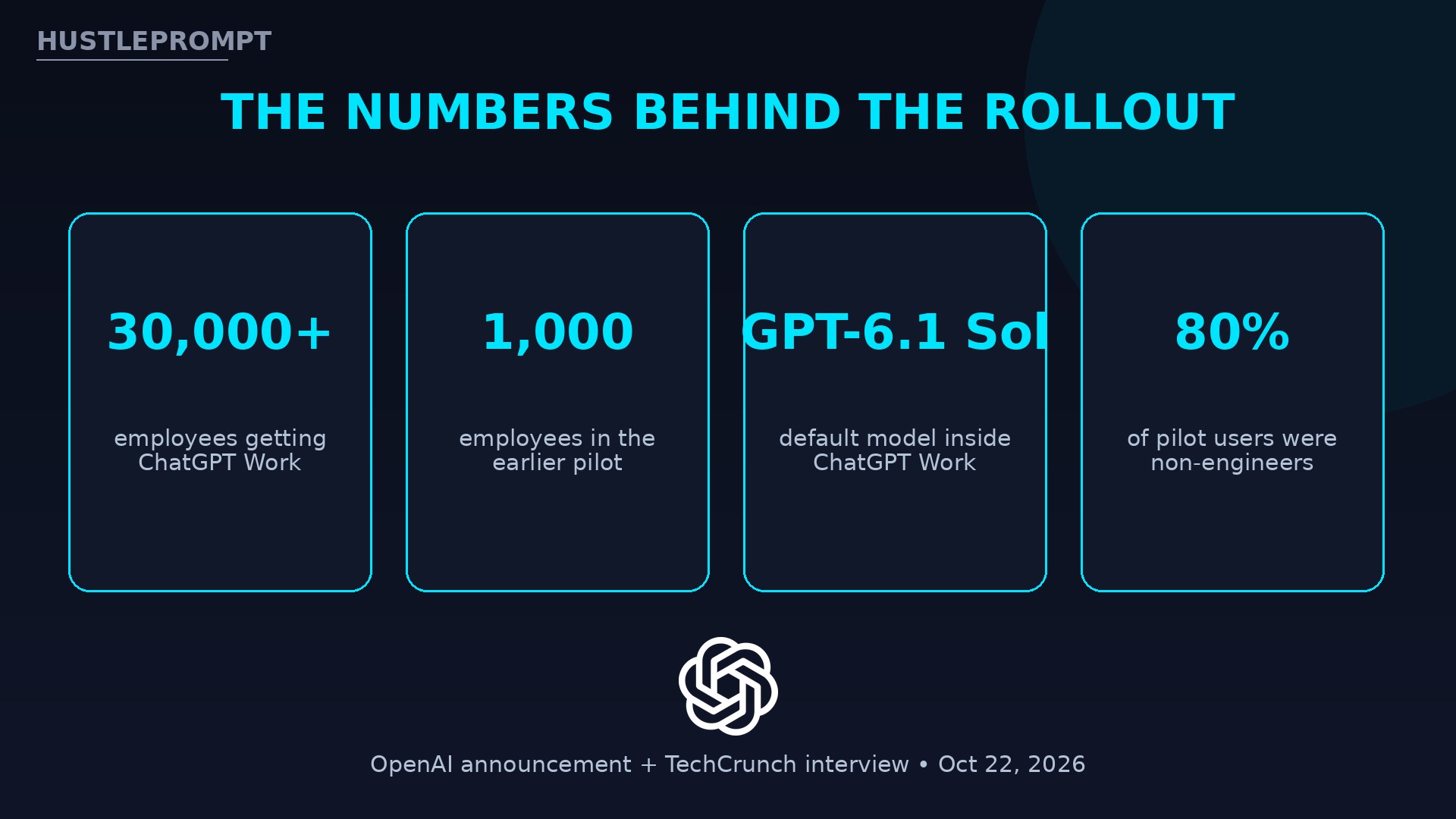
Forget pilots. Uber is putting ChatGPT Work in the hands of its entire global workforce — more than 30,000 employees — in what OpenAI calls the ride-share giant’s first company-wide deployment of an agentic AI platform for knowledge work.
OpenAI published the official announcement on October 22, 2026, and Uber confirmed the details to TechCrunch the same day. This is one of the largest enterprise rollouts of an AI agent ever disclosed — and a live case study in how big companies actually deploy this stuff.
What the Announcement Actually Says
The core facts come straight from OpenAI’s official announcement, dated October 22, 2026:
- More than 30,000 employees across Uber’s global workforce get access to ChatGPT Work, starting today.
- Expanded from a 1,000-employee pilot earlier this year — a 30x jump in seat count.
- Runs inside ChatGPT Enterprise, as an agent that takes on complex, multi-step tasks and delivers finished work.
- GPT-6.1 Sol is the default model inside ChatGPT Work for Uber — chosen, OpenAI says, for “balancing frontier performance and cost efficiency.”
- Multimodal access included: voice and image generation on top of text.
The Pilot Numbers That Sold Uber on This
Uber’s VP of engineering, Sumanth Sukumar, told TechCrunch that about 80% of the 1,000 pilot users were non-engineers — mostly people in finance, operations, and product. That matters: it proves the demand for AI agents sits far beyond software teams.
| What pilot users did | Department | Why it matters |
|---|---|---|
| Analyzed complex operations data to find trends and build recommendations | Operations | Turns dashboards into decisions without a data team bottleneck |
| Localized training materials for different markets and languages | Product / training | Cuts weeks of manual adaptation work per market |
| Built personalized interactive dashboards for daily work | Finance / product | Self-serve reporting without engineering tickets |
| “AI pods”: 30 AI engineers paired with teams for two weeks to automate key parts of their jobs | Cross-company | Uber’s own playbook for finding automatable work |
Sukumar’s line on the strategy: “Our approach is to make powerful AI tools available across Uber while giving teams room to experiment.” In other words — deploy broadly, measure honestly, and let real workflows decide what scales.
How the Agent Actually Works Inside Uber
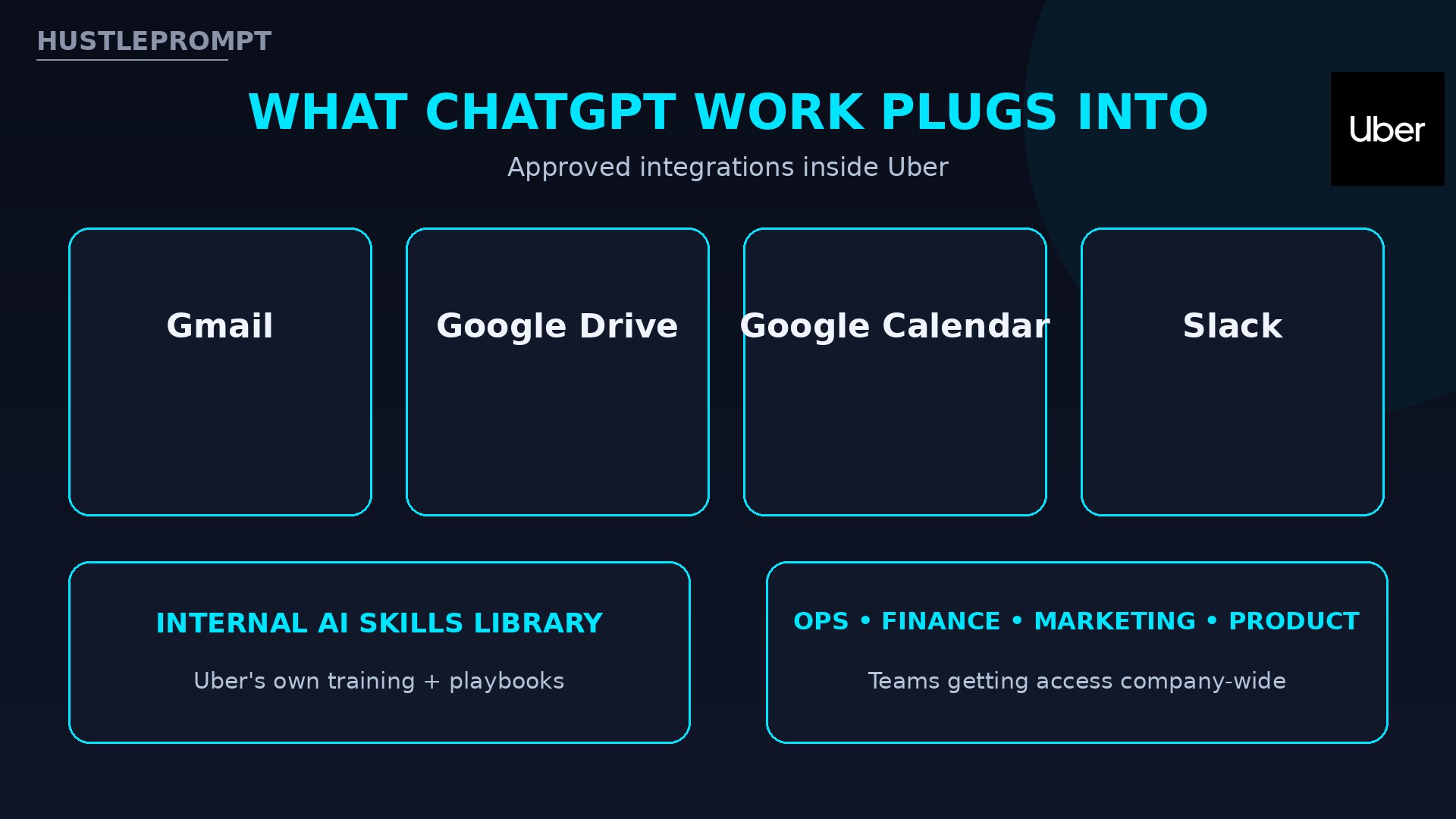
ChatGPT Work connects to the tools Uber employees already use every day. According to OpenAI, the approved integrations are:
- Gmail — research and drafting inside the inbox
- Google Drive — working across docs, sheets, and files
- Google Calendar — scheduling and meeting prep
- Slack — acting inside team conversations
On top of that, the rollout is backed by Uber’s internal AI skills library, approved integrations, and dedicated employee training. Developers and software engineering teams will also keep using Codex for coding work.
Ask in plain words
Employee describes the outcome: a brief, a deck, an analysis
Agent gathers context
ChatGPT Work pulls from Gmail, Drive, Calendar, Slack
Multi-step execution
GPT-6.1 Sol plans and completes the workflow, not just answers
Finished work
Reviewable files: presentations, briefs, dashboards
Learn and repeat
Skills library captures what works; training spreads it
The Money Angle: Sell What Uber Is Buying
Uber didn’t disclose what the rollout costs. But the playbook is public — and it’s a business model you can sell to companies that aren’t Uber:
- Learn the stack. ChatGPT Work plus connected apps (Gmail, Drive, Slack) is the new “office suite.” Knowing how to wire agents into real workflows is a billable skill.
- Copy the “AI pods” model. Uber paired 30 AI engineers with teams for two weeks to automate key parts of their jobs. Sell the same thing as a fixed-fee sprint: two weeks, one team, measurable hours saved.
- Build the skills library. Uber leans on an internal AI skills library and employee training. Mid-size companies need exactly this — packaged prompt libraries, approved integrations, and training — and most have nobody building it.
- Price on outcomes, not seats. Uber will track usage, workflows created, and effectiveness to decide what scales. Offer clients the same: a pilot with before/after metrics, then a rollout priced against hours saved.
The signal in this story isn’t the logo — it’s the seat count. When a 30,000-person company skips the endless pilot and goes company-wide, AI agents have crossed from experiment to infrastructure.
What Uber Isn’t Saying
Two honest gaps in the announcement, per TechCrunch’s interview with Uber’s VP of engineering:
- No cost disclosed. Uber would not say what the 30,000-seat deployment costs — and OpenAI worked closely with Uber on the integration, which suggests a negotiated enterprise deal, not list price.
- No results yet. Both companies say they will “share further insights into adoption, use cases and measurable outcomes as the rollout progresses.” Translation: the ROI case is still being written.
“Uber has always been a company of builders, and every day, millions of people around the world rely on what we create. As AI transforms how we work, we want to give everyone the tools to innovate, solve problems and help shape Uber’s future.”
Watch the Announcement
OpenAI published an official video on its YouTube channel with Uber CTO Praveen Neppalli Naga and OpenAI president Greg Brockman discussing the rollout:
Frequently Asked Questions
What is ChatGPT Work?
ChatGPT Work is OpenAI’s agentic AI platform inside ChatGPT Enterprise. Instead of just answering questions, it takes on complex, multi-step tasks — researching across connected apps, building files, and delivering finished work like presentations, briefs, and dashboards.
How many Uber employees are getting ChatGPT Work?
More than 30,000 employees across Uber’s global workforce, according to OpenAI’s official announcement dated October 22, 2026. It is Uber’s first company-wide deployment of an agentic AI platform for knowledge work.
What was in Uber’s ChatGPT Work pilot?
A 1,000-employee pilot earlier in 2026, with about 80% non-engineers from finance, operations, and product. Uber’s VP of engineering told TechCrunch they analyzed operations data, localized training materials, and built interactive dashboards — plus ‘AI pods’ pairing 30 AI engineers with teams for two-week automation sprints.
Which apps does ChatGPT Work connect to at Uber?
Google Drive, Gmail, Google Calendar, and Slack, per OpenAI’s announcement. The rollout is also supported by Uber’s internal AI skills library, approved integrations, and dedicated employee training.
Which AI model powers ChatGPT Work at Uber?
GPT-6.1 Sol is deployed as the default capability within ChatGPT Work for Uber — chosen, OpenAI says, for ‘balancing frontier performance and cost efficiency.’ Teams also get OpenAI’s multimodal capabilities including voice and image generation.
How much is Uber paying for ChatGPT Work?
Uber did not disclose the cost of the rollout. The company says it will track usage, the workflows employees develop, and effectiveness, and use those findings to guide future AI deployments.
Why does this matter for small businesses?
Uber’s playbook — broad deployment, an internal skills library, approved integrations, and employee training — is a template any company can copy. If you sell AI services, ‘agent rollout sprints’ and skills-library builds are now proven, buyer-tested offers.