
In a single Friday, the Pentagon picked its AI winner — and it was not the company whose models were already running inside its classified networks. The OpenAI Pentagon deal, announced late Friday by CEO Sam Altman, puts OpenAI’s models onto the military’s classified systems on the very same day President Trump ordered every federal agency to stop using Anthropic’s AI tools. One lab got a contract. The other got a six-month eviction notice.
What Altman announced
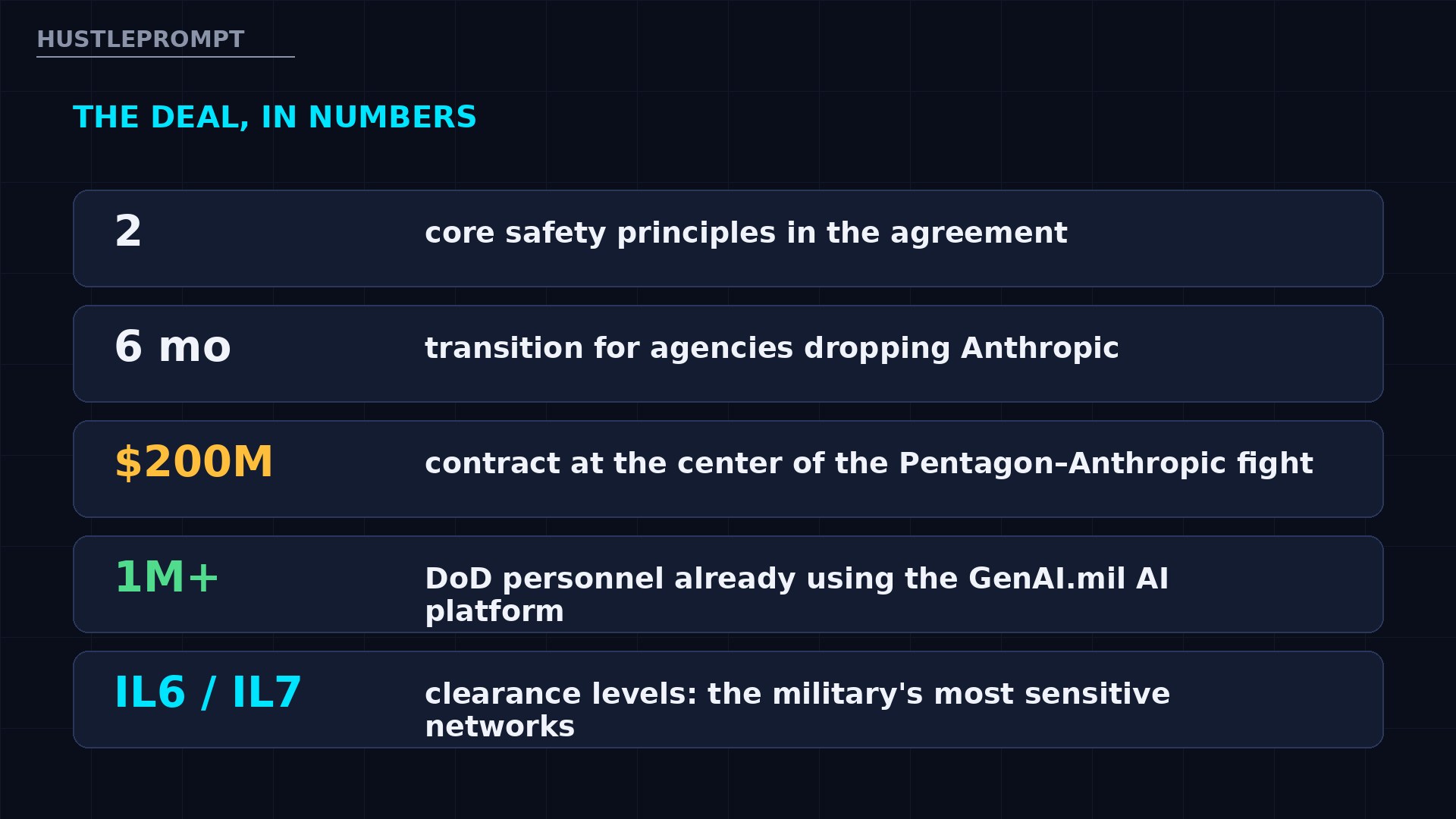
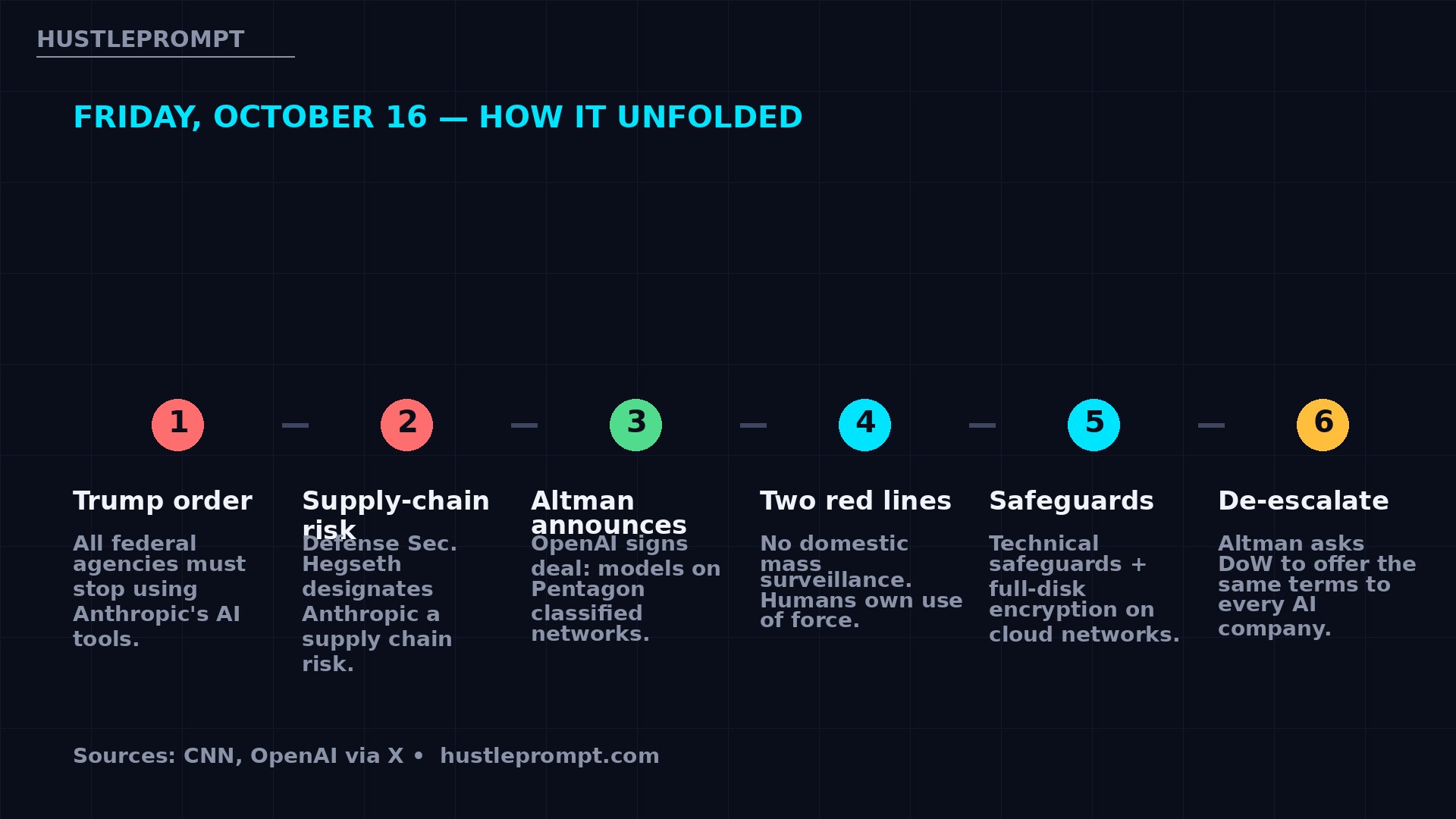
Altman said on X late Friday that OpenAI had signed an agreement with the Pentagon — the administration now calls it the Department of War — to deploy its AI tools on the military’s classified networks. Two non-negotiable safety principles anchor the deal, and Altman says the department agreed to reflect them in its own law and policy:
- No domestic mass surveillance. OpenAI’s models cannot be used for widespread surveillance of U.S. citizens.
- Humans own the use of force. A human must remain responsible for any use of force, including autonomous weapon systems.
OpenAI also committed to build technical safeguards, deploy with full-disk encryption on cloud networks, and send forward-deployed engineers to the Pentagon, CNN reported. Altman said the department had “displayed a deep respect for safety,” and asked the Pentagon to offer the same terms to all AI companies — pushing to de-escalate away from legal action toward negotiated agreements.
The same day Anthropic got the boot
Hours earlier, Trump ordered all federal agencies to cease using Anthropic’s AI tools, with a six-month transition. Defense Secretary Pete Hegseth declared Anthropic a “supply chain risk” — a label normally reserved for firms tied to foreign adversaries, which would force every military contractor to prove its work never touches Anthropic’s products. Trump was blunt on Truth Social: “We don’t need them, we don’t want them, and we will no longer deal with them.”
The backstory is a contract fight that went public. Anthropic had been negotiating a $200 million contract under which the Pentagon demanded “all lawful purposes” access. Anthropic refused without guarantees against domestic surveillance and autonomous weapons — the same red lines OpenAI just got written into its deal. Deputy Defense Secretary Emil Michael accused CEO Dario Amodei of dictating terms to the military, and the talks collapsed, bankb.it reported. Anthropic says it will legally challenge the designation.
OpenAI vs. Anthropic: what is actually different?
The awkward question — Altman called the deal “definitely rushed” — is why OpenAI succeeded where Anthropic failed, when the guardrails look nearly identical. OpenAI’s blog post draws the line:
| OpenAI’s position | Anthropic’s position | |
|---|---|---|
| Red lines | 3: mass surveillance, autonomous weapons, high-stakes automated decisions | 2: domestic surveillance, fully autonomous weapons |
| Enforcement | Multi-layered: own safety stack, cloud deploy, cleared staff in loop, contracts | Contractual guarantees demanded up front |
| Pentagon’s demand | Accepted broad lawful use, safeguards layered on top | Refused “all lawful purposes” without carve-outs |
| Outcome | Deal signed Friday | Banned; “supply chain risk” |
Sources: OpenAI via X; OpenAI blog post via TechCrunch; CNN; bankb.it.
Friday, October 16: how it unfolded
How to profit from the defense AI boom
Government AI contracts are multi-year and recession-proof. Where the opportunity sits now:
1. Sell forward-deployed AI engineering
OpenAI is embedding engineers inside the Pentagon, and AWS just committed $1 billion to forward-deployed AI engineers. Clients pay a premium for engineers who install, secure, and babysit AI inside their walls — and defense is now the highest-paying buyer.
2. Own the AI compliance niche
Every military contractor must now prove its systems never touch Anthropic’s products, and every AI vendor needs “red line” documentation. Compliance consulting for AI in regulated environments is a brand-new specialty with almost no competition.
3. Train the GenAI.mil workforce
GenAI.mil already has over one million users, heading toward three million personnel. Somebody has to teach them prompt engineering and secure AI use — training contracts at that scale are enormous.
FAQ
What exactly did OpenAI agree to with the Pentagon?
Its models will run on the military’s classified networks for lawful purposes, with two binding principles — no domestic mass surveillance and human responsibility for the use of force — plus technical safeguards, full-disk encryption, and OpenAI engineers on site.
Why did Trump order agencies to stop using Anthropic?
Anthropic refused “all lawful purposes” access without guarantees against domestic surveillance and autonomous weapons. The administration treated that as dictating terms to the military and answered with a ban plus a “supply chain risk” tag.
What does “supply chain risk” mean here?
Normally used for firms tied to foreign adversaries, it forces every military contractor to prove its work never touches Anthropic’s products — a designation Anthropic plans to challenge in court.
Are OpenAI’s safeguards really different from Anthropic’s?
On paper, barely — both drew the same red lines. The difference is packaging: OpenAI accepted broad lawful use and layered technical safeguards and on-site engineers on top, while Anthropic demanded contractual carve-outs first.
What are OpenAI’s three red lines?
Mass domestic surveillance, autonomous weapon systems, and high-stakes automated decisions such as “social credit” systems — protected, OpenAI says, through multiple technical layers rather than usage policies alone. A human must still remain responsible for any use of force.
Keep Reading
Sources: CNN, “OpenAI strikes deal with Pentagon hours after Trump admin bans Anthropic”; TechCrunch, “OpenAI reveals more details about its agreement with the Pentagon”; bankb.it, “OpenAI strikes deal with Pentagon”. All facts verified against these reports.