
This morning’s DeepSeek outage was a blunt reminder: the cheapest AI in the industry comes with the industry’s least reliable uptime. DeepSeek’s web, app, and API interfaces went down for about five hours — and anyone running a business on DeepSeek woke up to spinning prompts, “server busy” pop-ups, and dead automations.
If you build with cheap AI, you need to know exactly what happened, what the pattern is, and how to keep your revenue flowing when your model provider goes dark. Here’s the full breakdown.
What happened on October 15
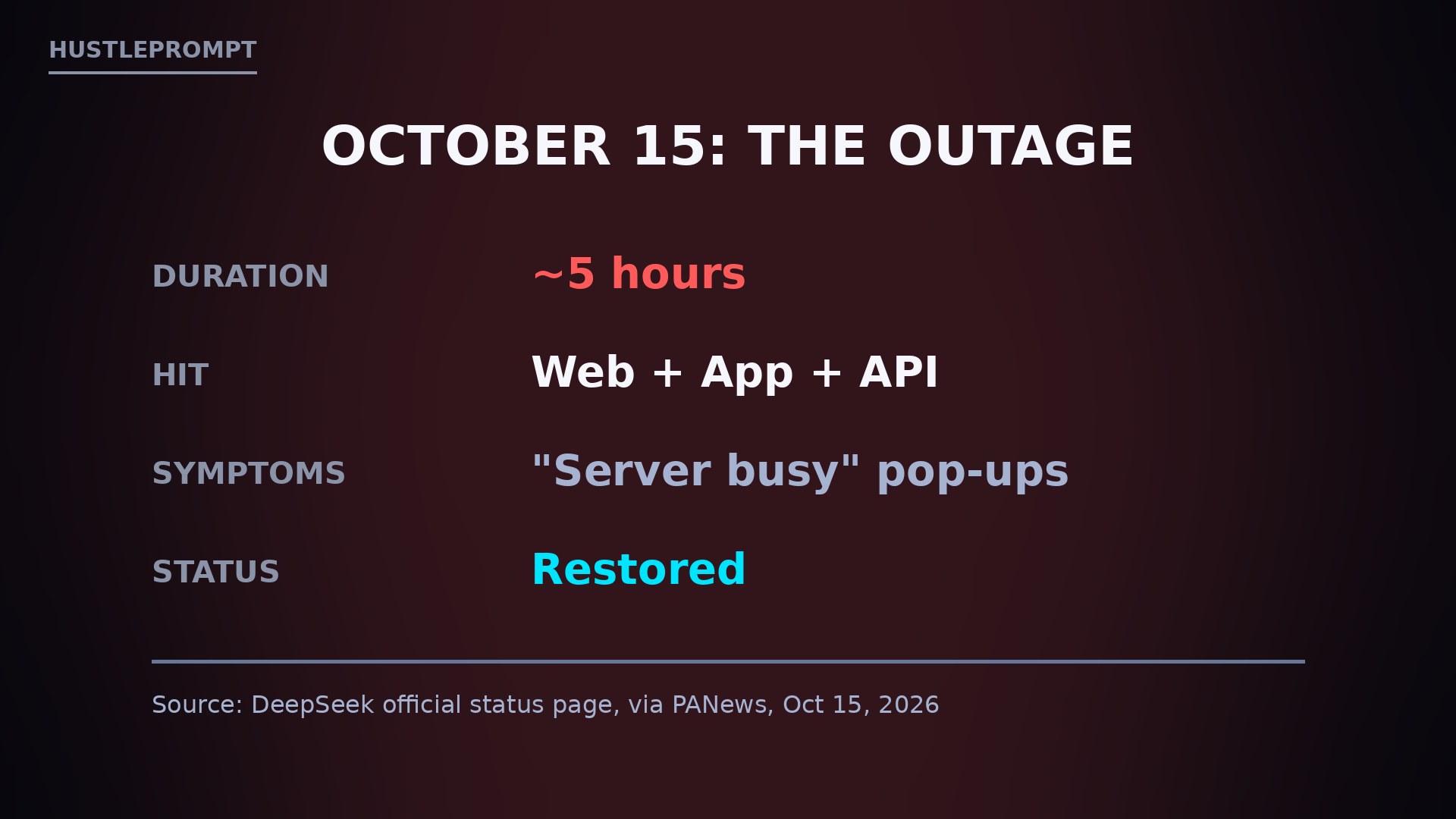
According to PANews, citing DeepSeek’s official status page, the outage struck on the morning of October 15. Users reported prompts spinning endlessly, frequent “server busy” and “server temporarily unavailable” pop-ups, and conversations interrupted mid-way. The disruption lasted about five hours, with intermittent failures throughout, before service was restored.
DeepSeek’s official status page now shows green: “Everything is running smoothly.” But the incident is already one of the longest AI-provider outages of the year.
| Detail | What we know | Source |
|---|---|---|
| Date | October 15, 2026 (morning) | PANews |
| Duration | About 5 hours, intermittent | PANews |
| Scope | Web, app, and API interfaces | PANews |
| Symptoms | Spinning prompts, “server busy” pop-ups, interrupted conversations | PANews |
| Current status | Restored — “Everything is running smoothly” | DeepSeek status page |
A pattern, not a fluke
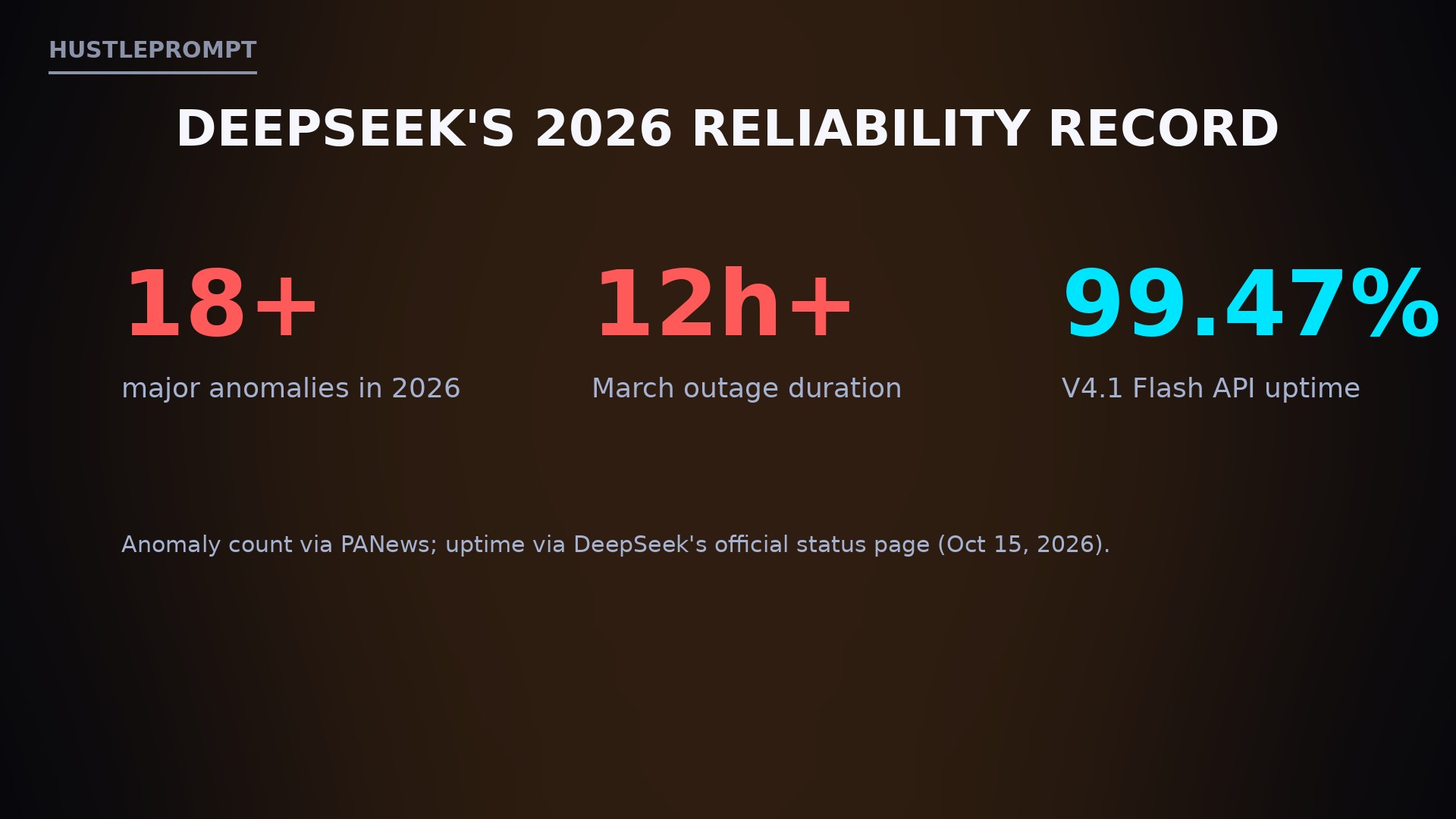
Five hours sounds like a lot. In DeepSeek’s case, it’s business as usual. PANews reports that since 2026 began, DeepSeek has experienced at least 18 large-scale service anomalies — and that includes an outage of over 12 hours back in late March.
DeepSeek’s own status page tells the same story in the numbers it publishes. The V4.1 Flash API — the cheap model most builders actually use — shows 99.47% uptime since July. The V4 Pro API sits at 99.74%, and the chat service at 99.45%.
Those numbers sound respectable until you do the math. 99.47% uptime means roughly 40 hours of downtime per year — more than a full work week of outages for the API that powers your support bot, your content pipeline, or your client automations.
Why millions still bet their business on DeepSeek
The answer is price — and the gap is enormous. DeepSeek’s official API docs price the Flash model at just $0.30 per million input tokens (peak, cache miss) and $1.20 per million output tokens. Off-peak, those rates are halved: $0.15 and $0.60.
Compare that with what the Western labs charge:
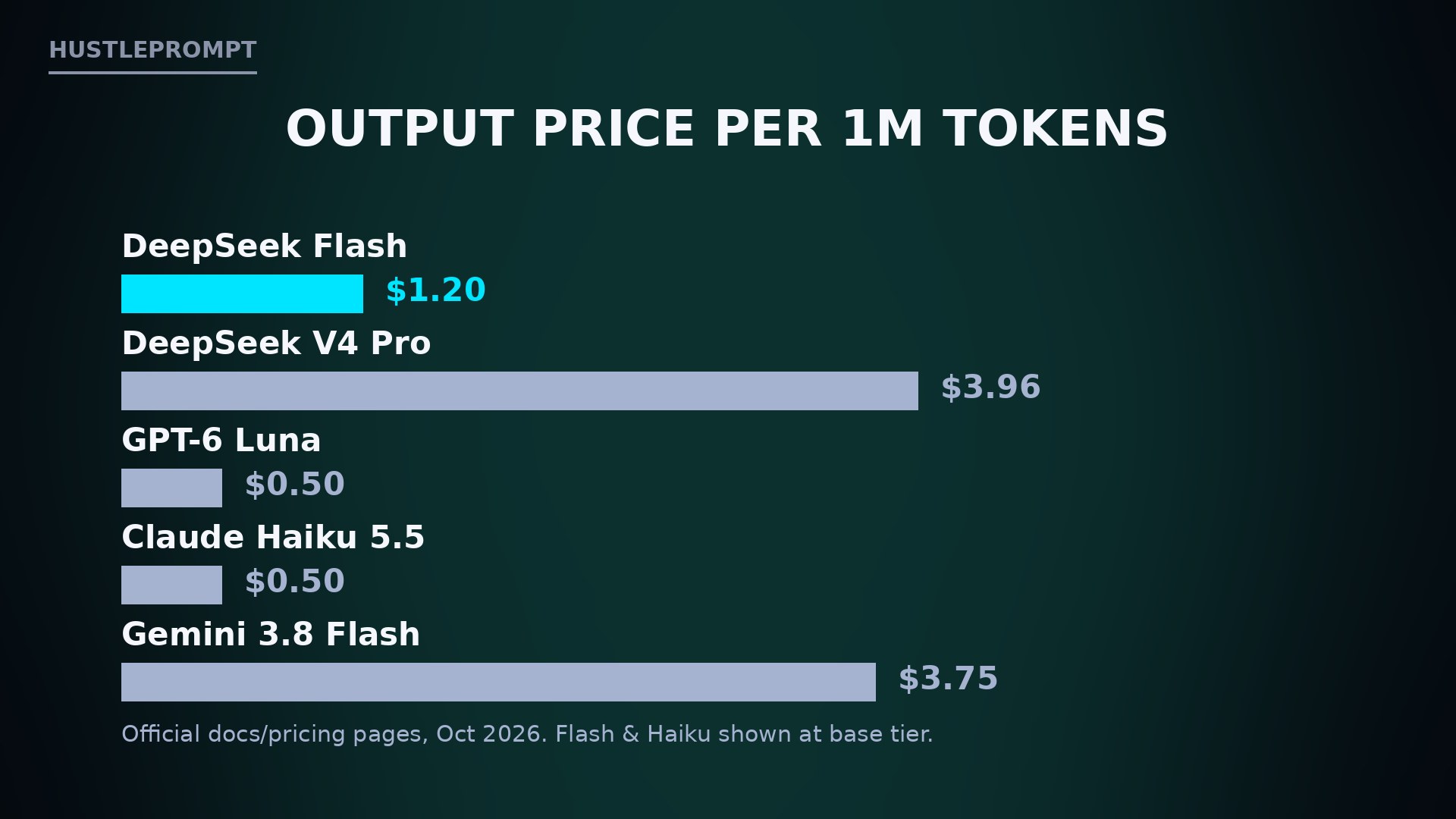
| Model | Input / 1M | Output / 1M | Source |
|---|---|---|---|
| DeepSeek Flash | $0.30 (peak) | $1.20 (peak) | DeepSeek API docs |
| DeepSeek V4 Pro | $1.32 (peak) | $3.96 (peak) | DeepSeek API docs |
| OpenAI GPT-6 Luna | $0.10 | $0.50 | OpenAI / VentureBeat |
| Claude Haiku 5.5 | $0.10 (under 100K tokens) | $0.50 | Anthropic / VentureBeat |
| Gemini 3.8 Flash | $0.75 | $3.75 (promo) | Google / VentureBeat |
GPT-6 Luna actually undercuts DeepSeek Flash on output price — $0.50 versus $1.20 — which makes today’s outage even more interesting. The “cheap but flaky” trade-off is no longer the only cheap option. But DeepSeek’s off-peak pricing ($0.60 output) and its huge context windows keep it wired into thousands of production stacks.
The failover playbook: 4 steps to survive the next outage
Every builder on a budget needs the same four-layer defense. Set it up once; it pays for itself the first time a provider goes dark.
How to set it up this week
- Pick one backup model. GPT-6 Luna ($0.10/$0.50) is the cheapest production-grade fallback. Get an API key now, not during an outage.
- Add a status watchdog. A simple cron job that hits DeepSeek’s status page every 5 minutes and pages you on failure costs almost nothing.
- Cache aggressively. DeepSeek’s cache-hit pricing is 50x cheaper than cache-miss ($0.003 vs $0.30 input) — caching cuts your bill and reduces outage blast radius.
- Test the flip. Run a game day: kill the primary key, confirm the backup answers, measure the switch time. If it takes more than 5 minutes, fix it.
How to profit from the fragility
Here’s the angle most people miss: every outage is a sales call for whoever sells reliability. Small businesses don’t have failover playbooks — they have a freelancer who set up “the AI thing” once.
- Sell “AI uptime audits.” Review a client’s AI stack, document single points of failure, install the 4-step playbook above. Charge $500–$2,000 per audit — the October 15 outage is your proof slide.
- Productize failover. Build a lightweight multi-provider router once and resell it to agencies. Retainer pricing: $200–$500/month per client for monitored AI infrastructure.
- Ride the migration wave. GPT-6 Luna is now cheaper than DeepSeek Flash on output tokens. Offer “DeepSeek-to-Luna” migration sprints for teams burned by today’s outage.
FAQ
How long was the DeepSeek outage on October 15, 2026?
About five hours, with intermittent disruptions. DeepSeek’s web, app, and API interfaces were affected before service was restored, per PANews citing the official status page.
Is DeepSeek back online now?
Yes. DeepSeek’s official status page shows “Everything is running smoothly” and all systems operating as expected.
How many outages has DeepSeek had in 2026?
At least 18 large-scale service anomalies since the start of 2026, including one lasting over 12 hours in late March, according to PANews.
What is DeepSeek’s official API uptime?
DeepSeek’s status page reports 99.47% uptime for the V4.1 Flash API and 99.74% for the V4 Pro API (July–October 2026) — roughly 40 hours of annual downtime at 99.47%.
How much does the DeepSeek API cost?
Per DeepSeek’s official API docs: Flash costs $0.15–$0.30 per million input tokens and $0.60–$1.20 per million output tokens (off-peak vs peak). V4 Pro costs $0.66–$1.32 input and $1.98–$3.96 output. Peak hours are 01:00–04:00 and 06:00–10:00 UTC, Monday–Friday.
What is the cheapest reliable alternative to DeepSeek?
OpenAI’s GPT-6 Luna at $0.10/$0.50 per million input/output tokens undercuts DeepSeek Flash on output price, and Anthropic’s Claude Haiku 5.5 matches it at $0.10/$0.50 for requests under 100,000 tokens.
Keep Reading