
The Meta net-zero pledge just hit reality. Meta’s own 2026 Sustainability Report, published November 19, 2026, says the company is re-evaluating the 2030 deadline for reaching net-zero emissions across its entire value chain — because the AI data-center buildout pushed its carbon footprint up 45% in a single year.
That is not a small miss. Meta’s net carbon footprint jumped to 11.8 million metric tons of CO2 equivalent in 2025, up from about 8.1 million the year before. And the fuller picture is worse: counting emissions the way the power grids Meta draws from actually produce them, the total reached 21.7 million metric tons — almost double the net figure.
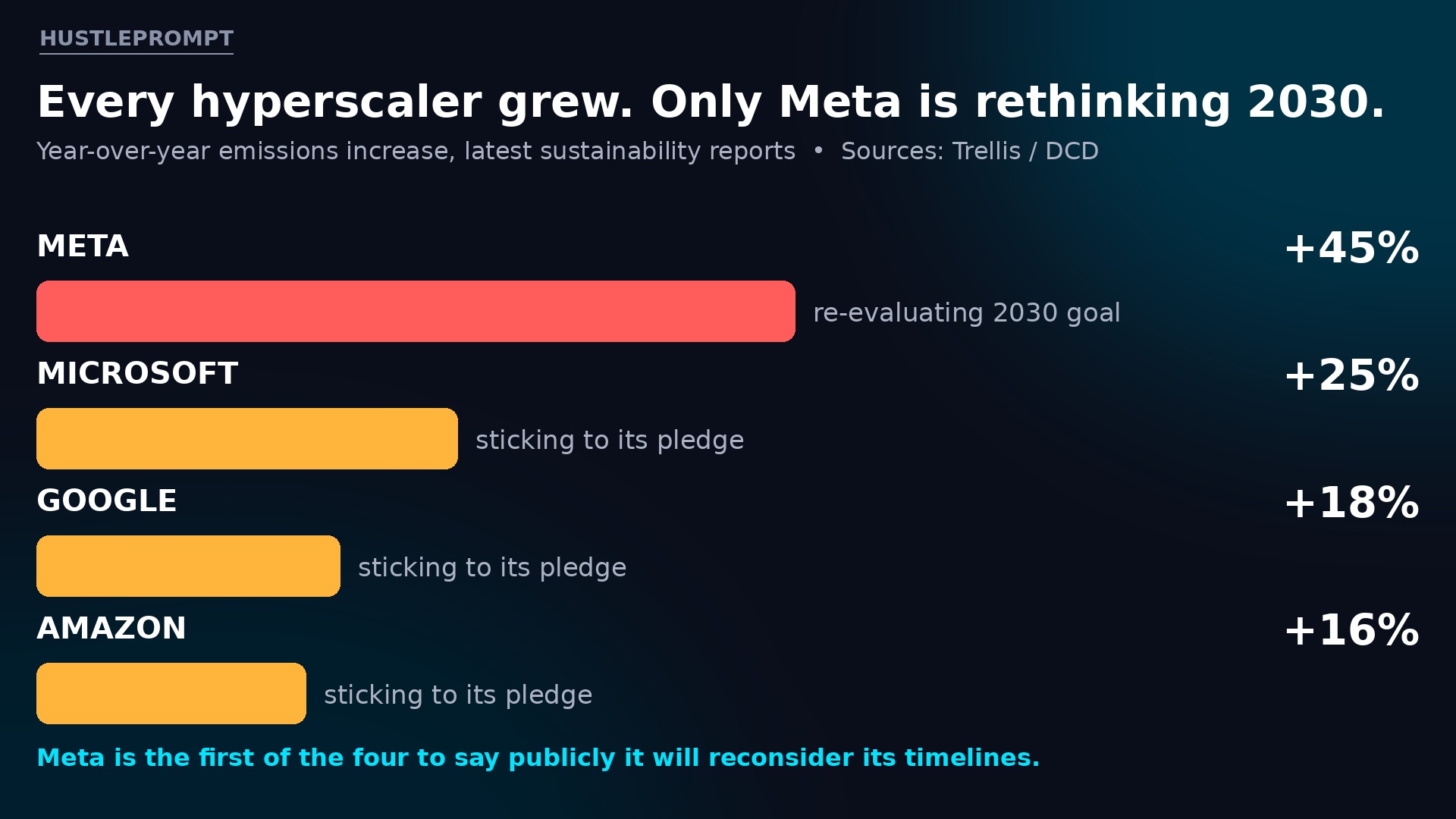
Meta is now the first of the big four hyperscalers to say publicly that its 2030 climate timeline may need to change. Microsoft, Google, and Amazon all reported double-digit emissions growth too — but none of them has put its 2030 commitment under review. Here is what Meta’s report actually says, why AI power demand broke the plan, and what it means for your money.
What Meta actually said
The announcement sits in the leadership message of the report, signed by Rachel Peterson, Meta’s vice president of data centers, and Blair Swedeen, its global head of net zero and sustainability. Their words leave little room for spin:
The evidence: Meta’s own words and numbers
“We are re-evaluating our timelines, sequencing, and interim milestones — including the 2030 timeframe for our net-zero emissions goal and our near-term intensity targets — so our approach reflects current operating realities while keeping progress transparent year over year.” — Rachel Peterson and Blair Swedeen, Meta 2026 Sustainability Report
The two executives also explained why the original plan failed: “When we set our net-zero emissions goal, we anticipated steady growth, falling clean energy costs, and changes in the broader system that would enable progress at the pace we envisioned. The reality has been far more complex.” Demand for AI infrastructure, they wrote, “has grown faster than almost anyone projected.”
| Measure (2025) | Result |
|---|---|
| Net carbon footprint | 11.8 million mtCO2e, +45% (2024: ~8.1M) |
| Location-based emissions | 21.7 million mtCO2e (2024: 15.6M, +~39%) |
| Electricity consumption | +35% to 24.8 TWh; electricity emissions +~38% |
| Purchased goods & services | +36% |
| Capital goods (servers, buildings) | +58%; ~73% of total footprint |
| Scope 3 vs 2021 levels | More than 105% above 2021 |
| Clean energy contracted | 30+ GW (10+ GW contracted in 2025) |
Every figure above comes from Meta’s 2026 Sustainability Report, published November 19, 2026, as reported by AFP, Trellis, and Data Center Dynamics. Meta gave no new date for the goal and said only that it will “share where this work lands.”

Why AI broke the 2030 plan
The report tells a clear story. Meta set its net-zero goal in 2020, betting on steady growth, falling clean-energy costs, and a grid that would decarbonize on schedule. Instead, three things happened at once.
- AI demand exploded. Electricity consumption rose 35% in a single year, driven by new data centers. Electricity-related emissions grew almost 38%.
- The buildout itself is the biggest emitter. Capital goods — servers, chips, buildings, equipment — jumped 58% and now account for roughly 73% of Meta’s carbon footprint. Every new data center adds emissions before it ever trains a model.
- Clean power could not keep up. Interconnection queues, permitting delays, and slow transmission buildout meant new clean-energy projects arrived slower than new AI demand. Meta matched 100% of its annual electricity use with clean and renewable energy for the sixth straight year — but matching annual demand on paper is not the same as having clean power available hour by hour where the data centers sit.
The result: Scope 3 emissions — the supply-chain and value-chain emissions Meta pledged to hold at or below 2021 levels by 2030 — are now more than 105% above 2021 levels. The original goal is not just off track. On the current trajectory, it is not reachable.
The gas question: how Meta powers the AI buildout now
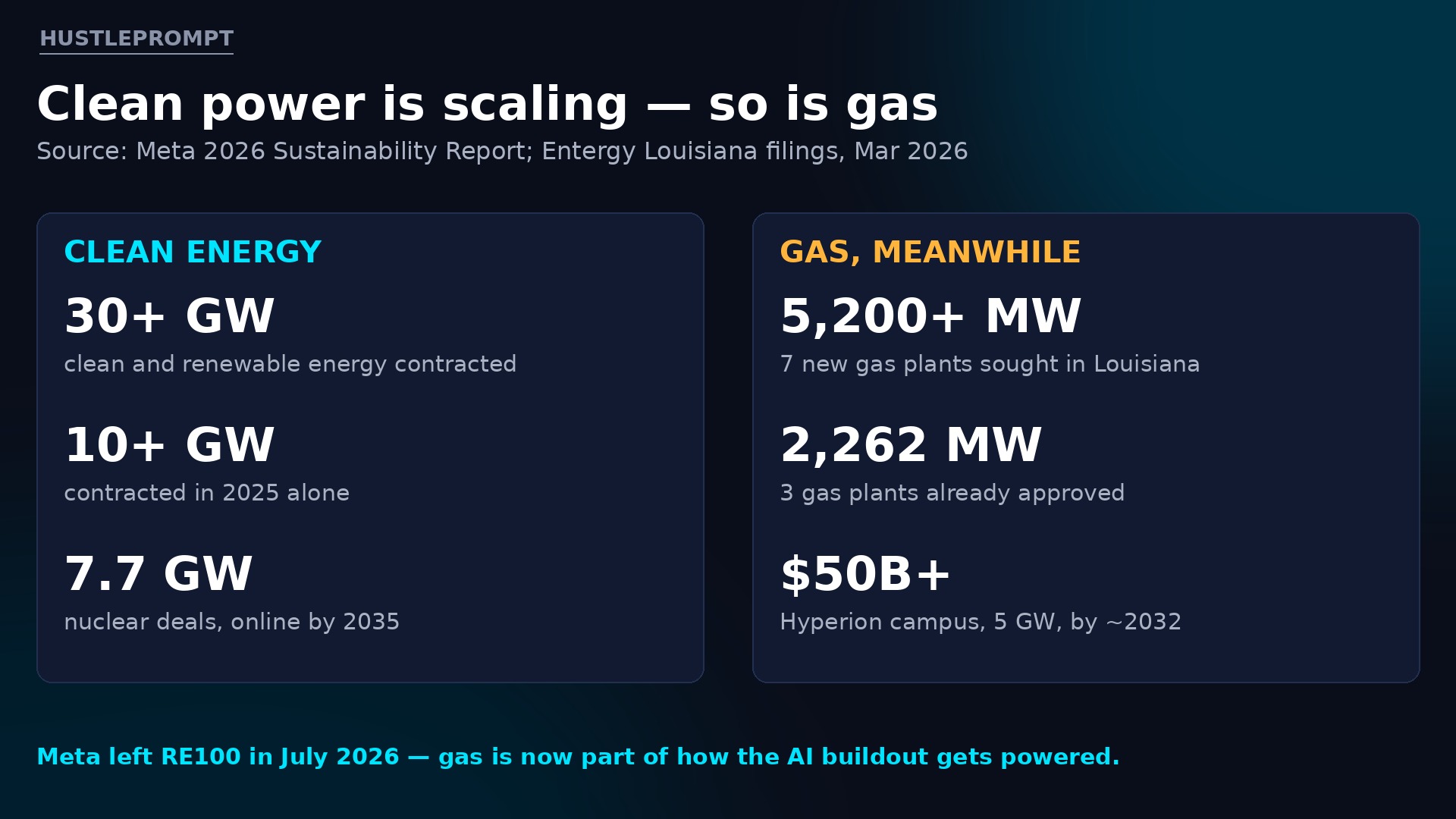
When clean power cannot arrive fast enough, Meta is turning to gas. The report says the company may deploy on-site natural gas where utilities cannot deliver power, and will buy low-methane certificates to offset some of those emissions. In July 2026, Meta left the RE100 initiative — the corporate pledge to use 100% renewable electricity — saying it could no longer meet the initiative’s technical criteria because of its new gas investments.
The clearest example is Hyperion, Meta’s giant AI campus in Richland Parish, Louisiana. The site is planned for 5 gigawatts of computing capacity and more than $50 billion of investment, with about 2 GW online by 2030 and full build-out around 2032. To power it, utility Entergy Louisiana has approval for three gas plants totaling 2,262 MW — and is seeking seven more totaling over 5,200 MW, all paid for by Meta under a 20-year deal. A regulator vote is expected in December 2026.
Data-center electricity use jumps 35% in one year as Meta races to build AI capacity.
Interconnection queues, permits, and transmission lag years behind new demand.
Meta turns to on-site and utility gas — and leaves RE100 in July 2026.
Emissions up 45%, Scope 3 more than double 2021 levels. Timelines go under review.
None of this means Meta has abandoned climate action. The report stresses that its long-term ambition is unchanged, and the clean-energy program is genuinely large: more than 30 GW contracted, including 10+ GW signed in 2025 alone and 7.7 GW of nuclear agreements expected online by 2035. The tension is timing. Clean energy is scaling — just not as fast as AI power demand.
Meta is not alone — but it is the outlier
The same pressure is hitting every hyperscaler. Microsoft’s emissions rose 25%, Google’s 18%, and Amazon’s 16% in their latest sustainability reports, with all three pointing to AI data-center expansion as the main driver. Amazon has even set a new carbon-intensity target for 2030 tied to its electricity use.
What sets Meta apart is honesty about the math. Its 45% jump is the largest percentage increase of the four, and it is the only one to say the 2030 timeline itself is under review. For context on the scale of the buildout: a study published in Nature Sustainability found that just 403 of the United States’ most powerful data centers already account for around 2% of the country’s electricity consumption, with a carbon footprint comparable to Denmark’s. Around 1,200 hyperscale data centers are online today, and hundreds more are planned.
What it means for your money
This is not just a climate story. It is an energy-cost story, and energy is now one of the biggest line items in the AI economy. Three money angles follow directly from Meta’s numbers:
- Power is the new bottleneck — and the new bill. Meta expects 2026 capital spending of $135-145 billion, mostly data centers and chips, and its third-quarter capex of about $34.9 billion pushed free cash flow negative even on $64.6 billion of quarterly revenue. When power is scarce, whoever controls cheap, reliable electricity controls the AI race — and pays for it.
- Gas is back in the AI economy. Meta’s pivot to gas, its exit from RE100, and a 5,200+ MW gas buildout in Louisiana show that dispatchable fossil power is, for now, the fastest way to feed a gigawatt campus. That supports gas producers, pipeline operators, and utilities with AI-load contracts — and it puts a ceiling on how fast the AI buildout can claim to be green.
- Clean-energy demand is still enormous. Meta contracted 10+ GW of clean power in a single year and holds 30+ GW in total, plus 7.7 GW of nuclear deals. The AI buildout is the largest new source of clean-energy demand in history. Solar, wind, battery storage, geothermal, and nuclear developers with projects that can actually connect to the grid are selling into a market that cannot get enough.
The practical takeaway: watch power, not just models. The companies winning the AI race will be the ones that can secure gigawatts of electricity at a price that works — whether that power is clean, gas-fired, or both.
How to position yourself as AI power demand grows
You do not need to pick a side in the climate debate to act on this trend. Here are concrete steps:
- Follow the power, not the press release. When a hyperscaler announces a new data center, check how it will be powered. Grid-connected clean power, on-site gas, or nuclear deals each point to different winners — utilities, gas producers, or clean-energy developers.
- Look at utilities serving AI campuses. Entergy Louisiana’s Meta deal is paid for by Meta under a 20-year contract, with Meta covering the full infrastructure cost. Regulated utilities with signed AI-load contracts and cost-recovery agreements are a direct way to play the buildout.
- Track the clean-energy backlog. Meta’s 30+ GW of contracted clean power and 7.7 GW of nuclear deals show where the money is flowing. Developers with permitted, grid-connected projects — not just announcements — are the ones that will actually deliver.
- Watch Meta’s next move. Meta has promised to share the outcome of its timeline review, but gave no date. When it lands, it will signal whether the industry’s 2030 climate pledges survive the AI era — or whether the whole sector resets its targets. That decision moves clean-energy and gas stocks alike.
- Price in power costs for AI services. If you sell AI-powered services or run AI workloads, energy is becoming a real cost driver. Model your margins on rising power prices in AI-dense regions, and consider providers whose data centers run on contracted clean power with locked-in rates.
- Do not bet against the buildout. Whatever happens to the 2030 goal, the buildout continues: $50 billion-plus for one campus, 1,200 hyperscale sites and counting. The money is in the infrastructure — power, chips, cooling, and construction — not in hoping the spending stops.
This is not financial advice — just a framework built on Meta’s own reported numbers. The AI race runs on electricity, and Meta just told the world that electricity is getting harder, dirtier, and more expensive to supply than anyone planned.
Frequently asked questions
What did Meta announce about its 2030 net-zero goal?
In its 2026 Sustainability Report, published November 19, 2026, Meta said it is “re-evaluating our timelines, sequencing, and interim milestones — including the 2030 timeframe for our net-zero emissions goal.” It gave no new date and said it will share the outcome of the review later.
How much did Meta’s emissions rise in 2025?
Meta’s net carbon footprint rose 45% to 11.8 million metric tons of CO2 equivalent, up from about 8.1 million in 2024. On a location-based basis — reflecting the actual grids its facilities draw from — emissions reached 21.7 million metric tons, up from 15.6 million.
Why did Meta’s emissions jump?
AI data-center expansion. Electricity consumption rose 35% to 24.8 TWh, capital goods (servers, buildings, equipment) jumped 58%, and purchased goods and services rose 36%. Clean-energy projects were delayed by interconnection queues, permitting, and slow transmission buildout, so demand outgrew clean supply.
Is Meta abandoning net zero?
No. Meta says its long-term ambition is unchanged — only the timelines and interim milestones are under review. It still aims for net zero across its value chain, matched 100% of its annual electricity use with clean and renewable energy for the sixth straight year, and holds 30+ GW of contracted clean power.
Why did Meta leave the RE100 initiative?
Meta left RE100 in July 2026, saying it could no longer meet the initiative’s technical criteria because of investments in new gas power. The company may deploy on-site natural gas where utilities cannot deliver power fast enough for its data centers.
What is the Hyperion data center in Louisiana?
Hyperion is Meta’s largest AI training campus, in Richland Parish, Louisiana. It is planned for 5 GW of computing capacity and more than $50 billion of investment, with about 2 GW by 2030. Entergy Louisiana has approval for three gas plants (2,262 MW) and is seeking seven more totaling over 5,200 MW to power it.
Are other tech giants facing the same problem?
Yes. Microsoft’s emissions rose 25%, Google’s 18%, and Amazon’s 16% in their latest reports, all driven by AI data-center growth. But Meta is the only hyperscaler so far to announce it is re-evaluating its 2030 commitment.