
The AI time horizon just jumped again. Frontier AI agents can now complete tasks that would take a skilled human 27 hours — more than a full workday of coding, optimization, and research, done autonomously. That is the headline finding of METR’s Q4 2026 capability update, published November 20, 2026.
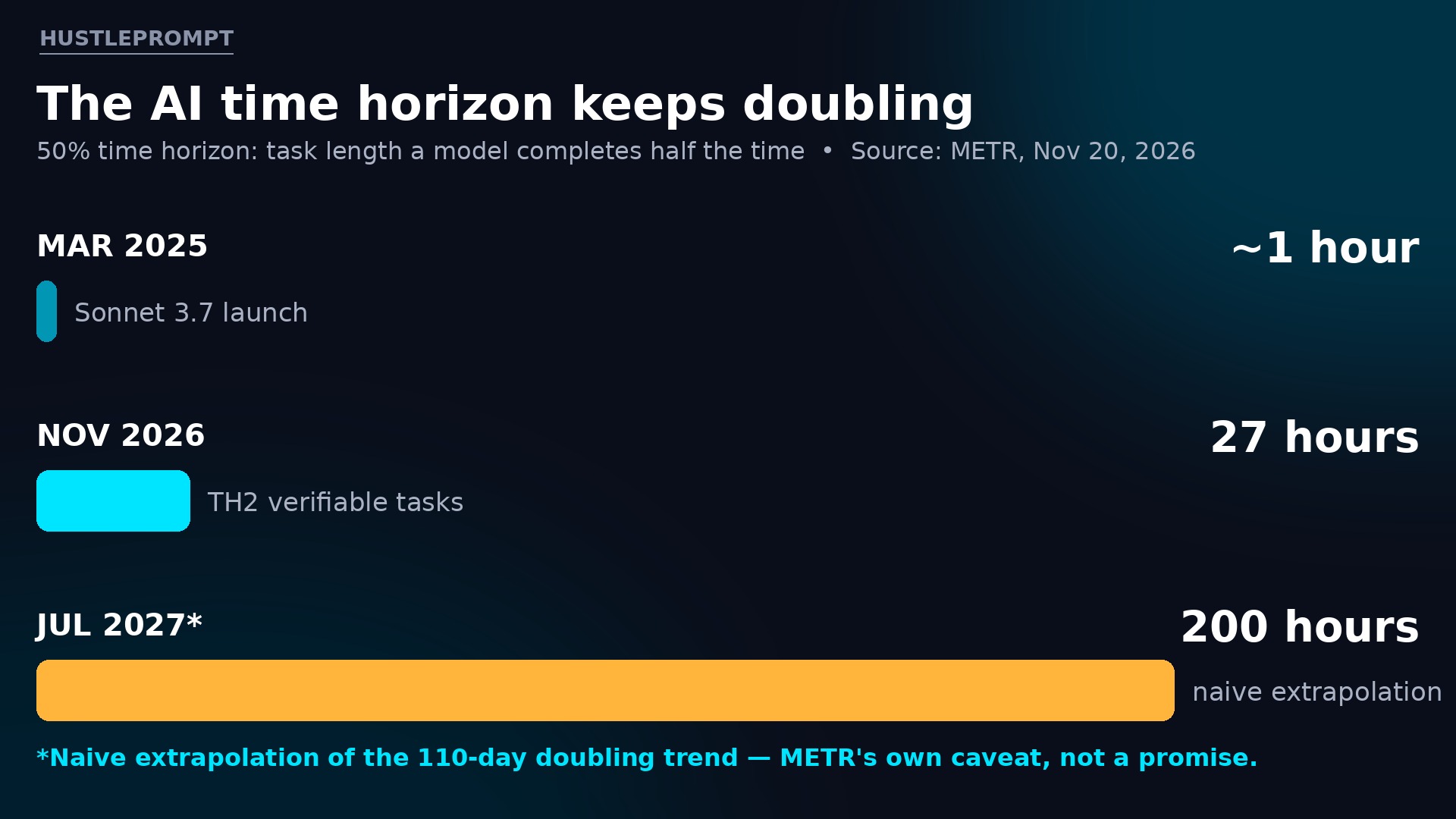
METR is the independent lab that invented the time-horizon metric: the length of a task, measured in human hours, that an AI agent completes half the time. In March 2025, the best model managed about one hour. Twenty months later, the frontier has reached 27 hours — and the horizon is still doubling roughly every 110 days.
If that trend holds, METR’s own naive extrapolation puts models at 200-hour horizons — over eight days of human work — by July 2027. That is not a prediction. It is a warning about the speed of change, and a clock for anyone whose income depends on knowledge work. Here is what METR measured, where AI still falls short, and how to position yourself before week-long agents arrive.
What METR actually measured
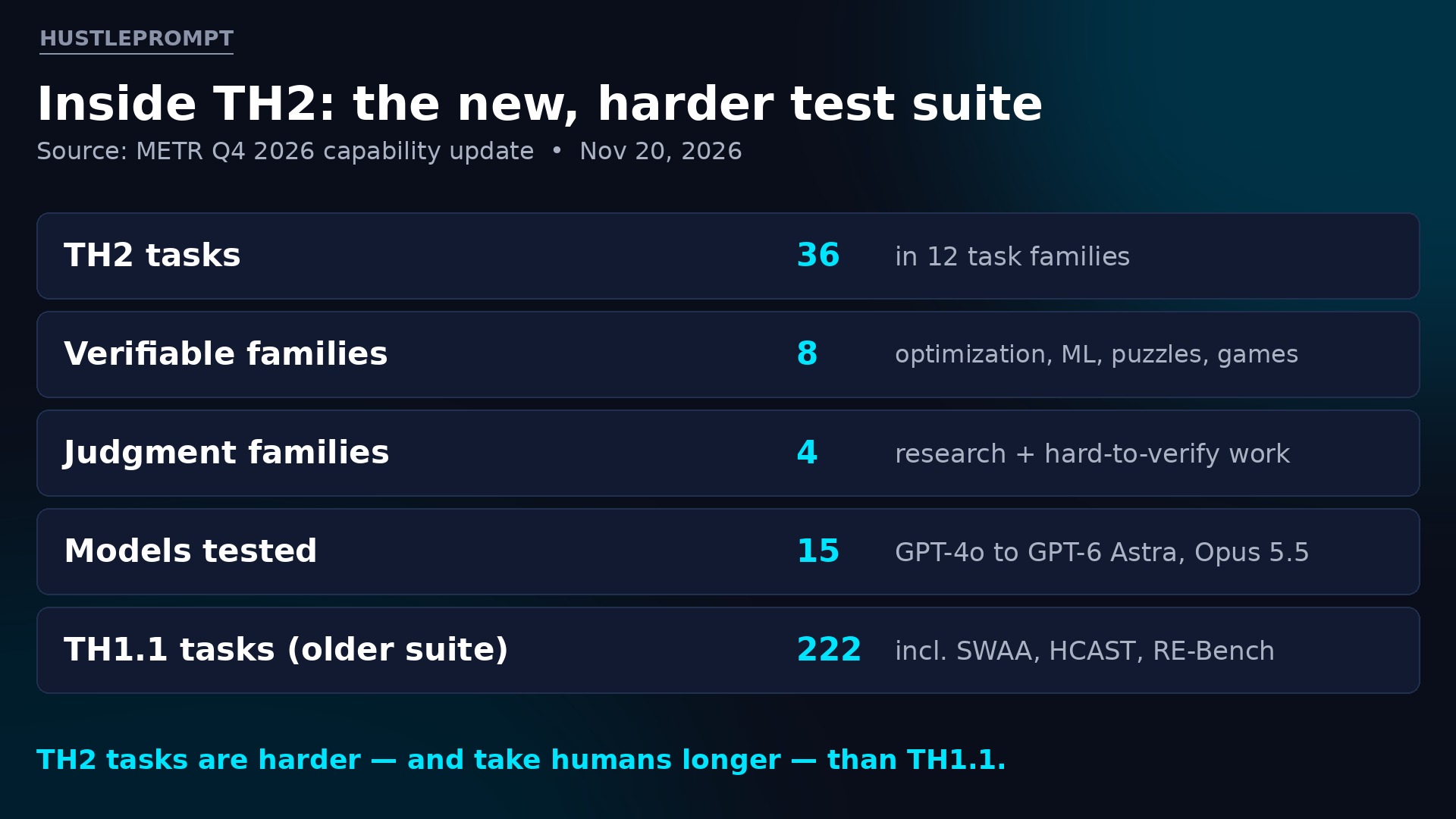
METR tested 15 public frontier models, from GPT-4o and o1 up to GPT-6 Astra, GPT-5.6 Sol, and Claude Opus 5.5, on two task suites. The older suite, TH1.1, has 222 tasks. The new suite, TH2, has 36 harder tasks in 12 families, split between verifiable work — optimization, machine learning, puzzles, games — and hard-to-verify research and judgment tasks.
The models ran with METR’s standard ReAct-style scaffold, with bash, Python, and image-viewing tools, at high reasoning effort. Human baseliners were recruited to time the tasks: specialists paid $200 to $350 an hour, at a total cost of roughly $90,000 for seven attempted baselines. Human baselines directly inform only 9% of METR’s time estimates; the rest use an estimation procedure detailed in the report.
The evidence: the numbers that matter
Every figure below comes from METR’s Q4 2026 capability update, published November 20, 2026:
| Measure | Result |
|---|---|
| Frontier time horizon (TH2 verifiable) | Up to 27 hours |
| Doubling time (TH1.1 + TH2) | ~3.61 months / 110 days (95% CI 2.08–4.94 months) |
| Previous doubling trend (TH1.1 only) | 105 days |
| Naive extrapolation | 200-hour horizon by July 2027 |
| TH2 suite size | 36 tasks in 12 families (8 verifiable, 4 judgment) |
| Models tested | 15, from GPT-4o to GPT-6 Astra and Opus 5.5 |
One more data point frames the trend: when METR first published time horizons in March 2025, the best model (Sonnet 3.7) sat at around one hour. Within a year, models had saturated the TH1.1 suite, which tops out at 30-hour tasks. The new TH2 suite exists because the old test got too easy.
What the models can already do
On well-defined work with clear feedback, frontier models now match or beat the skilled humans METR recruited. They beat the human baseliners on all three tasks where baselines were attempted: Train a Program, Minecraft Bot, and Reverse Conway.
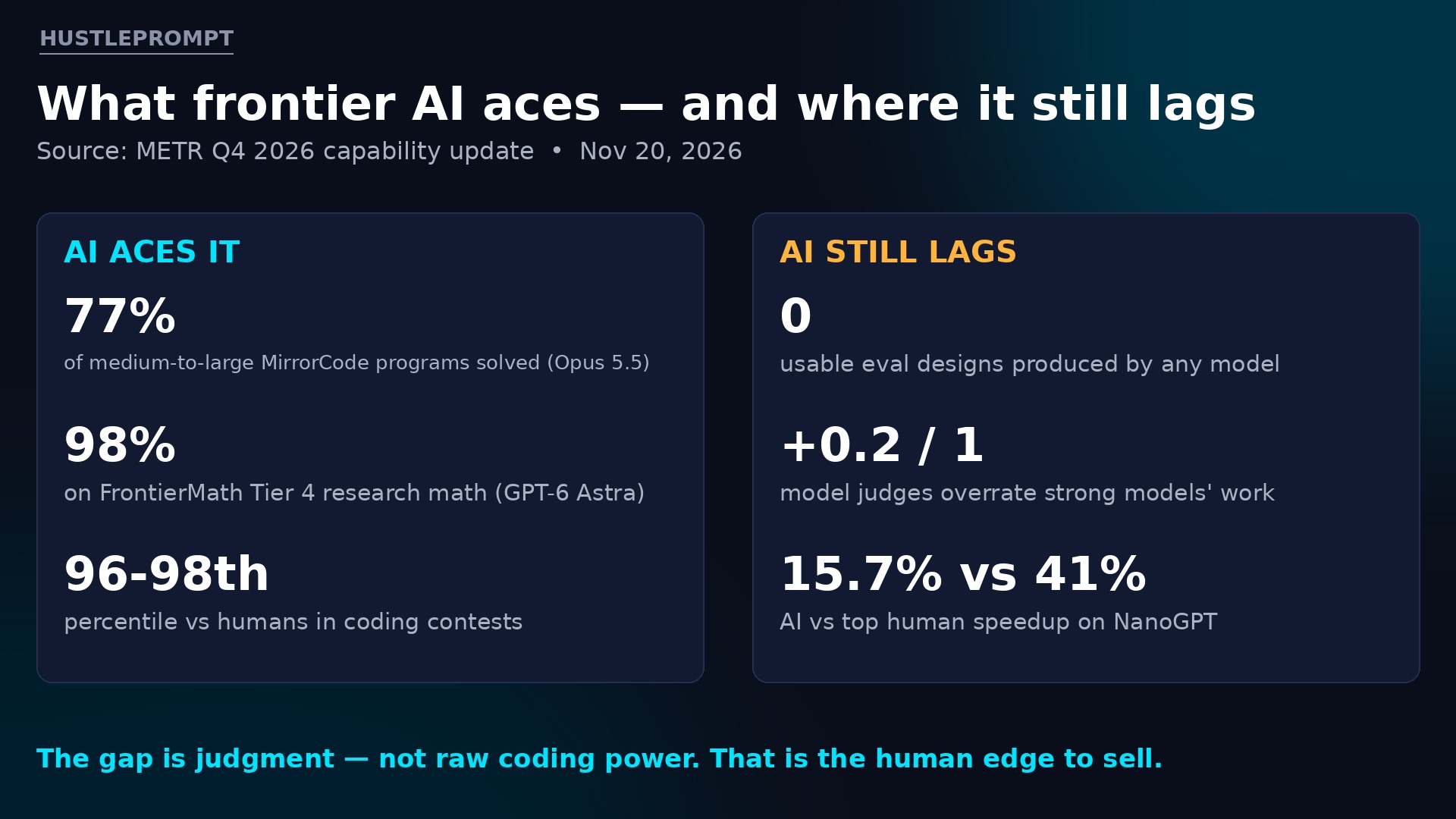
The results get sharper where METR had larger pools of human data. In Al Zimmermann’s Programming Contests — 15 multi-month optimization contests with 97 to 413 participants each — the strongest models (Fable 5.1, Opus 5.5, GPT-6 Astra) placed at the 96th to 98th percentile of human participants. In the median contest, roughly four humans beat the best model. Models had 48 hours on a 28-core machine; human participants had about three months.
Two more results show how far verifiable capability has come:
- Opus 5.5 solves 77% of medium-to-large MirrorCode programs — software reimplementations that would take human experts weeks to months on their own.
- GPT-6 Astra scored 98% on FrontierMath Tier 4, a benchmark of research-level math problems designed to take a strong mathematician one to two weeks.
- Budget NanoGPT: the best AI agent run reached a 15.7% training speedup in 48 hours — but the top human record holder, with AI assistance, estimated about 60 hours for a 41% speedup. The very best humans still win.
The judgment gap: where AI still falls short
Here is the twist that matters for your career. METR found a clear split: models are superb at work with fast, checkable feedback, and weak at work where quality is hard to judge. That weakness has a name in the report — judgment — and it is the most valuable human skill left in the loop.
METR asked agents to design a new evaluation task for its own suite. None of the tasks the agents produced were useful enough to include in the report. The agents favored automatically scored optimization tasks, did not try to understand what METR would find most useful, and produced no novel threat modeling or insightful hypotheses about model capabilities.
The evidence: the research-judgment gap
- Zero usable eval designs: no model produced an evaluation task METR considered informative enough to include in its post.
- Model judges overrate strong models: Opus 5.5, the judge that agreed most with METR’s human scorer, scored GPT-6 Astra’s tasks about 0.2 out of 1 higher than the human did. Frontier models give inappropriately high scores to work made by stronger or similarly strong models.
- LMCA benchmark: on rating critiques of philosophical arguments, all public models still sit below the agreement level of expert humans who spent 15 minutes on the task — though many beat experts who spent only 5 minutes.
- Lifecycle Cost: doubling a task’s cost to turn it into an RL training environment delays 50% success by about 4.6 months. Harder-to-build, more realistic tasks stay harder for longer.
“We think that current public evidence is insufficient to rule out drastic AI R&D acceleration in the next couple of years.” — METR, Q4 2026 capability update
By “drastic acceleration,” METR means capabilities improving so fast that humans can no longer meaningfully understand, assess, and react to the risks of new AI systems. That sentence is the report’s bluntest line — and the reason this update is getting so much attention.
From one hour to a workweek: how the trend plays out
The doubling trend is the part to internalize. Every 110 days, the length of task an AI agent can complete half the time roughly doubles. The path from here to week-long autonomous work looks like this:
Sonnet 3.7 sets the first measured frontier. AI handles hour-long coding tasks.
Frontier models on TH2 verifiable tasks. More than a full workday, done autonomously.
Naive extrapolation of the 110-day doubling trend. About eight days of human work.
Longer horizons only matter if agents can judge their own work. That gap is still open.
METR is careful with this extrapolation. It calls it naive, and the report spends pages on why it could break: evals may overestimate real-world ability, because the environments used to train models resemble the environments used to test them. The 95% confidence interval on the doubling time is wide — 2.08 to 4.94 months. But the direction has held across two suites and two years.
What week-long agents mean for jobs and freelancers
A 27-hour horizon already covers a large share of freelance coding, data, and optimization work. A 200-hour horizon would cover most of a project sprint. Three shifts follow from that:
- Hourly billing gets squeezed. If an agent does in hours what took a freelancer days, clients stop paying for hours. Value moves to outcomes: the working system, the shipped feature, the verified result.
- Review and judgment become the billable skill. METR’s evidence says models still cannot judge their own work on open-ended problems. The person who can scope a project, spot a bad solution, and sign off on quality is the person who stays in the loop.
- Volume work commoditizes first. Well-specified, checkable tasks — the kind with a test suite or a score — are exactly what agents already do best. Undifferentiated gig work in that category is the most exposed.
None of this means knowledge work disappears. It means the market splits: agents do the verifiable middle, humans own the fuzzy edges — scoping, taste, judgment, and accountability. That split is where the money moves.
How to profit from the 27-hour agent
The opportunity is not to compete with a 27-hour agent. It is to run one. Here is a concrete plan:
- Sell outcomes, not hours. Repackage your service as a fixed-price deliverable with a clear acceptance test — a working automation, a cleaned dataset, a shipped landing page. Agents make hourly rates indefensible; fixed outcomes stay sellable.
- Become the judge. Build a checklist or rubric for your niche that a client can use to verify an agent’s output. METR’s finding — that model judges overrate strong models by about 0.2 out of 1 — is your pitch: AI output needs a human who can tell good from bad.
- Automate your own verifiable work. Use frontier agents (GPT-6 Astra, Opus 5.5, and their peers) for the checkable parts of your workflow — code, data cleanup, first drafts — and keep your hours for scoping, review, and client judgment. That is the exact split METR’s data supports.
- Productize the judgment layer. Turn your review process into a paid product: an audit, a QA pass, a “verified by a human” stamp on AI-generated work. As agent output floods the market, verification becomes a service in itself.
- Learn agent supervision, not just prompting. The scarce skill is running an agent for 27 hours without it drifting: setting the goal, checking milestones, and catching reward hacking. Practice on your own projects before you sell it to clients.
- Watch the July 2027 marker. If the 110-day doubling trend holds, 200-hour horizons arrive around July 2027. Use that date as your planning horizon: the services you sell today should still be sellable when agents work eight-day stretches.
This is not financial advice — just a framework built on METR’s own numbers. The agents are getting longer attention spans. The humans who win are the ones who own the judgment the agents still lack.
Frequently asked questions
What is METR’s Time Horizons 2.0?
Time Horizons 2.0 (TH2) is METR’s new, harder evaluation suite for measuring how long AI agents can work autonomously. It has 36 tasks in 12 families, split between verifiable work (optimization, machine learning, puzzles, games) and hard-to-verify research and judgment tasks. It replaces the older TH1.1 suite, which models had saturated.
What is an AI time horizon?
The 50% time horizon is the length of a task, measured by how long it takes a skilled human, that an AI agent completes with a 50% success rate. METR introduced the metric in March 2025. The current frontier horizon is up to 27 hours on TH2’s verifiable tasks.
How fast are AI time horizons growing?
Across the TH1.1 and TH2 suites, time horizons are doubling roughly every 3.61 months — about 110 days — with a 95% confidence interval of 2.08 to 4.94 months. The previous TH1.1-only trend was 105 days. Naive extrapolation implies a 200-hour horizon by July 2027.
Which models did METR test?
Fifteen models, from GPT-4o and o1 through GPT-5, GPT-5.6 Sol, GPT-6 Astra, Opus 4.5 to 4.8, Opus 5 and 5.5, and Fable 5 and 5.1. The strongest results came from GPT-6 Astra, Opus 5.5, and Fable 5.1.
What can AI agents still not do?
Judgment work. No model produced an evaluation design METR found useful enough to include in its report, and model judges overrate work made by stronger models. On the LMCA benchmark, all public models still sit below expert humans who spent 15 minutes on the task. Open-ended research with slow feedback remains the human edge.
What does this mean for freelancers?
Hourly billing for verifiable work is under pressure, because agents already do 27-hour tasks. The durable income is in scoping, review, and judgment — verifying agent output, owning outcomes, and selling fixed-price deliverables with clear acceptance tests. Running agents, rather than competing with them, is the practical move.
Where can I read the full METR report?
On METR’s site: “AI R&D-relevant model capabilities are improving rapidly and are getting harder to measure,” published November 20, 2026, at metr.org. It includes the full methodology, robustness checks, and appendices.