
Microsoft Aion Instruct is now free inside Microsoft Edge — and it changes the math of shipping AI on the web. Announced November 19, the 2.3-billion-parameter open-weights model replaces Phi-4-mini as Edge’s built-in small language model, and a new Prompt API origin trial lets live sites call it directly from JavaScript.
No API key. No per-token bill. No server. The model runs on the visitor’s own device, and the text they type never leaves it.
What Microsoft Announced on November 19
Microsoft announced three updates on the Microsoft Edge blog:
- Aion Instruct is generally available as an open-weights model on Hugging Face and as Edge’s built-in small language model.
- A Prompt API origin trial lets developers use the Prompt API and Aion Instruct on a live site today.
- A developer preview of the experimental Decisions API, which returns fast, structured answers about text.
Edge downloads Aion only when a site or feature first needs it, and only on devices that can run it well. Users can turn it off in Edge settings.
“At 2.3B parameters, Aion is smaller, faster, and available on many more devices than Phi, while delivering comparable quality for common web tasks such as text synthesis and generation, summarization, instruction following, and structured outputs.”
Aion vs Phi Silica: Smaller Model, Much Bigger Context
Aion replaces two predecessors: Phi-4-mini in Edge, and Phi Silica as the Windows OS model. The trade: fewer parameters, far more context.
Aion Instruct vs Phi Silica (official figures)
| Spec | Phi Silica | Aion 1.0 Instruct |
|---|---|---|
| Parameters | 3.8B | ~2.29B |
| Input context | 3.5K tokens | 32,768 tokens |
| Role | Windows OS model | Edge + Windows OS model |
| License | — | MIT (open weights) |
Sources: Microsoft Foundry blog, Hugging Face model card. Context is about 9 times larger.
How Strong Is Aion? The Benchmarks
Microsoft published Aion’s scores on the model card:
- MMLU 55.15 and MMLU-Pro 33.35 — general knowledge.
- GSM8K 74.91 and MATH-500 48.00 — grade-school and competition math.
- IFEval 83.90 — following instructions precisely, the skill that matters most for browser features.
- GPQA 28.18 — graduate-level science questions, the hardest test here.
Respectable for 2.3B: 28 layers, grouped-query attention, tool calling, 8 languages.
How the Prompt API Works On-Device
The Prompt API is the developer-facing half of the announcement: an experimental web API that lets a site prompt the model built into Edge, from JavaScript.
One download, then free AI forever
Use the on-device model when it fits; switch to a cloud provider when a task needs more power.
The origin trial changes that: register for it, and visitors on regular Edge can run your on-device AI features on your live site — see the developer documentation.
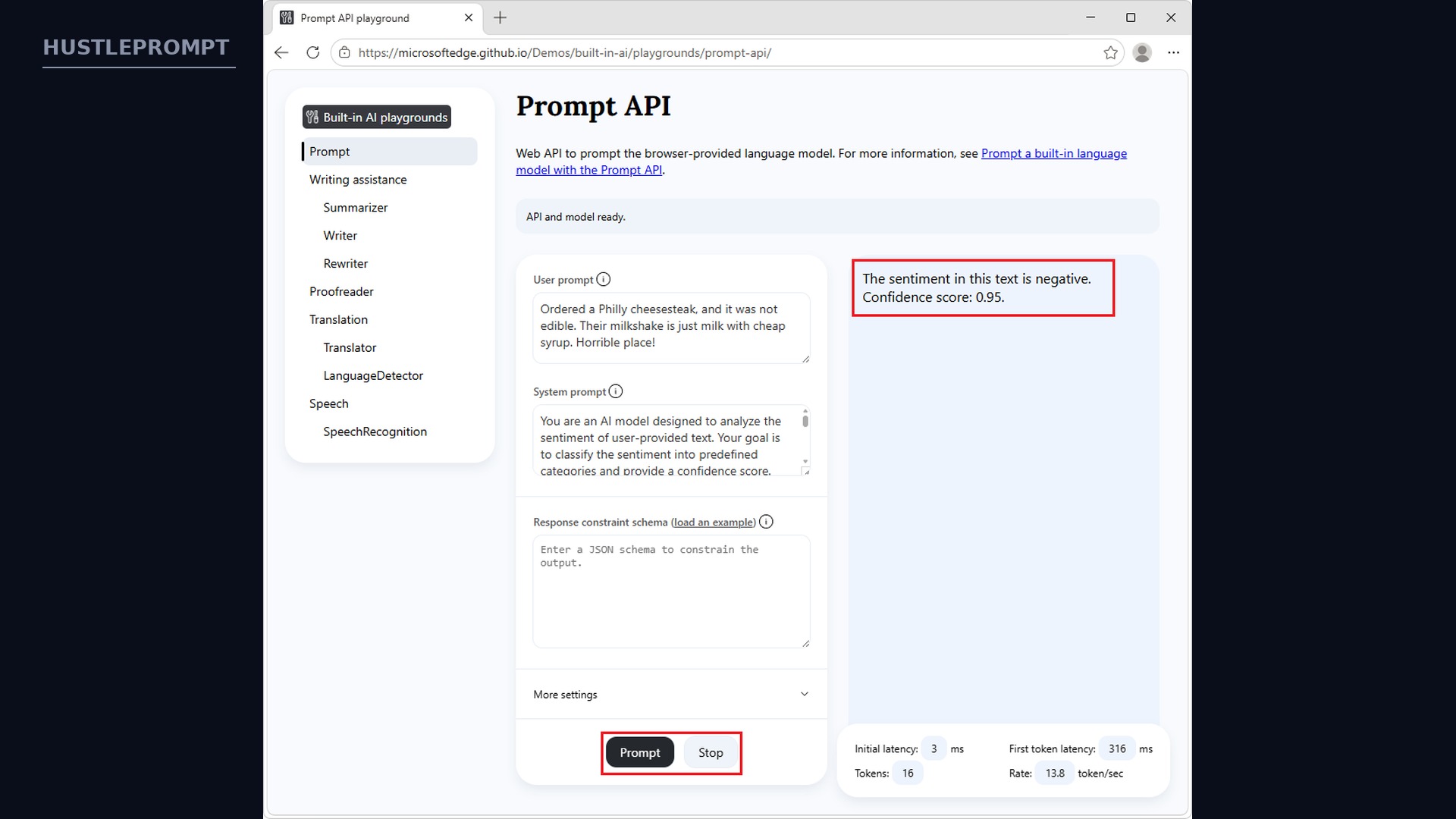
Microsoft’s Prompt API playground. Screenshot: Microsoft Learn.
In the playground demo, a sentiment check returned “negative” with 0.95 confidence in 16 tokens at 13.8 tokens per second — all inside the browser, with output constrainable to a JSON schema.
What the Decisions API Adds
The Decisions API, an experimental preview in Edge Canary and Dev, asks yes/no, multiple-choice, or scoring questions about text — and returns probabilities and a confidence value in one pass, without generating text.
Video: Microsoft Edge, November 19, 2026.
Microsoft’s example asks three questions about one product review in a single call: what the review is mainly about (quality, shipping, or price), a satisfaction score from 1 to 5, and whether the customer is asking for help. That is a support-ticket router or lead scorer — a few lines of JavaScript, zero server cost. One warning: the Decisions API is explicitly experimental, and Microsoft says to “expect both the API and its implementation to change.”
How to Profit: What Builders Can Ship With It
Every AI feature on a website today usually means an API bill. Aion in Edge removes it for the tasks a 2.3B model handles well. Microsoft states the benefits plainly: “Reduced cost: There’s no cost associated with using a cloud AI service,” and “Improved privacy: The data input to the model never leaves the device, and isn’t collected to train AI models.”
- Summarize and rewrite widgets. Offer any content site a “summarize this page” button powered by the Prompt API. Charge a flat monthly fee — your marginal cost is zero.
- Review and ticket classification. Use the Decisions API to sort support tickets, score reviews, and route leads. No server to maintain.
- Private AI as a selling point. “Your text never leaves your device” is a real differentiator for lawyers, doctors, and anyone handling sensitive text.
- Offline-capable tools. After the one-time download, prompts work with no network at all. Build writing helpers that keep working on a plane.
- Open-weights products. Aion is MIT-licensed on Hugging Face, in PyTorch, ONNX, and GGUF. Fine-tune it and ship it in your own product — not just in Edge.
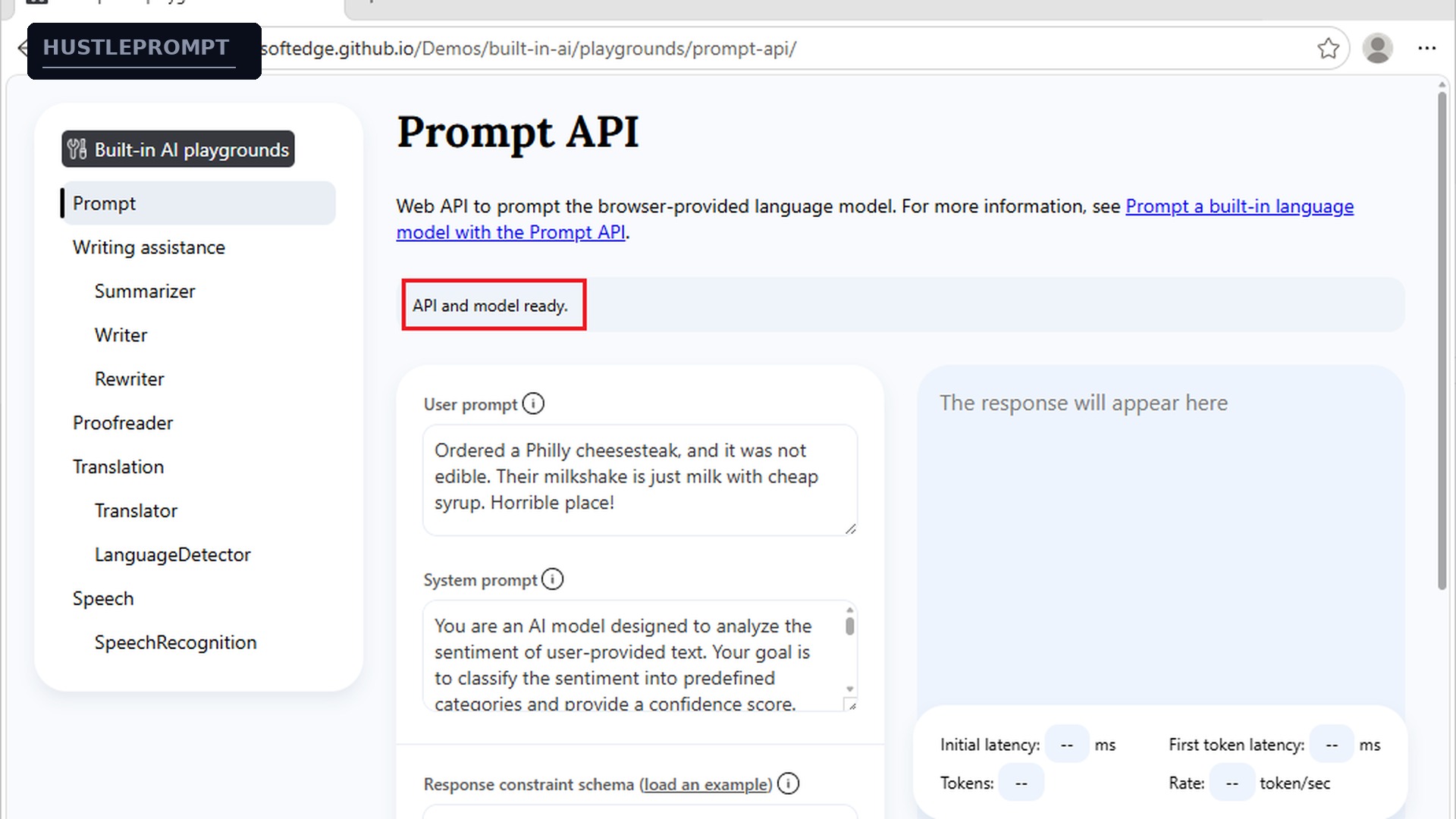
“API and model ready” once the download finishes. Screenshot: Microsoft Learn.
The Limits to Know Before You Build
The hardware bar is real, and the API is still experimental.
- Hardware: Windows 10/11, macOS 13.3+, or 64-bit Linux with Vulkan drivers and Edge 159+. At least 20 GB free storage — below 5 GB, Edge deletes the model. GPU needs 3 GB of VRAM; no download over a metered connection.
- Local testing: Edge 158+, enable the Prompt API flag in edge://flags, and check the device performance class at edge://on-device-internals — it must be Medium or higher.
- Small-model limits: Aion can miss details, state things wrong, and struggle with complex multi-step reasoning. Validate outputs before they reach users, especially for anything high-stakes.
- Watermarking: Aion adds invisible watermarking to fulfill text provenance requirements in some regions. Developers must account for the AI-generated content watermark.
- Experimental status: The Prompt API is a developer preview and the Decisions API is explicitly experimental. Both can change.
What to Watch Next
The bigger rollout is Windows:
- December 4, 2026: Aion 1.0 Instruct is planned to begin rolling out to Windows Insider Preview devices, via the Beta External build.
- January 2027: retail rollout is planned, completing the transition from Phi Silica, with the optimized version and a local moderation model by end of January.
- GPU expansion: Aion is coming to supported GPUs, including Nvidia RTX-series and AMD RDNA4 cards.
- Ignite 2026: session THR888, “Build On-Device AI Experiences w/ Windows AI APIs,” with a recording to follow.
Microsoft is also dropping the LAF token requirement. The window is now: the origin trial is open, the model is free.
Frequently Asked Questions
What is Microsoft Aion Instruct?
Aion Instruct is Microsoft’s 2.3-billion-parameter open-weights small language model, built for on-device AI. It is the built-in model in Microsoft Edge — replacing Phi-4-mini — and is becoming the Windows OS small language model, replacing Phi Silica. It is released under the MIT license on Hugging Face.
Is Aion Instruct really free to use?
Yes, for the on-device use Microsoft describes. There is no per-token charge: the Prompt API runs the model on the user’s own device, and Microsoft’s documentation states plainly, “There’s no cost associated with using a cloud AI service.” The only costs are the one-time model download and the device hardware to run it.
How do I try the Prompt API on my own site?
Register for the Prompt API origin trial, which lets visitors on regular Microsoft Edge run your on-device AI features on your live site. For local testing, use Edge 158 or later, enable the Prompt API flag in edge://flags, and check that your device performance class is Medium or higher at edge://on-device-internals. Microsoft also offers a public Prompt API playground to try it without writing code.
What hardware do I need to run Aion Instruct?
For the Prompt API developer preview: Windows 10 or 11, macOS 13.3 or later, or 64-bit Linux with Vulkan GPU drivers and Edge 159 or later. You need at least 20 GB of free storage on the Edge profile volume, a GPU with 3 GB of VRAM or more, and an unmetered connection for the first download. If free storage drops below 5 GB, Edge deletes the model.
What is the Decisions API?
It is an experimental API in Edge Canary and Dev that asks yes/no, multiple-choice, or scoring questions about text and returns probabilities and a confidence value in a single pass — without generating any text. Example uses: detecting user intent, sorting and routing user-generated content, and scoring and ranking items in real time. Microsoft warns the API and its implementation may change.
When does Aion come to Windows?
Aion 1.0 Instruct is planned to begin rolling out to Windows Insider Preview devices on December 4, 2026, with rollout to retail devices planned for January 2027, completing the transition from Phi Silica. A further optimized version, paired with a local content moderation model, becomes the Windows OS model by the end of January 2027. Microsoft is also expanding Aion to supported GPUs, including Nvidia RTX-series and AMD RDNA4 cards.
What are Aion’s limits?
It is a 2.3B-parameter model, so it can miss fine details, make factual mistakes, and struggle with complex multi-step reasoning, per Microsoft’s own model card. It may also be susceptible to adversarial attacks. The Prompt API is a developer preview and the Decisions API is experimental, so both can change. And it only runs on devices that meet the hardware bar — a GPU with at least 3 GB of VRAM and 20 GB of free storage.