
Most AI bills charge you for thinking out loud. This one charges you for deciding.
Milliseconds.ai is a new automated API platform that launched on October 25, 2026, built for one narrow job: take text, images, or audio in, and return a structured decision your app can act on.
No paragraphs. No pleasantries. Just labels, fields, and answers, at a vendor-listed price of $0.04 per million input tokens.
What Milliseconds.ai Actually Is
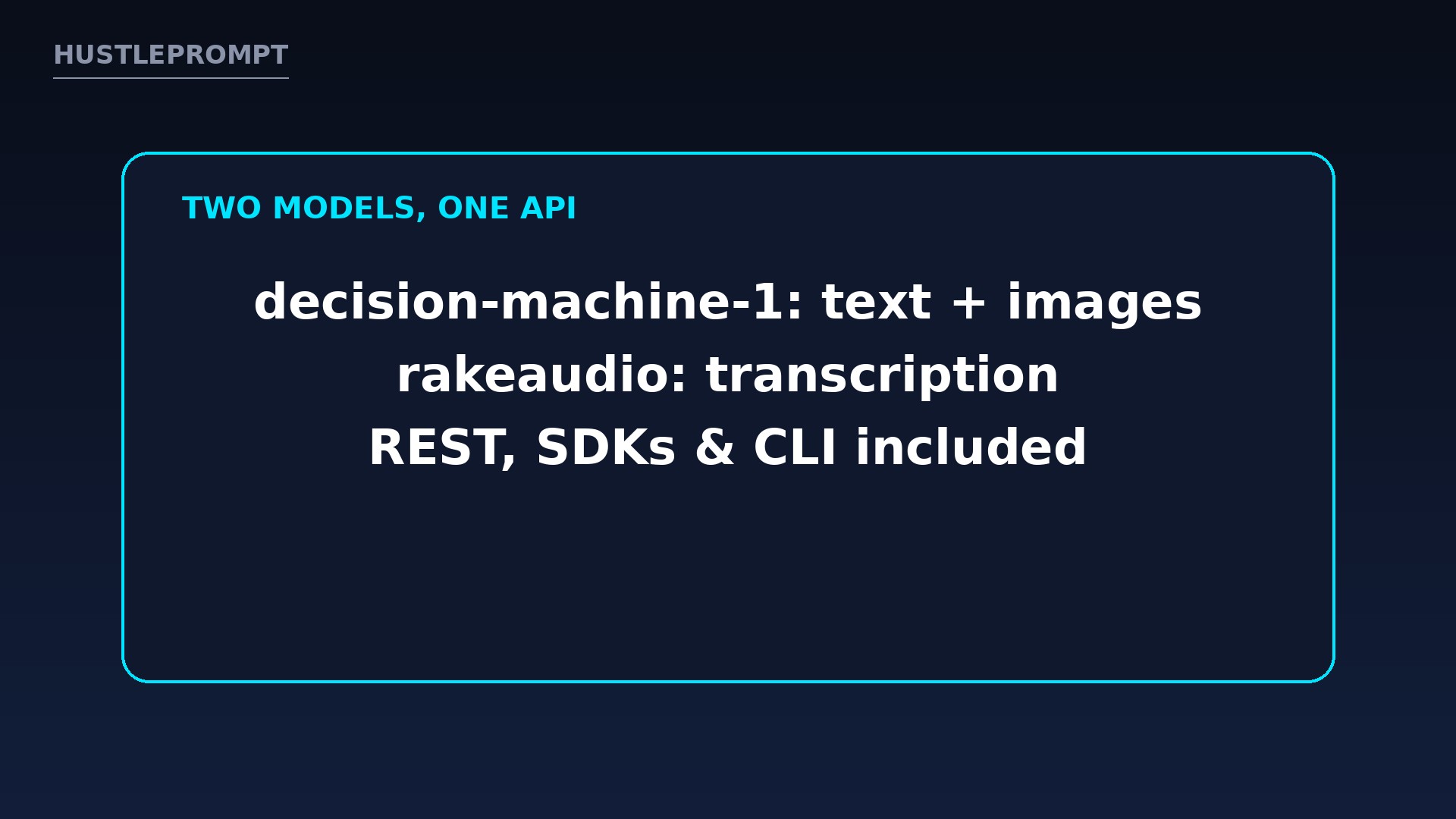
The platform runs two models behind one API. The first, decision-machine-1, handles text and images. The second, rakeaudio, handles transcription.
Decision-machine-1 does not generate prose. It classifies text, picks labels, walks a label tree, rates content, extracts fields, finds entities, and verifies values against a source.
That distinction is the whole product. When your app only needs a yes, a category, or a field, a full chatbot response is wasted money and wasted time.
The Evidence: Official Pricing and Timing
| Item | Detail | Official figure |
|---|---|---|
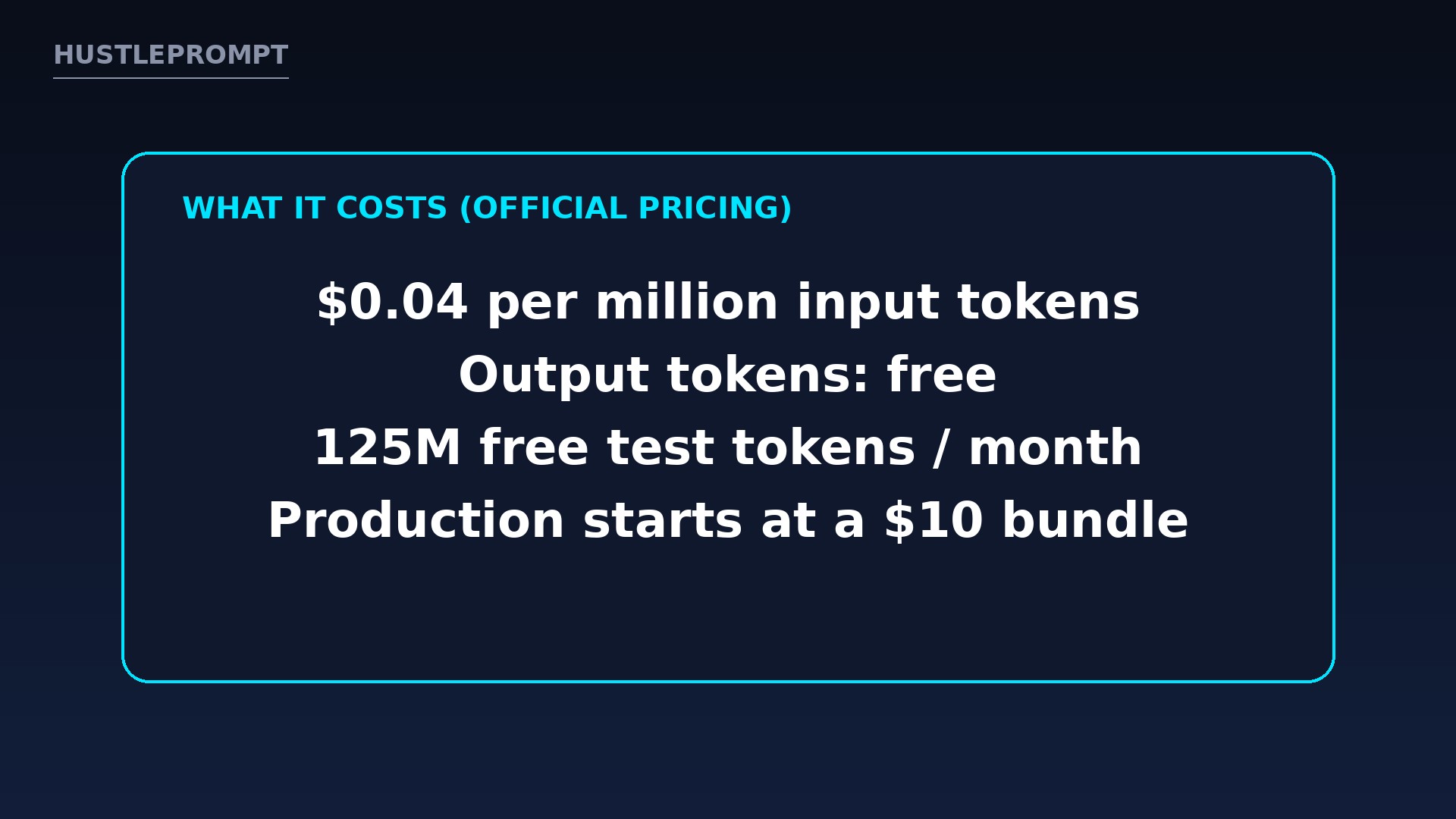
| decision-machine-1 | Text and images | $0.04 per million input tokens; output free |
| rakeaudio | Transcription | $0.12 per audio hour with speakers; $0.10 without |
| Test keys | 125 million free input tokens per month | 30 requests per minute; 500,000 input tokens per minute |
| Production entry | Credit bundle of at least $10 | 1,000 requests per minute; 1 million input tokens per minute |
| Decision timing | About 90 ms per decision | Answer: 0.3–0.9 s; extract: 2.5–3.5 s at medium image detail |
| Usage headers | x-input-chars and x-input-tokens | Every response reports the input actually billed |
Token counting is unusually transparent. For decision-machine-1, one token equals 3.8 characters of the compact JSON request body, rounded up once per request. Images bill a fixed token count by detail level instead: 1,000 tokens at low, 2,000 at medium, and 4,000 at high detail.
Do the math on that. A request body of about 1,900 characters counts as roughly 500 tokens, so ten thousand such requests would be about 5 million tokens, or about $0.20 at the listed rate. Real bills depend on the full request body.
The Milliseconds.ai Decision Flow
One API call carries the input plus the labels, questions, or schema you want answered.
decision-machine-1 returns labels, fields, or a decision; rakeaudio returns a transcript.
Headers report x-input-chars and x-input-tokens, so you can reconcile every call.
Route the ticket, approve the return, file the invoice field, or flag the value for review.
How It Works, Step by Step
- Start on a test key. Test keys need no card and include 125 million free input tokens per month, shared across the organization.
- Pick the capability. Classify, answer yes or no, rate, extract fields, find entities, or verify a value against source text.
- Send a small, strict request. Short, structured inputs keep token counts low, and the API validates arguments before spending tokens.
- Read the headers. Use x-input-tokens to reconcile usage against the console instead of guessing from request counts.
- Move to production when volume justifies it. Production starts with a credit bundle of at least $10, and higher lifetime spend unlocks higher rate limits.
How Freelancers and Small Businesses Can Profit
Decision APIs make money in the boring middle of a business: triage, routing, and data entry.
- Offer inbox triage as a service. Route support mail by intent, flag refund requests, and surface buying signals for a monthly fee.
- Sell invoice and receipt extraction. Small firms still retype paperwork by hand, and a field-extraction workflow built on this API can be priced per document or per month.
- Add transcription to content services. Transcribe calls, interviews, and meetings with rakeaudio, then sell the transcript plus a structured summary as a package.
- Build guardrails for AI agents. Use cheap decisions to check an agent’s next action before it spends money or contacts a customer.
The pitch to clients is simple: the API cost is pennies per thousand decisions, so the service fee pays for judgment, setup, and reliability, not tokens.
Route low-stakes calls automatically, and send high-stakes calls, like refunds and account closures, to a human.
What to Watch Before You Build on It
First, this is a new, small vendor that grew out of CloudRaker’s Paperwork API. Test failure modes before betting a client workflow on it.
Second, the free allowance is shared. All test keys in an organization share the same 125 million monthly tokens, and test requests pause at 429 when the balance runs out.
Third, batch billing counts every item. A batch of 24 texts with 3 statements counts as 72 inference requests, per the vendor’s own pricing page, so batch size affects rate limits directly.
Frequently Asked Questions
What is Milliseconds.ai?
An automated API platform launched October 25, 2026, offering structured decisions on text and images via decision-machine-1 and transcription via rakeaudio.
How much does Milliseconds.ai cost?
$0.04 per million input tokens, with output tokens free. Production starts with a credit bundle of at least $10.
What is the free tier?
Test keys include 125 million free input tokens per month, with no card required, shared across the organization.
How fast is a decision?
About 90 ms for a decision, per the vendor, with answer calls at 0.3–0.9 seconds and extract calls at 2.5–3.5 seconds.
How are tokens counted?
For decision-machine-1, one token equals 3.8 characters of the compact JSON request body. Responses carry x-input-chars and x-input-tokens headers showing the billed amount.
Does it replace a chatbot?
No. It returns labels, fields, and decisions rather than prose, fitting routing, classification, extraction, and verification.
Keep Reading
Sources
- Milliseconds.ai official pricing page
- Milliseconds.ai official documentation: pricing
- Milliseconds.ai vendor launch post on Product Hunt
All figures in this article come from Milliseconds.ai’s own pricing page and documentation. Independent benchmarks were not available at publication time.