
Nemotron 3.5 Transcribe does in one pass what used to take a chain of tools. NVIDIA introduced the open-weight speech model on Wednesday, October 28, 2026, and it turns a recorded conversation into a transcript, speaker labels, a translation, and answers about the audio itself.
That last part is the shift. Most transcription pipelines still detect speech, write it down, label who spoke, and then summarize, According to NVIDIA’s official announcement, Transcribe folds those jobs into a single promptable model, steered with plain-language instructions.
What NVIDIA actually announced
The announcement came in NVIDIA’s RTX Spark update, published at 15:00 UTC on October 28, 2026, which is 16:00 in Madrid. It is not a rumor. NVIDIA says the model is available today on Hugging Face.
Introduced today: NVIDIA Nemotron 3.5 Transcribe, a new, open-weight speech model that turns recorded conversations into useful information, per NVIDIA’s official blog.
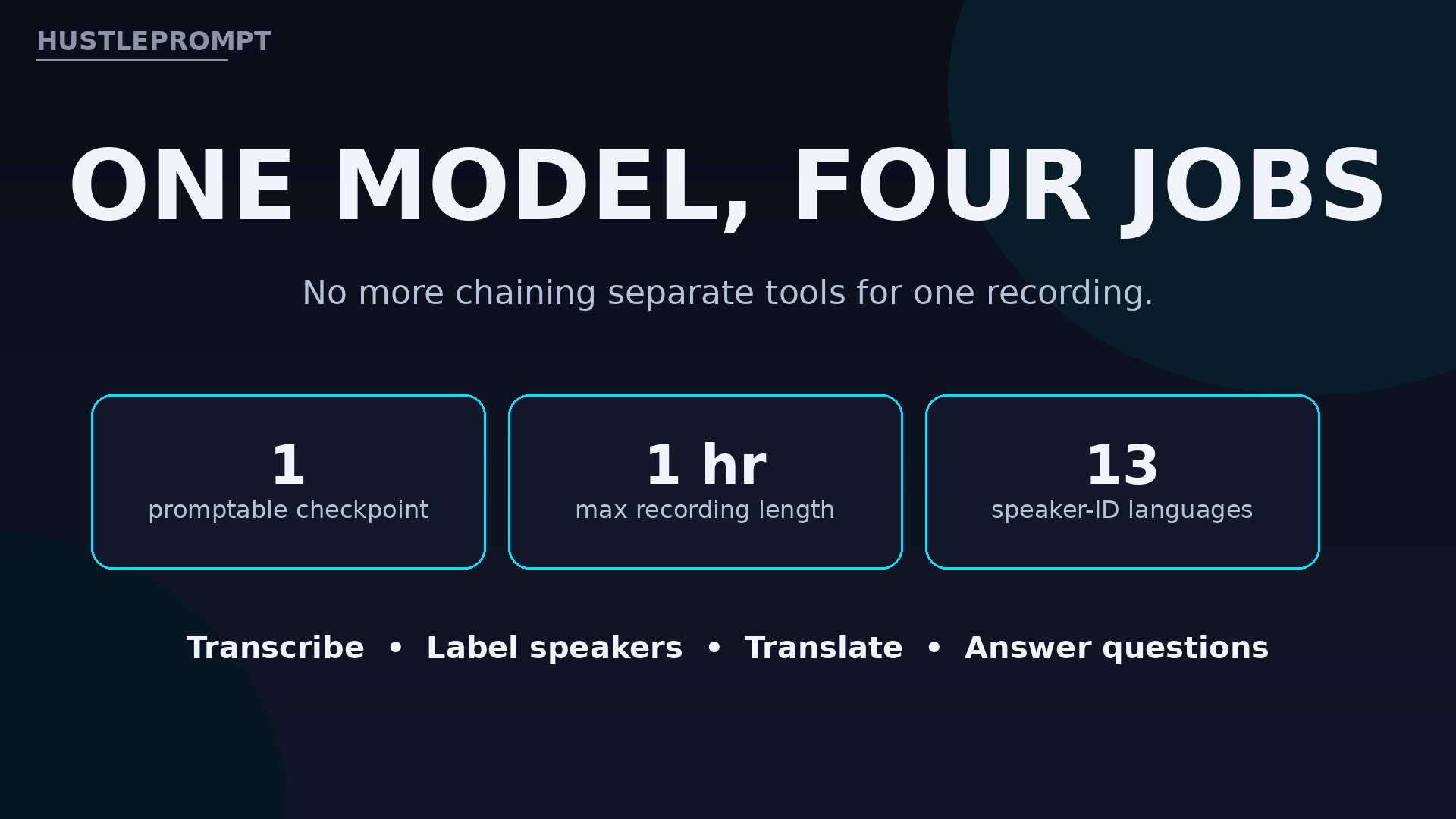
One model, four outputs: transcription, speaker labels, translation, and questions about the audio.
Coverage: 40 languages transcribed, including seven Indic languages, per NVIDIA.
Rankings cited by NVIDIA: No. 1 on the Hugging Face Open ASR leaderboard, and No. 2 among open-weight models on Artificial Analysis.
The numbers, with sources attached
| Spec | Figure | Source |
|---|---|---|
| Languages transcribed | 40, including seven Indic languages | NVIDIA blog |
| Translated to or from English | 31 languages | Launch coverage |
| Speakers labelled | Up to 8, across 13 languages | Launch coverage |
| Maximum recording length | Up to 1 hour | Launch coverage |
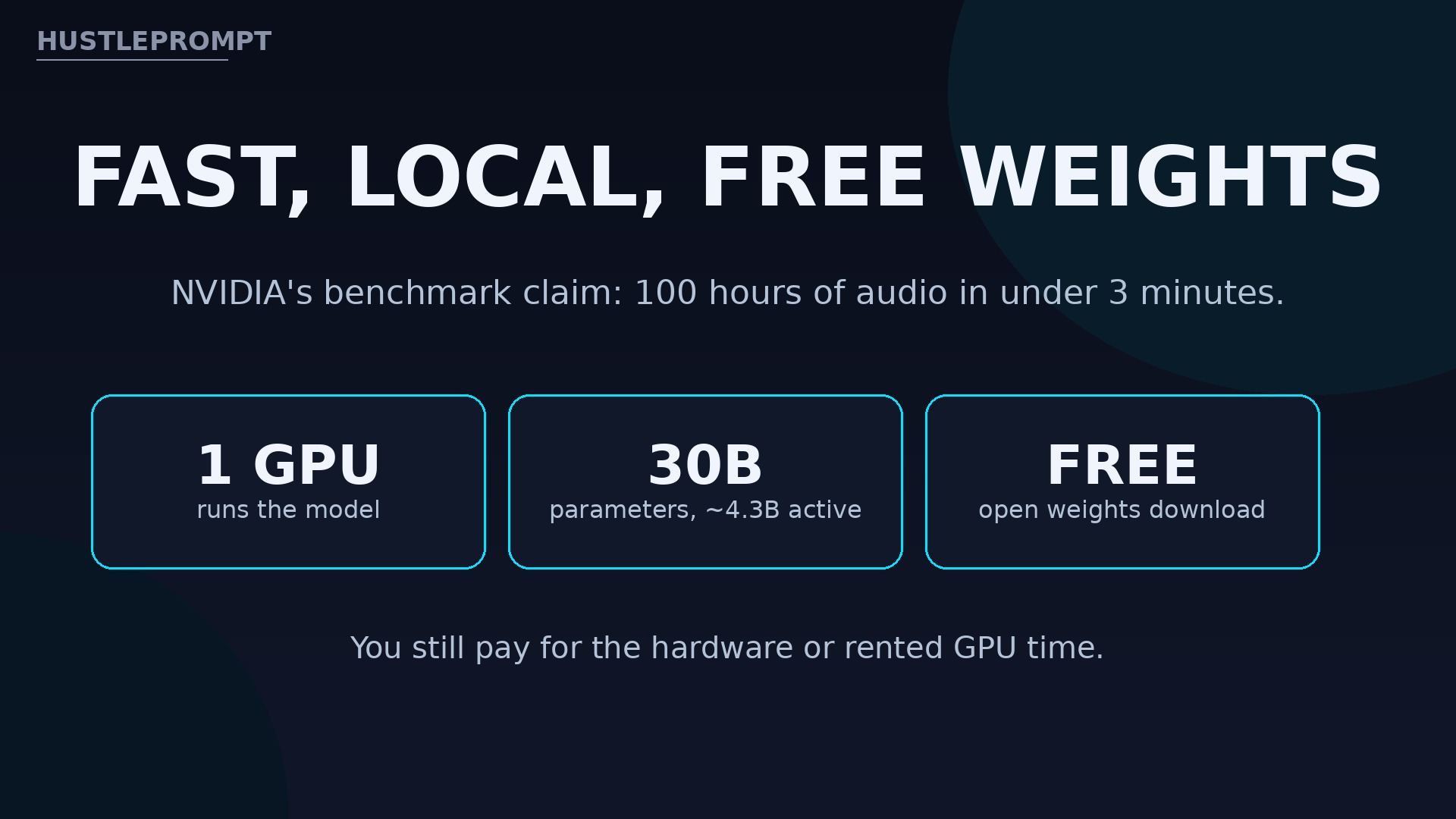
| Parameters | 30 billion total, about 4.3 billion active per token | NVIDIA / coverage |
| Formats on Hugging Face | BF16, FP8 and NVFP4 | NVIDIA blog |
The size trick is the point. A 30-billion-parameter model sounds like data-center hardware, but only about 4.3 billion parameters are active per token, according to NVIDIA. That sparse design is why the company says it runs on a single graphics processor.
How it works
Start with a recording, not a live stream. That is the model’s clearest limit: TechCrunch reports that Transcribe works with recorded audio, not livestreams, so it is not a live-captioning tool.
1. Feed it one recording. A meeting, an interview, or a call, up to an hour long.
2. Prompt it in plain language. NVIDIA’s examples: “Transcribe this recording and label each speaker,” “Translate this audio into English,” and “List what decisions were made in this meeting.”
3. Get a different output from the same audio. Change the prompt and the same checkpoint returns a verbatim transcript, a clean summary, or answers about the recording.
4. Teach it your vocabulary. Prompts can include product terms and formatting conventions, which NVIDIA says helps in healthcare, financial services, and customer service.
Where it runs, and what “free” really means
NVIDIA lists deployment on RTX Spark and DGX Spark systems, Jetson AGX Thor devices, and GeForce RTX 5090 graphics cards. The NVFP4 version can be deployed through NeMo-Speech.cpp or vLLM, per the official blog.
The weights are free to download, as TechCrunch’s launch report puts it, but free weights are not a free business. You still pay for the hardware or the rented GPU time, plus the work of building a product around the model.
Speed and accuracy claims, labelled honestly
NVIDIA’s speed claim, reported by launch coverage, is that one Blackwell server GPU processes 100 hours of audio in under three minutes. Treat that as a vendor benchmark, not a promise about your laptop.
On accuracy, coverage reports two different benchmark stories, and they measure different things. Artificial Analysis is reported to have tied Transcribe with Mistral’s Voxtral Small for first place among open-weight models at 2.8% AA-WER. Separately, SiliconANGLE reports company figures of 30.8% word error out of the box, dropping to 20.8% with careful prompting, and 11.8% when fine-tuned on an Indian medical speech benchmark. Do not compare those percentages directly: different tests, different conditions, and the second set is NVIDIA’s own.
How to profit from Nemotron 3.5 Transcribe
- Sell private meeting transcription. Offer firms transcription that never leaves their machine or cloud. Privacy is the pitch; open weights make it credible.
- Build a niche vocabulary pack. Fine-tune with Granary v2 on one industry, such as medical dictation, and charge for accuracy on names and terms generic tools mangle.
- Turn calls into deliverables. Sell the summary, decision list, and action items as the product, not just the transcript.
- Offer multilingual repurposing. From one interview, deliver a transcript, an English translation, and captioned clips. Three outputs, one package.
- Charge for deployment, not downloads. Install the model on a client’s GPU machine, wire it to their storage, and maintain it.
What it cannot do yet
- Live audio: built for recorded audio, not livestreams or real-time captions.
- Guaranteed accuracy: leaderboard rankings do not replace testing on your own recordings, accents, and noise.
- Free operation: weights are free to download, but hardware, power, and maintenance still cost money.
Frequently asked questions
What is NVIDIA Nemotron 3.5 Transcribe?
An open-weight speech model, introduced October 28, 2026, that transcribes recorded audio, labels speakers, translates, and answers questions about the audio in one promptable model.
How many languages does it support?
It transcribes 40 languages, including seven Indic languages, per NVIDIA, translates 31 to or from English, and labels speakers in 13 languages.
Is Nemotron 3.5 Transcribe free?
The weights are free to download from Hugging Face. You still pay for the GPU hardware or rented GPU time needed to run it.
Can it transcribe live audio?
No. It is built for recorded audio, not livestreams, so it is not a live-captioning tool.
What hardware does it need?
NVIDIA says it runs on a single GPU, from Jetson AGX Thor and DGX Spark systems to Blackwell cards and GeForce RTX 5090 cards, with NVFP4 deployment via NeMo-Speech.cpp or vLLM.
How accurate is it?
NVIDIA cites No. 1 on Hugging Face Open ASR and No. 2 among open-weight models on Artificial Analysis.