
For years, OpenAI and Google were the two names most often set against each other in the AI race. On October 21, 2026, they became business partners: OpenAI’s frontier models and its Codex coding agent are coming to Google Cloud’s Model Garden — putting OpenAI’s technology on all three of the largest U.S. cloud platforms for the first time.
The deal is as much about procurement as models: Google Cloud customers will buy GPT-6 models through the Marketplace, pay on a single invoice, and spend cloud commitments they already have. That opens a consulting market overnight.
What Was Actually Announced
Both companies published matching announcements on October 21: OpenAI’s OpenAI models are coming to Google Cloud and Google’s matching post, which calls it an expansion of its “foundation of openness and choice.”
- Which models: GPT-6 Astra, GPT-6.1 Sol, GPT-6 Luna — private preview now for select enterprise customers; GA “in the coming weeks.”
- How you pay: Google Cloud Marketplace, single invoice, draw down existing spend commitments; counts toward Flexible Savings Plans.
- Codex included: local Codex CLI and Desktop can connect to Google’s Gemini platform for inference starting today; Antigravity and Gemini Agent are “coming soon.”
- Microsoft: “Microsoft remains OpenAI’s primary cloud partner.” Expansion, not a breakup.
OpenAI president Greg Brockman: “an important step in making our most capable models and Codex available where customers are already building.” Google Cloud CEO Thomas Kurian: “focused on giving customers a broad selection of models, including those from OpenAI.”
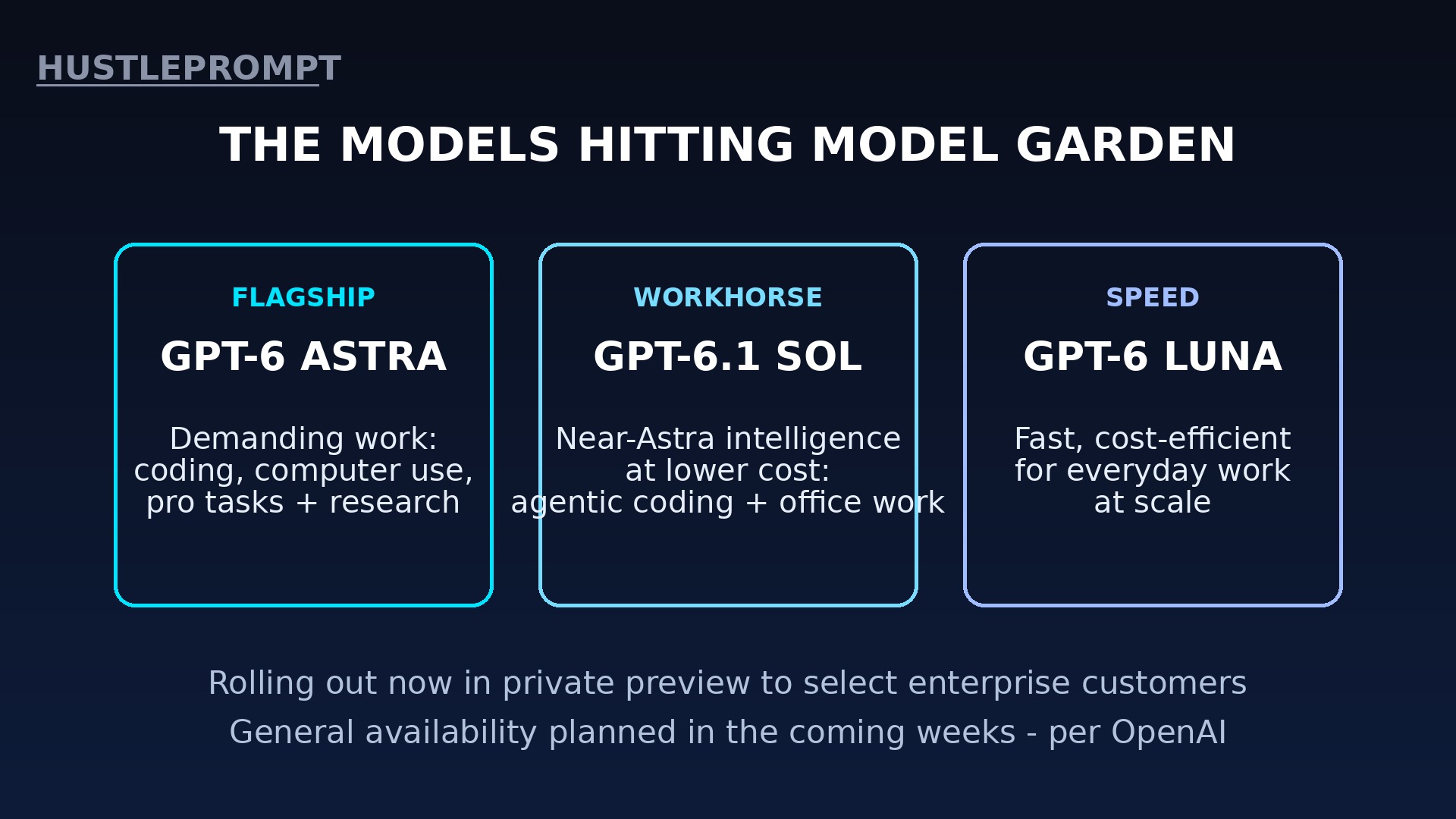
The Three Models Hitting Model Garden
Google’s official lineup for the preview:
| Model | What Google says it is for | Status |
|---|---|---|
| GPT-6 Astra | Demanding work across coding, computer use, professional tasks, and scientific research | Private preview |
| GPT-6.1 Sol | Near-Astra intelligence at lower cost for agentic coding and office work | Private preview |
| GPT-6 Luna | Fast, cost-efficient for everyday work at scale | Private preview |
One environment, every model, no new procurement paperwork: Google says customers can “dynamically select and swap the optimal model for any use case based on performance, latency, and cost efficiency.”
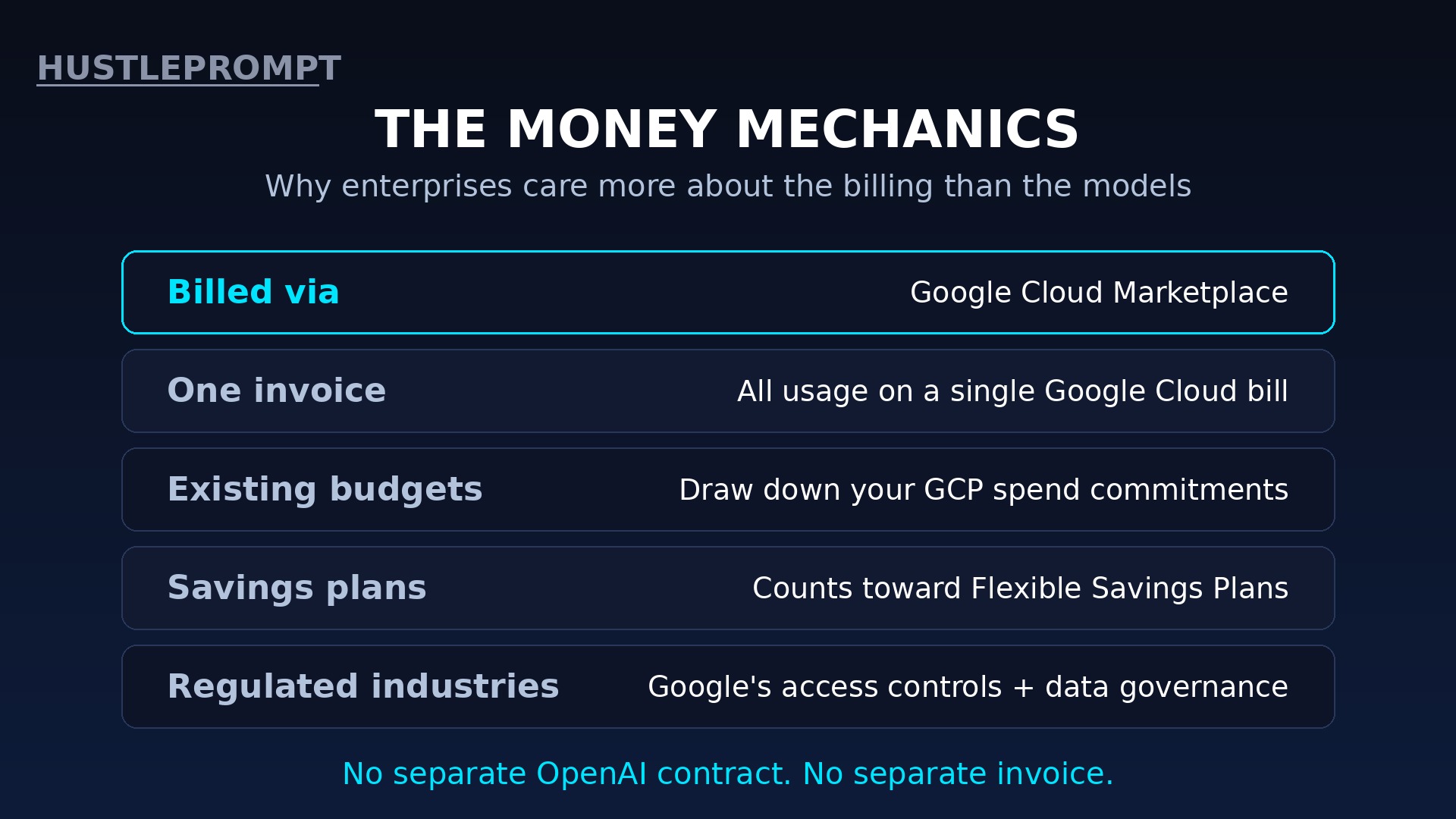
The Money Mechanics: Why the Billing Matters More Than the Models
Enterprise AI deals are won in procurement, not on leaderboards. Before this deal, buying OpenAI models meant a separate contract, a separate vendor review, and a separate invoice. What changes:
| Mechanic | What it means |
|---|---|
| Billed via Marketplace | All OpenAI usage on a single Google Cloud invoice — no separate OpenAI contract |
| Spend commitments | Enterprises draw down existing Google Cloud commitments for the purchases |
| Regulated industries | OpenAI models paired with Google’s access controls and centralized data governance |
The sentence that opens banks and hospitals as customers: “Customer prompts, context, and outputs remain entirely within your designated data perimeter and are never used to train foundation models,” with Zero Data Retention coming soon.
Why This Happened Now
Until April 2026, Microsoft held an exclusive license to OpenAI’s technology. When it ended, AWS started hosting OpenAI models the next day. Google Cloud now completes the set:
How OpenAI conquered all 3 U.S. clouds in 6 months
Microsoft holds an exclusive license to OpenAI’s technology. Azure is the only cloud route.
The exclusive license ends. Amazon Web Services starts hosting OpenAI models the next day.
Google Cloud completes the set: GPT-6 models + Codex land in Model Garden.
Microsoft remains OpenAI’s “primary cloud partner” — expansion, not divorce.
CNBC reported Google’s cloud growth hit about 82% in Q2, versus 37% at Amazon and 42% at Microsoft. Google calls itself “the only hyperscale cloud provider offering access to all three leading closed source LLMs” — Gemini, Claude, and GPT. For OpenAI, the context is money: reports say it is courting investors at a $1.4 trillion valuation ahead of a planned IPO, with $50 billion in annualized revenue.
How to Profit From the Model Garden Gold Rush
This creates billable work now, during the private preview and GA ramp. Key insight: your existing Google Cloud account becomes your OpenAI account, with compute billed against commitments clients already have.
- Model Garden migration consulting. Companies routing OpenAI calls through a direct contract need help moving spend into Model Garden. Charge $3,000–$10,000 per project — the work is identical across clients.
- Codex-on-GCP sprints. Connecting Codex CLI and Desktop to Google’s Gemini platform is brand new. Offer a fixed-scope 2-week sprint: stand up the pipeline, wire it into the repo, document it.
- A model-routing service. A/B-test GPT-6 Astra against Gemini 4 Argon and Claude on client tasks, then route each request to the cheapest model that passes quality. Monthly retainer; you keep the spread.
- Regulated-industry consulting. Google’s data-perimeter guarantees unlock banks, insurers, and healthcare-adjacent firms — at 2–3x standard rates.
- Join the private preview now — early experience is what you sell when demand peaks at GA.
What We Don’t Know Yet
- Pricing: neither announcement listed per-token prices on Google Cloud — watch for a Marketplace markup at GA.
- Exact dates: GA is “in the coming weeks”; Antigravity and Gemini for business are “coming soon.”
- Feature parity: unclear whether every feature of OpenAI’s own API works through Model Garden on day one.
- The revenue split: Google typically takes a Marketplace cut — neither company disclosed it.
Frequently Asked Questions
When will OpenAI models be available on Google Cloud?
GA is planned “in the coming weeks” (announced Oct 21, 2026). The three models are in private preview now — request access.
Which OpenAI models are coming to Google Cloud?
GPT-6 Astra (flagship), GPT-6.1 Sol (near-Astra smarts at lower cost), GPT-6 Luna (fast, cost-efficient) — plus Codex.
How do you pay for OpenAI models on Google Cloud?
Through Google Cloud Marketplace on a single invoice: draw down existing spend commitments; counts toward Flexible Savings Plans. No separate OpenAI contract.
Is this the end of the OpenAI–Microsoft partnership?
No — “Microsoft remains OpenAI’s primary cloud partner.” The exclusive license ended in April 2026; OpenAI expanded to AWS, now Google Cloud.
Can regulated industries use OpenAI models this way?
Yes — Google says prompts, context, and outputs stay within your data perimeter and never train models; Zero Data Retention is coming soon.
How can freelancers make money from this?
Fastest plays: migration consulting ($3,000–$10,000/project), Codex-on-GCP sprints, model-routing services, regulated-industry consulting. Join the private preview now.
Keep Reading
Sources: OpenAI models are coming to Google Cloud — official OpenAI blog (Oct 21, 2026) · Google Cloud brings OpenAI models to customers — official Google Cloud blog (Oct 21, 2026)