
What if busy podcasters paid you every week to do the job they dread most? That is the AI podcast editing service in one sentence: you turn a podcaster’s raw recording into a polished episode, plus show notes and short clips, using AI tools to move fast and your own ears to keep the result human.
Why Podcasters Will Pay for This
Podcasting is now a weekly habit for tens of millions of Americans, and every one of those shows needs editing.
Editing is also the bottleneck. A host can record for an hour, but cleaning up that hour, writing the show notes, and cutting clips can eat an entire evening. That repeatable pain is exactly what a service business can solve.
Evidence: podcasting keeps growing, and video is now part of it
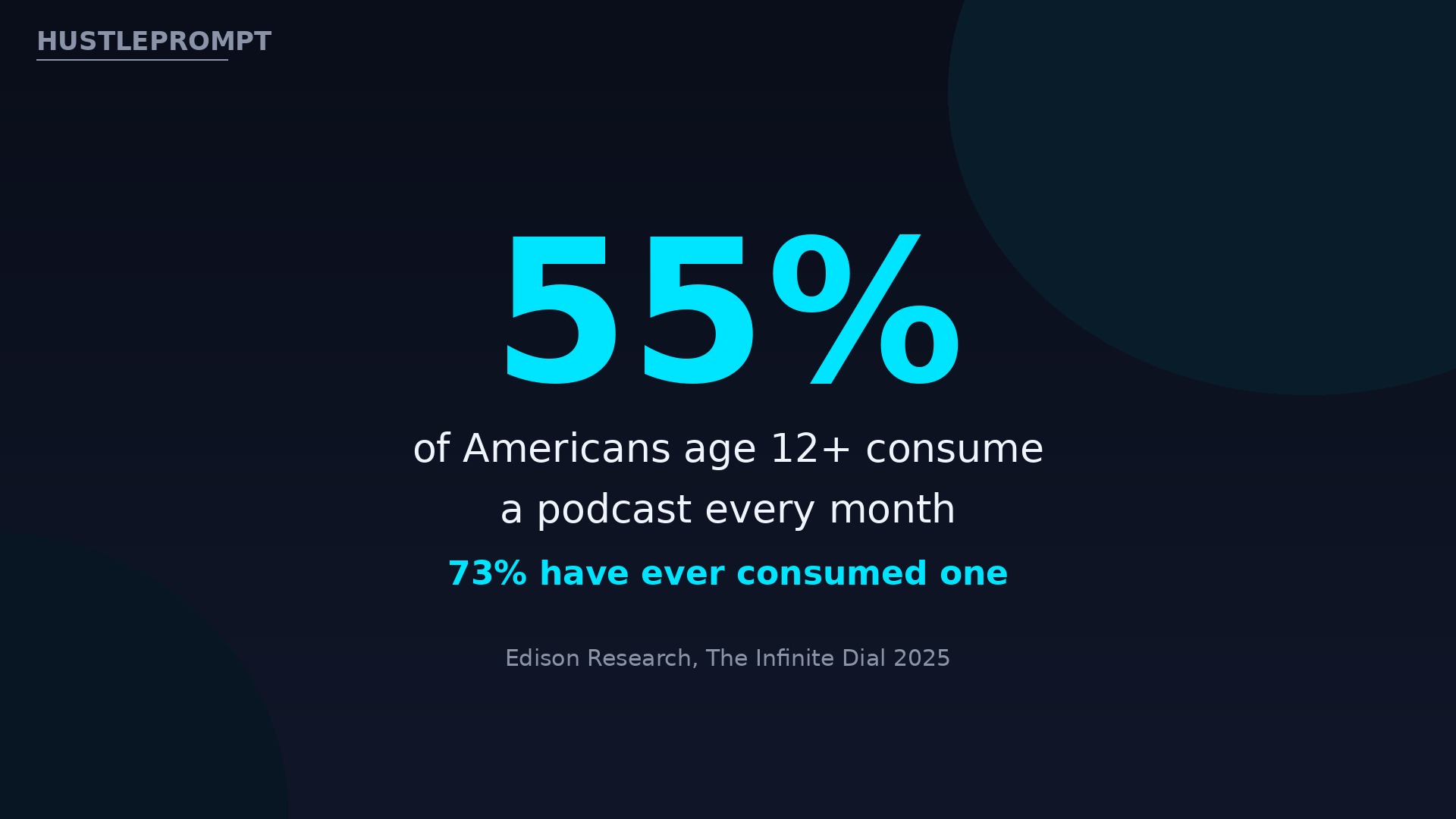
Edison Research’s Infinite Dial 2025 found that 55% of Americans age 12 and older now consume a podcast monthly, and 73% have ever consumed a podcast in audio or video form, an estimated 210 million people. Source: Edison Research, The Infinite Dial 2025.
The same study found that 51% of Americans age 12 and older have watched a podcast, and YouTube is the service U.S. weekly podcast listeners use most often, at 33%, ahead of Spotify at 26% and Apple Podcasts at 14%. Source: Edison Research, The Infinite Dial 2025.
What the Service Actually Includes
A standard episode package includes four deliverables.
- A polished audio episode: fillers, pauses, and mistakes removed, levels balanced, intro and outro added.
- Show notes with timestamps, key takeaways, guest links, and a short summary for the podcast host.
- Two to three short vertical clips with captions, cut from the strongest moments, ready for Reels, TikTok, and Shorts.
- A one-page delivery note: what you cut, and anything the host should fix next time.
Notice what is not on the list: recording, hosting, or promoting the show. You sell post-production, not the whole podcast. That boundary keeps your workload predictable and your price easy to defend.
The 6-Step Production Workflow
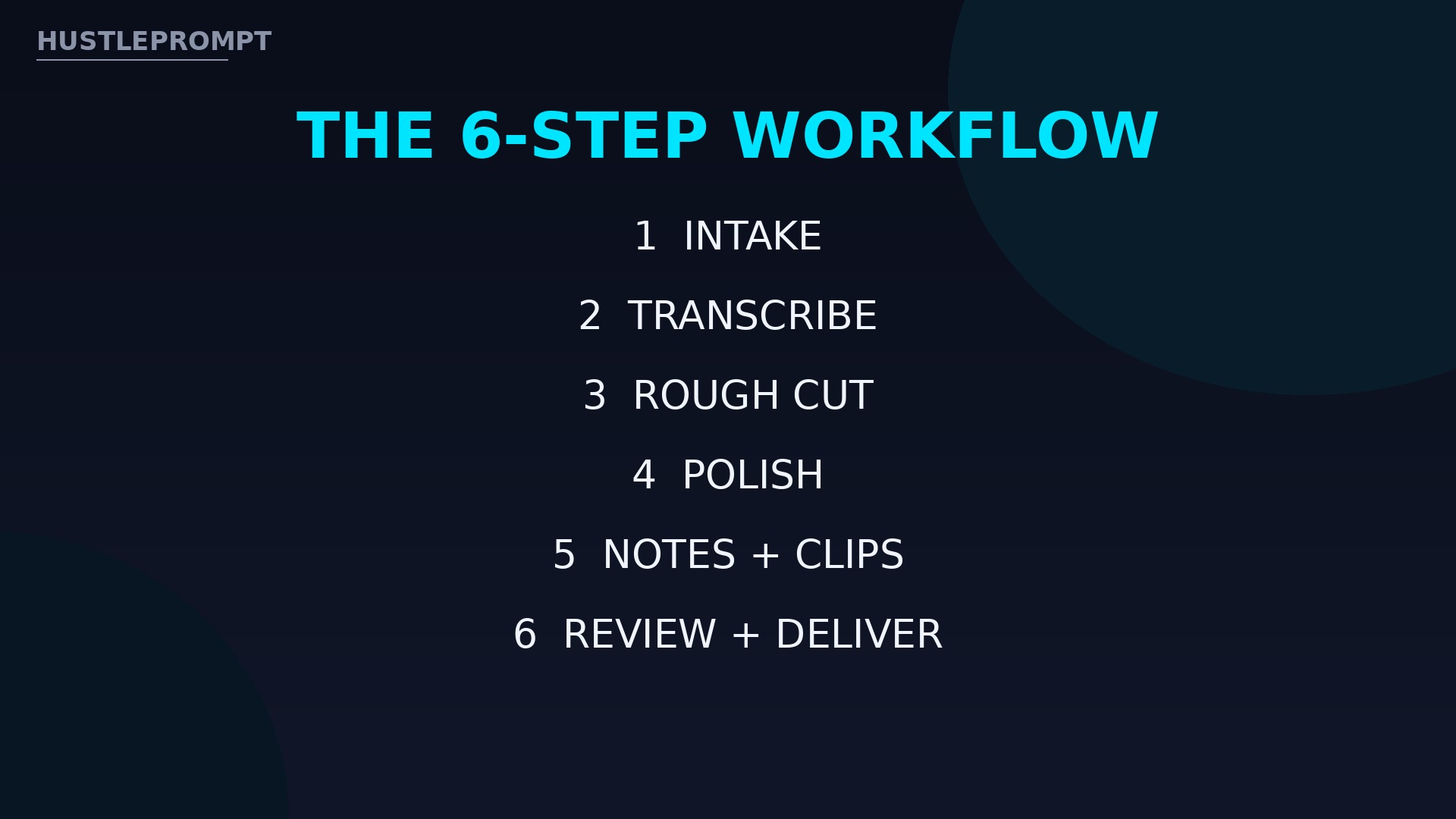
Every episode follows the same six steps, in the same order. Clients stay because the process feels reliable.
From raw recording to published episode
Host uploads audio or video plus episode notes.
AI transcript becomes your editing surface.
Delete mistakes by deleting text.
Clean audio, balance levels, add music.
Write notes, cut captioned clips.
Host approves, you export final files.
Step 1: Pick One Type of Podcaster
Start with one niche you can serve without faking expertise: business interviews, solo educational shows, or local community shows.
Every show has its own editing rules: true crime needs tension, business interviews need clean, quotable answers. Learn one rhythm, and your edits get faster.
Step 2: Build a Sample Episode Before You Pitch
Never pitch with an empty portfolio. Take a public-domain recording, or record a short mock interview with a friend, and produce a complete sample package.
Your sample should show all four deliverables: a 10-minute polished edit, one page of show notes, and one captioned clip. Send the clip first when you pitch.
Step 3: Choose Tools That Keep Costs Low
Descript is the most common starting point for this service: you edit audio and video by editing a transcript. Delete a sentence from the text, and the matching audio disappears.
Its AI features do the repetitive work: filler-word removal, gap shortening, and Studio Sound for cleaning up background noise and room echo. You still listen to the full episode, because AI cannot judge a joke, a pause for effect, or a sentence that only sounds wrong in context.
Evidence: Descript pricing, verified across independent reviews
Descript’s current plans, confirmed by multiple 2026 reviews of its official pricing page, are: Free $0, Hobbyist $16 billed annually ($24 monthly), Creator $24 billed annually ($35 monthly), and Business $50 billed annually ($65 monthly). Sources: Sonix Descript pricing review and Shade Descript pricing guide.
Watch the usage meters, not just the headline price. Paid plans are limited by media minutes and AI credits, and heavy months can push you into top-ups. Confirm at checkout: Descript restructured pricing in September 2025 and may change it again.
| Descript plan | Monthly price (billed monthly) | Monthly price (billed annually) | Media minutes |
|---|---|---|---|
| Free | $0 | $0 | 60 |
| Hobbyist | $24 | $16 | 600 (10 hours) |
| Creator | $35 | $24 | 1,800 (30 hours) |
| Business | $65 | $50 | 2,400 (40 hours) |
Prices are per editor seat and exclude taxes. For most solo editors, the Creator plan is the practical starting point: 30 hours of media covers several weekly shows. Start on the Free plan, and upgrade only when paying clients cover the cost.
Step 4: Write Show Notes That Actually Get Read
Show notes are not a transcript dump. A listener scanning them should grasp the episode in 30 seconds.
Use the same template for every episode, filled only from the transcript and the host’s notes.
- One-paragraph summary: what the episode is about and who it helps.
- Timestamps: five to eight chapter markers with short, specific labels.
- Key takeaways: three to five quotable points, checked against the transcript.
- Links: guest websites, books, and tools mentioned, each verified by clicking it.
- Call to action: the single next step the host wants.
Never invent a quote, a link, or a guest credential. If the transcript does not support it, leave it out and flag it for the host.
Step 5: Price It as a Retainer, Not by the Hour
Podcasters publish on a schedule, so price on a schedule. A monthly retainer per show is easier to sell and renew than hourly billing.
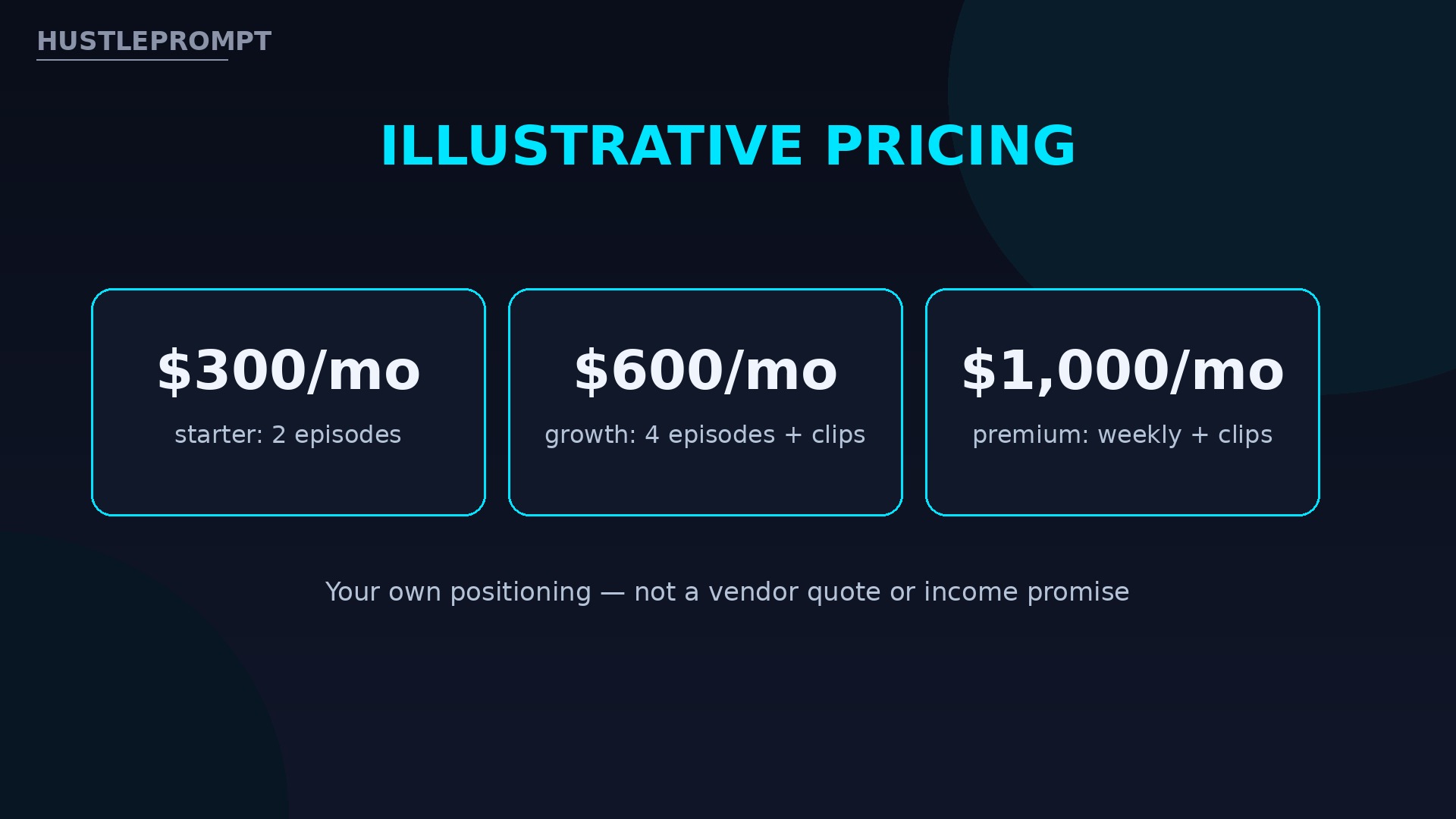
The packages below are positioning illustrations for your own service, not vendor quotes, market rates, or income promises. Set your price from your costs and what podcasters in your niche actually pay.
- Starter, $300 per month (illustrative): two audio-only episodes per month, edited, with basic show notes.
- Growth, $600 per month (illustrative): four episodes per month, audio plus video edit, full show notes, and two clips per episode.
- Premium, $1,000 per month (illustrative): weekly episodes, audio and video, show notes, three clips per episode, and a monthly performance summary.
Illustrative math only: three Growth clients at $600 per month equal $1,800 per month gross, before tool subscriptions, taxes, and time. That is arithmetic, not a promise. Shows pause, and some niches will not pay these rates.
Step 6: Pitch, Onboard, and Keep the Client
Find hosts where they already complain about editing: podcast communities, creator groups, and replies under editing tutorials.
A short pitch script you can adapt: “I edit interview podcasts in your niche. Here is a 60-second clip from a sample episode. If you like the pacing, send me one raw episode and I will return a polished edit, show notes, and clips on your schedule.”
Onboarding is one shared folder, one intake form, and one rule: the host uploads by an agreed day each week, and you deliver by an agreed day. Put turnaround time, revision rounds, and file formats in writing before the first paid episode.
Stay Honest About AI
Tell every client where AI helps and where you take over. AI transcribes, removes fillers, and drafts notes. You judge pacing, tone, and truth.
Never clone a host’s voice without explicit, written permission, and never use AI to invent a sentence the host did not say.
Watch the Video
Video: Step-By-Step Tutorial: Recording & Editing Your Podcast in Descript — Wit & Wire’s step-by-step Descript tutorial walks through recording, importing, transcript-based editing, filler removal, Studio Sound, and exporting — the exact workflow this podcast editing service delivers for clients. (Wit & Wire)
FAQ
How much can I charge for AI podcast editing?
There is no standard rate. The illustrative packages here run from $300 to $1,000 per month per show, depending on your speed, niche, and whether you deliver video and clips.
Do I need expensive software to start?
No. Descript’s Free plan and free tools like Audacity cover the basics. Upgrade once paying clients cover the subscription.
Can AI edit a whole episode unsupervised?
No. AI can transcribe, cut fillers, and draft notes, but it cannot judge pacing, humor, or whether a cut changes meaning. Every episode needs a full human listen before delivery.
How long does one episode take to edit?
After onboarding, a standard 45-minute episode often takes two to three hours end to end. Your first episodes will take longer, so do not quote a turnaround promise until you have delivered at least three in that niche.
Should I offer video editing too?
Yes, if your niche publishes video. With 51% of Americans having watched a podcast, video is a real upsell. Charge separately for it: multicam video edits take far longer than audio-only edits.
What if a host’s audio quality is terrible?
Be honest before you take the job. AI cleanup can reduce noise and echo, but it cannot rescue a recording made across a room on a phone speaker. Offer a short paid test edit first.