
Most real estate listings read like a tax form. An AI real estate listing description service fixes that problem for busy agents, turning a bare fact sheet into copy that books showings.
Agents know great copy matters. They just lack time to write it between showings and client calls.
That gap is your opening. You supply the words, the structure, and the compliance check. The agent supplies the facts and approves the final draft.
Note: this service is listing copywriting, not virtual staging. A previous HustlePrompt tutorial covered staging a home’s photos. This one sells the words that sit next to those photos.
Why Agents Will Pay for Listing Copy
Real estate is an agent-driven market. Agents handle most transactions, which means they are also the people drowning in listing work.
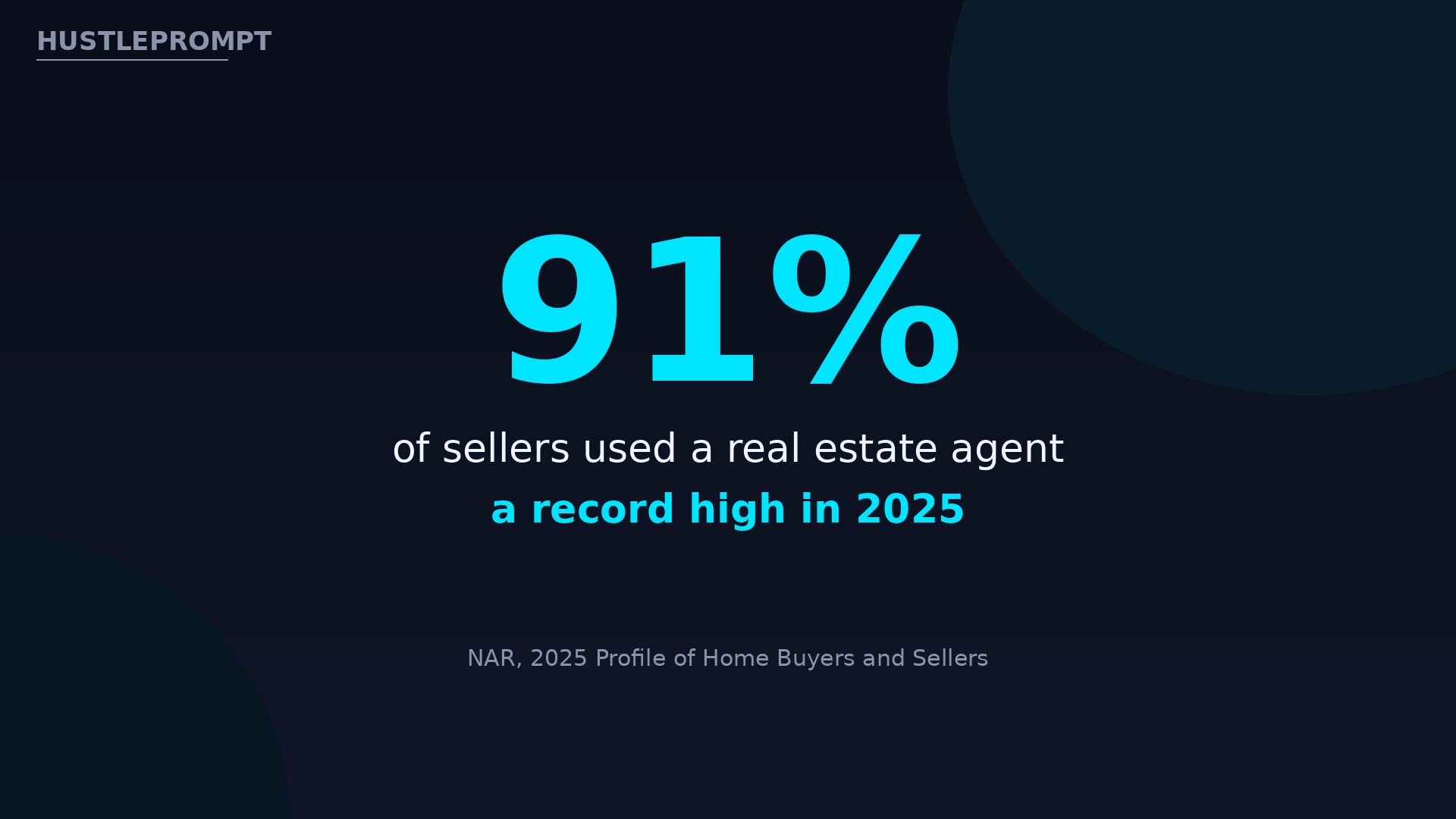
Evidence: agents dominate the market. In the National Association of Realtors’ 2025 Profile of Home Buyers and Sellers, 91% of sellers used an agent, matching a record high, while 88% of buyers bought through an agent. For-sale-by-owner sales fell to just 5%.
Agent-assisted homes also sold for more: a median of $425,000 versus $360,000 for for-sale-by-owner homes. Agents have the deal flow. What they lack is writing time.
Presentation quality moves buyers. That is the second half of your sales pitch.
Evidence: presentation pays. Redfin’s 2013 study found professionally photographed homes in the $400,000 range sold about three weeks faster and for over $10,000 relative to list price. Homes priced $200,000 to $1 million sold for $3,400 to $11,200 more relative to list price.
That study measured photography, not copywriting, and it is from 2013. Treat it as evidence that buyers reward strong presentation, not a promise that copy alone raises a sale price.
Source: Redfin, “Homes Photographed With High-Quality Real Estate Photography Sell for More Money”.
What You Actually Sell
Sell a finished, ready-to-paste listing package, not “AI access.”
Every package should include:
- A headline that leads with the property’s strongest verifiable feature
- A main description of 150 to 250 words, written room by room
- A short social-media caption version for Instagram, Facebook, and the MLS remarks field
- A bullet list of verified features: beds, baths, square footage, parking, and upgrades
- One fair-housing compliance pass before delivery (see below)
Offer three tiers so agents can start small and upgrade:
- Single listing: one description plus one caption
- Listing plus social pack: description, three caption variants, and open-house copy
- Monthly retainer: a set number of listings per month for high-volume agents and teams
Your AI Toolkit and What It Costs
You need one strong writing model, one editing pass, and a fact-check habit. Fancy software is optional.
Start with ChatGPT. The free tier is enough to test the workflow before you spend anything.
| ChatGPT plan | Price | Best for this service |
|---|---|---|
| Free | $0 | Testing prompts and writing your first samples |
| Go | $8/month | Light daily drafting with expanded limits |
| Plus | $20/month | Regular client work, the sensible default for most freelancers |
| Pro | $100 or $200/month | Heavy daily volume; only upgrade when Plus limits actually slow you down |
Prices change, so confirm at checkout before you quote tool costs to yourself or a client. Sources: Suprmind’s ChatGPT pricing compilation and Engadget’s report on the $100 Pro tier.
Your real quality control is human. Read every draft aloud and delete every claim you cannot verify.
The 6-Step Listing Production Workflow
Follow the same workflow for every listing. Consistency turns a side hustle into a retainer.
Collect the fact sheet, photos, and MLS remarks from the agent.
Pick one lead feature: light, layout, location, or renovation.
Generate a structured draft from verified facts only.
Cut hype, fix flow, verify every number and claim.
Remove any people- or neighborhood-based language.
Send copy, captions, and a one-line change log.
Step 1: Run a Tight Intake
Never write from photos alone. Ask for a one-page fact sheet first.
Your intake form should capture:
- Address, price, beds, baths, square footage, lot size, and year built
- Renovations with dates, plus what is original versus updated
- Parking, storage, heating and cooling, and HOA details if any
- Showing instructions
- Anything the agent explicitly wants left out
If a fact is missing, leave it out. Never guess.
Step 2: Choose One Angle
Every strong listing leads with one idea. Pick the angle from the facts: a sun-filled unit leads with light, a renovated kitchen with the renovation, a large lot with outdoor space.
Write your headline from that angle. Make the first sentence prove it with a specific detail, such as “south-facing windows” or “a 2024 kitchen remodel.”
Step 3: Draft With AI, Then Edit Like a Human
Feed the model only verified facts:
“Write a 200-word listing description from these verified facts only. Do not invent features, dates, or distances. Lead with [angle]. Use a room-by-room flow and end with a showing call to action. Facts: [paste fact sheet].”
Then do the work the model cannot do. Cut empty adjectives like “stunning” and “must-see,” replace vague claims with measurements, and ask: would I book a showing from this paragraph?

Fair-Housing Compliance: Describe Properties, Never People
A careless phrase can create legal trouble for the agent and for you.
The federal Fair Housing Act prohibits housing ads that indicate a preference, limitation, or discrimination based on a protected class: race, color, religion, sex, disability, familial status, and national origin.
The National Fair Housing Alliance rule is simple: describe the property and its amenities, not the person you imagine living there.
Delete phrases like these, even when they sound friendly:
- “Perfect for a young family” or “ideal for couples” (describes people, not the home)
- “No children” or “adults only” outside a lawful senior-housing context
- “Exclusive neighborhood” or any phrase that codes a neighborhood by its residents
- “Walking distance to the synagogue/church/mosque” (ties the home to a religion)
Safe replacements describe the home itself: “three bedrooms,” “ground-floor primary suite,” “fenced yard.” When in doubt, cut the line and ask the agent’s broker.
This is general information, not legal advice. State and local laws add protected classes in many places, so check the rules where each listing sits. Sources: National Fair Housing Alliance, Responsible Advertising and DoorLoop’s summary of HUD advertising guidelines.
Pricing, Outreach, and Your First Clients
Price per listing at first, then convert happy agents to retainers.
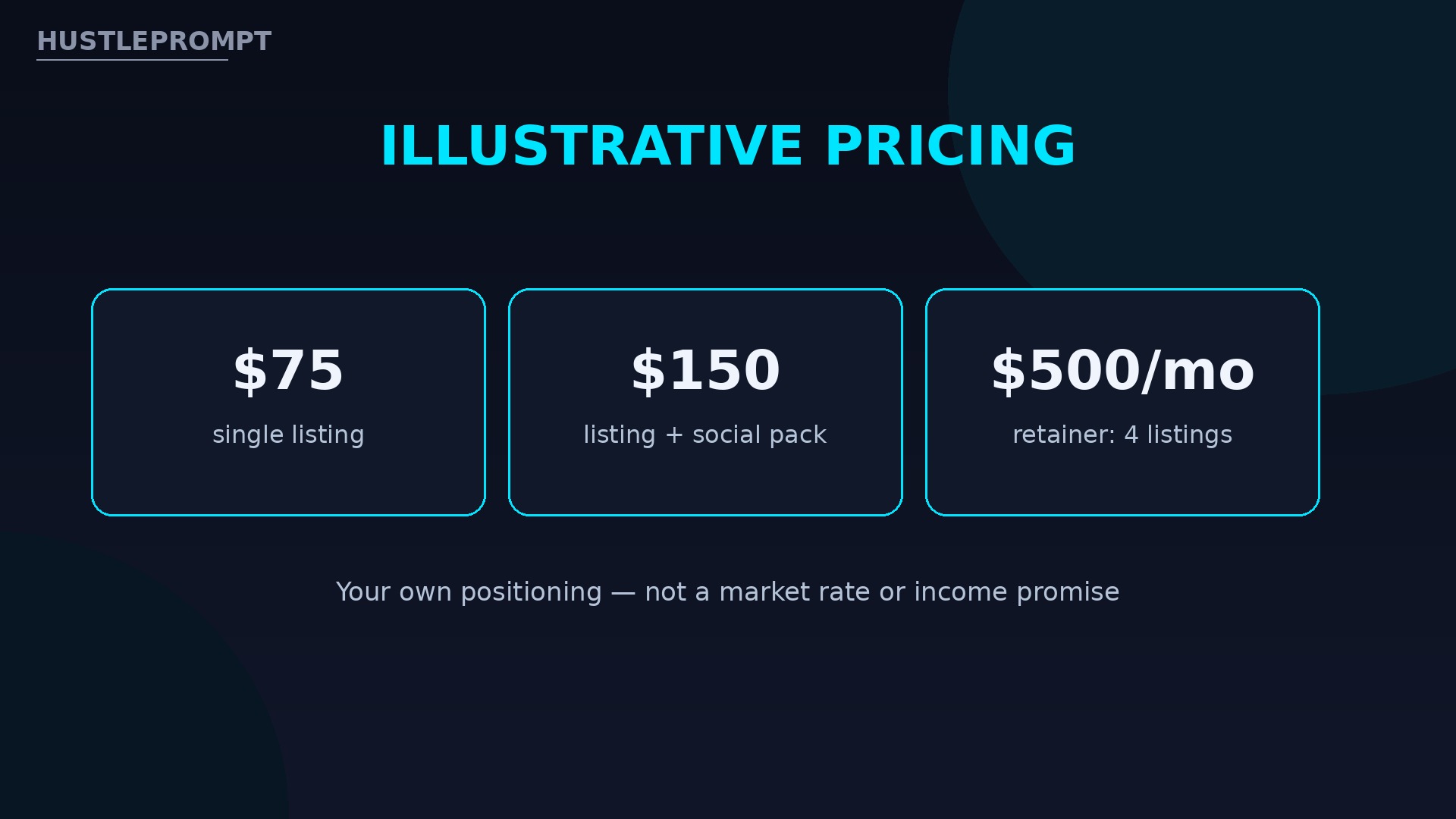
These are positioning illustrations for your own service, not income promises and not market rates:
- Single listing: $75, a low-friction trial price for a first agent
- Listing plus social pack: $150, your standard offer
- Monthly retainer: $500 for four listings, for agents who list every month
Illustrative math only: four retainer clients at $500 would gross $2,000 per month before tool costs and taxes. Real income depends on volume, quality, and market.
Find your first three clients with direct, specific outreach:
- Pick ten agents in one city who list regularly and whose current descriptions are thin or generic.
- Rewrite one of their live listings as a free sample, using only public facts, and send it with a short note.
- Offer the next listing at your trial price, with a 48-hour turnaround promise you can actually keep.
One rewritten sample beats ten cold pitches. Keep a simple portfolio of before-and-after pairs, with the agent’s permission, and never invent results.
FAQ
Do I need a real estate license to write listing descriptions?
No. You write marketing copy, not practice real estate. The licensed agent remains responsible for accuracy and compliance, so always route final approval through them.
How long should a listing description be?
Aim for 150 to 250 words, plus a short caption version. Portals truncate long text, so put the strongest feature and key facts in the first two sentences.
Can I use AI to write the whole listing?
You can draft with AI, but never deliver a raw AI draft. Verify every fact, cut invented details, and run the fair-housing pass yourself.
What if the agent gives me almost no facts?
Send your intake form back and ask for the missing fields. A short, accurate listing beats a long, invented one.
How do I handle a property with obvious flaws?
Do not hide them and do not advertise them. Focus on verified strengths and neutral language. Never mislead a buyer.
How fast should I deliver?
Promise 48 hours for a single listing. A missed deadline costs more than a slower promise.
Is this service different from virtual staging?
Yes. Virtual staging changes how a home looks in photos. This service changes the words buyers read beside them. Many agents buy both, so the two services refer work to each other.
Watch the Video
Watch Kyle Handy’s walkthrough of listing structure, storytelling, and the Fair Housing Act below.
Video: How To Write A Real Estate Listing Description That Shines — Kyle Handy’s tutorial on writing a real estate listing description that shines — structure, storytelling, and the Fair Housing Act, matching this service’s workflow and compliance pass. (Kyle Handy)