
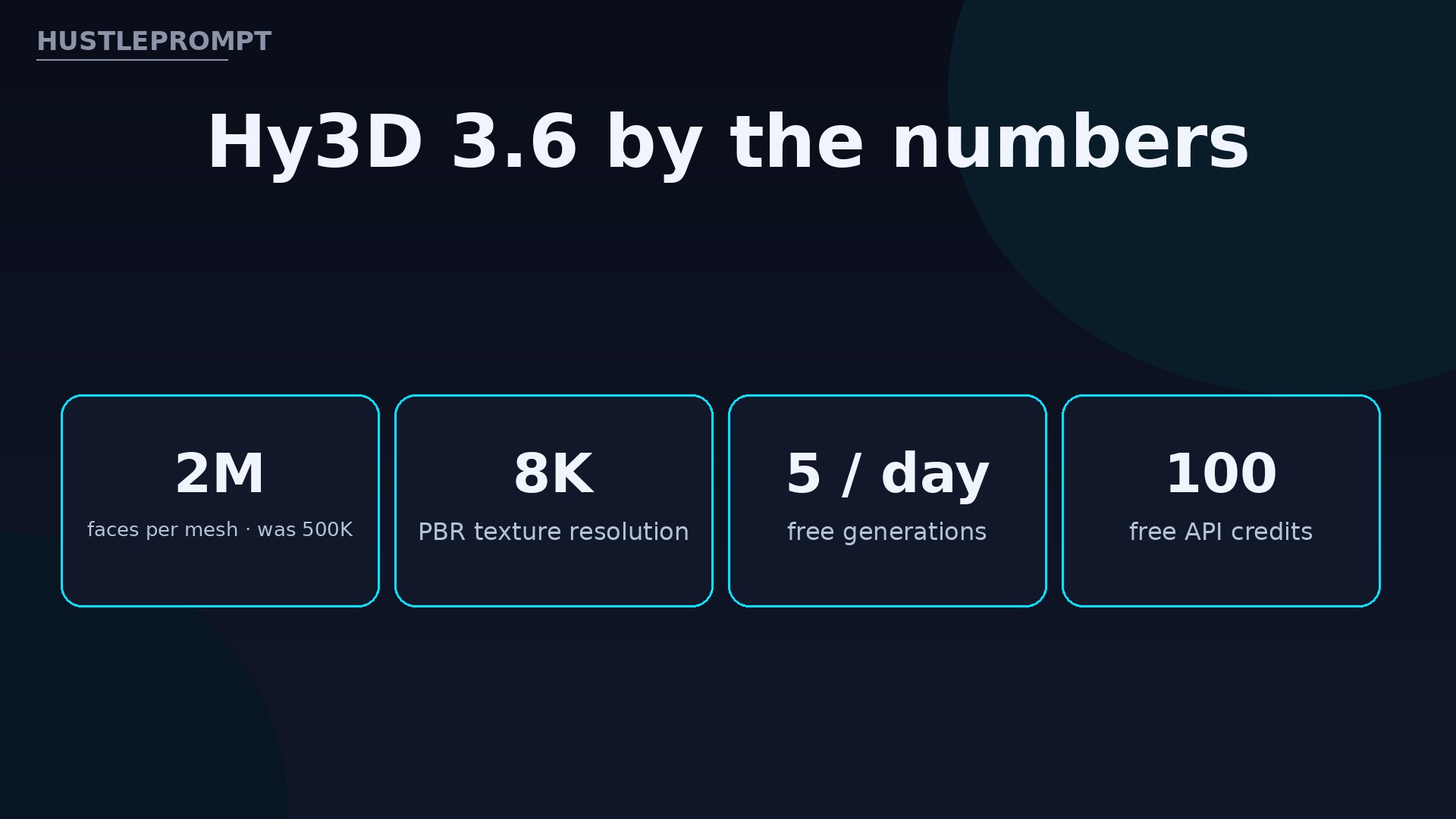
Tencent’s Hy3D 3.6 turns a text prompt into a film-ready 3D asset. Released November 27, 2026, the new model jumps to 2 million faces per mesh — four times the 500,000 of version 3.1 — with PBR textures up to 8K. It is live now through the Tencent Cloud Token Hub API, free to try at five generations a day.
The upgrade targets professional creators, not quick previews. Tencent says Hy3D 3.6 is built for game and film pipelines, where a mesh has to survive editing, rigging, and rendering — not just look good in a screenshot. The model is already inside three Tencent products: the Miora creative agent, the LAP game-asset platform, and the WorkRally filmmaking platform.
What makes Hy3D 3.6 different
Most text-to-3D tools assemble objects from code and basic shapes. Hy3D 3.6 is a native 3D model: it learns the geometry, textures, and material properties of 3D assets directly during training. The output is a native asset that can enter a professional workflow.
Under the hood, the model compresses geometry and texture into a shared sparse representation with a variational autoencoder, then generates both together with a diffusion transformer. Tencent adds supervised fine-tuning and preference optimization to tune outputs for professional creators.
The practical result is cleaner surfaces. Tencent says the model fixes the usual failures of AI modeling: uneven surfaces, blurred boundaries, and distorted details. It is built for characters, creatures, clothing, and complex props.
The evidence: 4x the faces, 8K textures
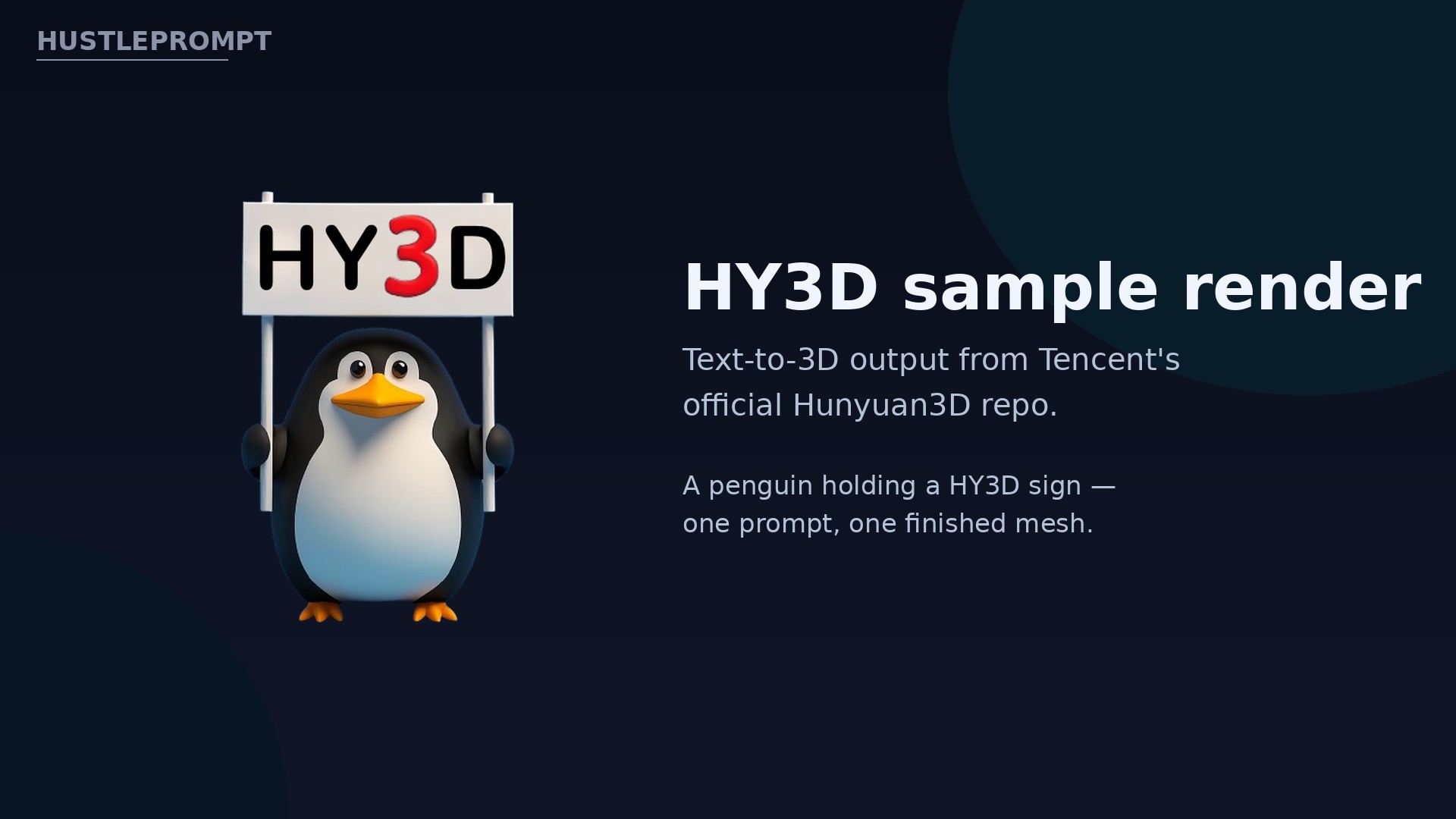
The evidence: what Tencent says the model is for.
“Hy3D 3.6 is particularly suited to generating characters, creatures, clothing and complex props from reference artwork, preserving silhouettes and curved surfaces while producing material maps for subsequent editing.”
— Tencent, via TechNode, November 27, 2026
Tencent also ran a blind test with hundreds of professional 3D artists and modelers. The company says Hy3D 3.6 outperformed comparable models on geometry quality, texture quality, and usability. The test was organized by Tencent, so treat it as a vendor claim, not an independent benchmark.
| Spec | Hy3D 3.6 | Hy3D 3.1 |
|---|---|---|
| Faces per mesh | Up to 2,000,000 | 500,000 |
| Texture resolution | Up to 8K PBR | Not disclosed |
| Input | Text or one image | Text or one image |
| Output formats | OBJ, GLB, FBX, STL, USDZ | Not disclosed |
| Free tier | 5 generations a day | Not disclosed |
Sources: TechNode. Try it at the Hunyuan 3D creation service.
How Hy3D 3.6 works
The pipeline has three stages, and the middle one is the advance:
TEXT TO 3D IN THREE STEPS
1. Prompt or picture in: type a description or upload one reference image.
2. One shared representation: a VAE compresses geometry and texture together, so shape and surface stay in sync.
3. Mesh plus materials out: a diffusion transformer generates both at once, then SFT and preference optimization polish the result.
Because shape and texture are generated together, the model holds curved surfaces and clean silhouettes instead of painting a texture onto a lumpy mesh.
What it costs
The free tier is real. The Hunyuan 3D creation service gives five free generations a day, and new API users get 100 free credits when they activate the Token Hub service. Tencent has not published per-asset list pricing beyond those free tiers, so check the Token Hub page for current rates before you build a business on it.
For comparison, the Hunyuan 3D series has passed 6.53 million community downloads across its open versions. Hy3D 3.6 itself ships as an API service, with no open weights announced.
How to profit from Hy3D 3.6
The model removes the hardest part of 3D work — the first mesh. The money is in finishing, packaging, and delivering it.
- Sell finished assets, not raw outputs. Generate the base mesh, clean it up, and list it on 3D marketplaces. Buyers pay for ready-to-use files, not prompts.
- Offer text-to-3D as a service. Indie game teams and filmmakers need props, creatures, and characters fast. Quote per asset and bill for the finishing work.
- Use the free five a day to build a portfolio. Five generations a day is 150 a month. Publish the best as samples, and let the portfolio sell the service.
- Print what you generate. STL export means a generated model can become a physical product: figurines, ornaments, prototypes. One prompt can end as a printed object on a shelf.
- Batch through the API for client work. When one client needs fifty props, the console is too slow. The Token Hub API turns the model into a production line.
Watch: Tencent Cloud’s MWC26 reel, including its HY 3D pitch for creators. Official Tencent Global video.
Frequently asked questions
What is Tencent Hy3D 3.6?
Hy3D 3.6 is Tencent Hunyuan’s latest native 3D generation model, released November 27, 2026. It turns text or one image into production-grade 3D assets with up to 2 million faces and 8K PBR textures.
How much does Hy3D 3.6 cost?
The Hunyuan 3D creation service gives five free generations a day, and new API users get 100 free credits. Tencent has not published per-asset list pricing beyond the free tiers.
Is Hy3D 3.6 open-source?
No. Tencent has not announced open weights for Hy3D 3.6. Earlier Hunyuan3D versions were open-sourced, and the series has passed 6.53 million community downloads.
What can I make with Hy3D 3.6?
Characters, creatures, clothing, and complex props for games and film. Outputs come in OBJ, GLB, FBX, STL, and USDZ, for standard 3D tools and 3D printers.
How is Hy3D 3.6 different from 3.1?
Four times the faces (2 million, up from 500,000) and textures up to 8K, with cleaner geometry and better material maps. Shape and texture are learned together, not separately.
Keep Reading