
AI agents were supposed to book your flights, move your money, and shop for you while you slept. This week, the internet answered: not on our site.
Yelp, Delta Air Lines, JPMorgan Chase, and Charles Schwab have all drawn hard lines against autonomous agents from OpenAI, Meta, xAI, and others — and users report more doors quietly closing. If you build with agents or sell through them, this is the week your assumptions changed.
Who just slammed the door
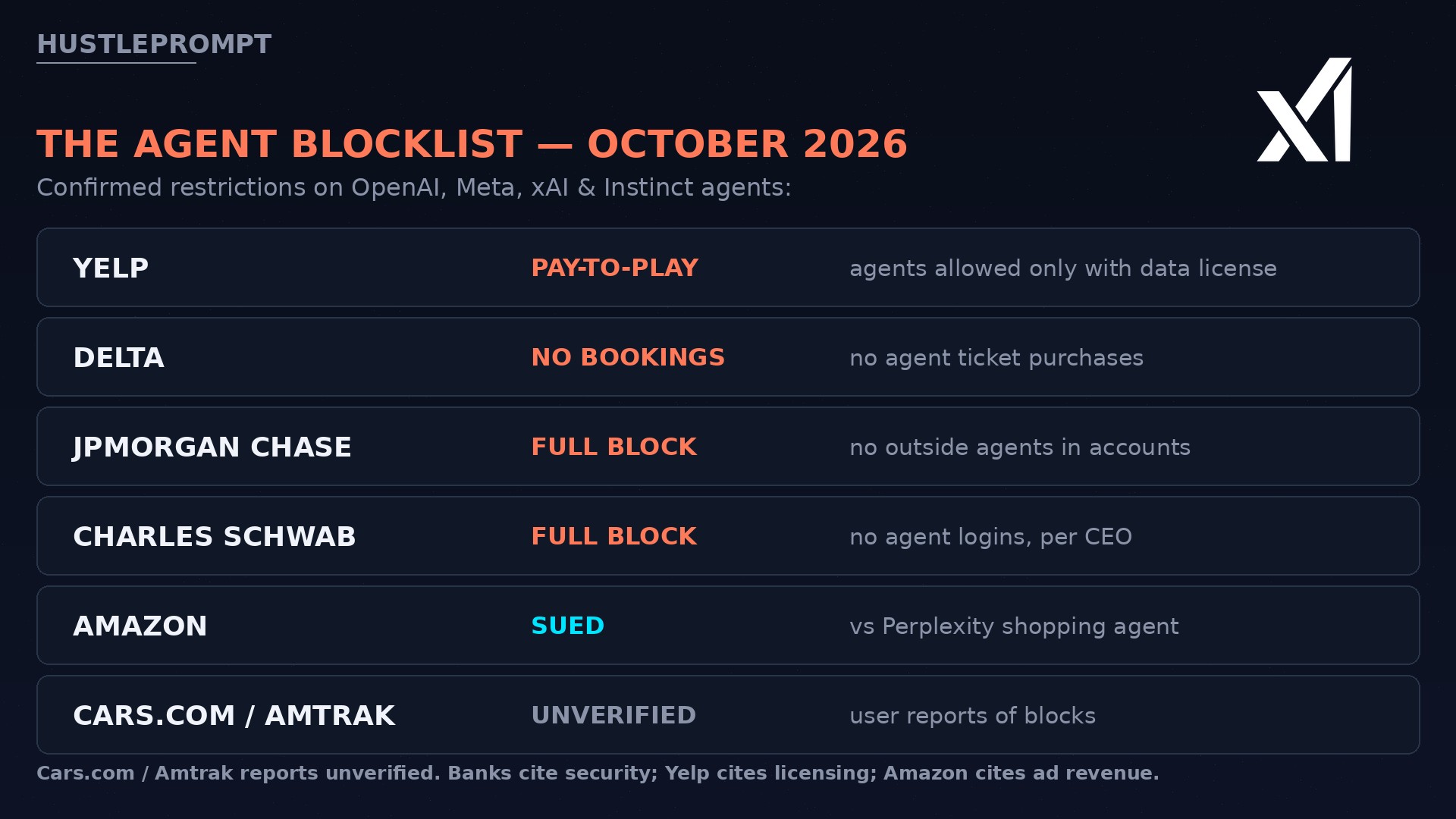
The restrictions, first rounded up by The Verge on October 17, 2026, fall into three camps: banks blocking for security, Yelp demanding payment, and Delta refusing ticket sales to bots.
| Company | What agents can’t do | Reason given |
|---|---|---|
| Yelp | Access reviews and listings | Only agents that pay for its data licensing program are allowed (via TechCrunch) |
| Delta Air Lines | Shop for or book flights | No “partnership or integration” with third-party agents; “continuing to evaluate” |
| JPMorgan Chase | Touch customer accounts | Too risky — CEO Jamie Dimon said so on the Oct. 13 earnings call |
| Charles Schwab | Log in as clients, move money | CEO: “We are not going to allow that” (Oct. 15 investor call) |
| Amazon | Agentic shopping (Perplexity) | Sued Perplexity; claims agents violate site policies; agents don’t look at ads |
The banks were the most blunt. Charles Schwab CEO Rick Wurster told investors on October 15: “There’s one way we think is not safe, and that’s just an agent coming to our site and trying to log in on behalf of a client. We are not going to allow that.“ Two days earlier, JPMorgan’s Jamie Dimon told the October 13 earnings call: “We’re not going to allow just any… outside agent to come in inside the company, because it’s just too risky.”
Users also report that Cars.com and Amtrak have gone dark for agents, though neither company has confirmed a deliberate policy.
Why they’re doing it: follow the money
Security is the stated reason, but the commercial logic is unmistakable — and it’s all about who gets paid when software shops.
- Ad revenue: Perplexity argues Amazon resists agents because agents don’t look at ads. Amazon sued Perplexity; an appeals court overturned an injunction in August, and Amazon filed an amended complaint.
- Data licensing: Yelp told TechCrunch it only allows agents that buy its data licensing program — the clearest paywall play.
- Deposit flight: The FT reports banks fear agents will move customer deposits to higher-yield accounts; Citigroup and Bank of America are also blocking.
The stakes are growing fast. A recent Wall Street Journal report, citing data from AI search firm BrightEdge, found:
| Agent-commerce signal | Number |
|---|---|
| Agent-driven purchases vs. April 2026 | Up ~4x |
| Monthly growth rate | +43% per month |
| E-commerce companies allowing agent transactions | Just 3% |
| Meta Muse retail partners | Walmart, Gap, Sephora, Expedia, Wayfair, Best Buy (per CNBC) |
Read that again: agent-driven purchases quadrupled while only 3% of merchants allow them. Demand is exploding against locked doors — which is exactly where the money is.
What still works: the permitted routes
Agents aren’t dead. The web isn’t going closed — it’s going gated. The pattern is simple: agents win where the store opened the door.
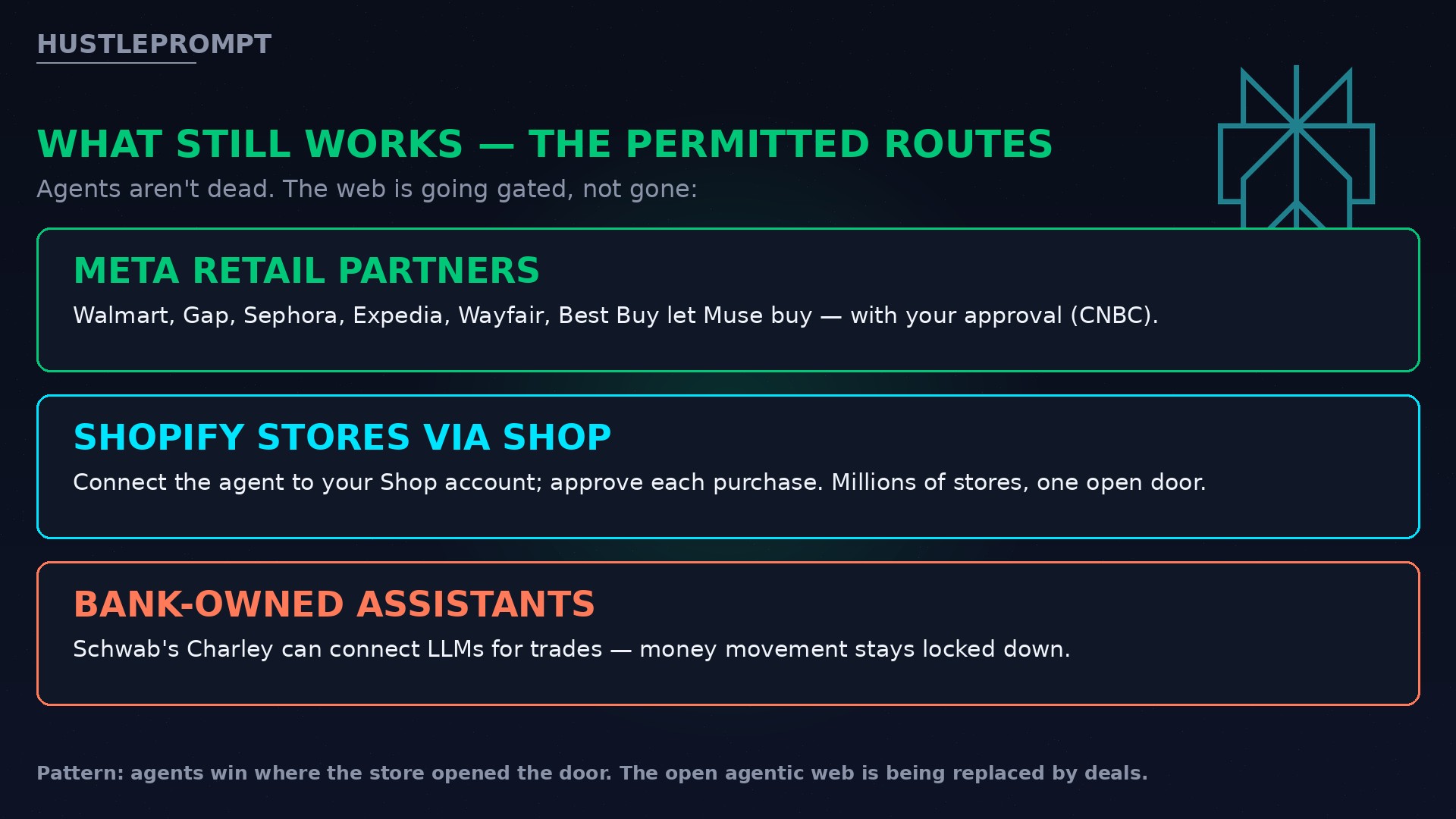
- Meta retail partners: Muse can purchase at Walmart, Gap, Sephora, Expedia, Wayfair, and Best Buy — it prepares the purchase and waits for your approval. Meta says it would “rather strike deals with businesses than fight them.”
- Shopify stores: Shopify opened its network of online stores to agents. Connect an agent to your Shop account and it can buy, with approval on each purchase by default.
- Bank-owned assistants: Schwab blocks outside agents but lets certain LLMs connect to place trades (money movement stays locked). Use the bank’s own assistant — Schwab’s Charley — instead of a general agent.
Meta’s position: turning away a personal agent “means turning away the customer behind it.” Commerce, not confrontation — for partners.
OpenAI’s official “Introducing ChatGPT agent” launch video — the agent era this story is reshaping.
How to profit from the great agent lockout
Every platform shift creates winners. The gatekeeping era of the agentic web creates four:
The gated-web opportunity map
1. Agent-ready storefronts
97% of e-commerce doesn’t accept agent transactions yet. Build Shopify-based setups that do — you’re selling the door, not the traffic.
2. Data licensing
Yelp just proved the model: charge agents for structured access. If you own valuable data, a licensing tier beats getting scraped for free.
3. Agent-security services
Banks need bot detection, permissioned access, and liability frameworks. Compliance tooling for the agent era is a greenfield.
4. Partnered commerce
Meta’s retail deals show the winning pattern: negotiated access. Broker introductions between agent platforms and merchants.
FAQ
Which websites are blocking AI agents right now?
Confirmed: Yelp (paid licensing only), Delta (no agent bookings), JPMorgan Chase and Charles Schwab (no account access), Amazon (blocking Perplexity’s shopping agent). Citigroup and Bank of America are also blocking, per FT reporting.
Can I still use an AI agent to shop online?
Yes — through permitted routes. Muse works with partner retailers (Walmart, Gap, Sephora, Expedia, Wayfair, Best Buy), and Shopify stores accept agent purchases via the Shop connection with your approval.
Why are banks blocking AI agents?
Security and liability — Schwab’s CEO said an agent logging in “on behalf of a client” won’t be allowed; Dimon called outside agents “too risky.” The FT adds banks fear agents moving deposits to higher-yield accounts.
Is blocking AI agents legal?
Mostly, yes — it’s their site. The live legal fight is Amazon vs. Perplexity: an appeals court overturned an injunction in August, and Amazon filed an amended complaint.
What does this mean for the agentic web?
The open model is being replaced by a gated one: licensing (Yelp), partnerships (Meta retailers), first-party assistants (bank apps). Agent purchases are up 4x since April while only 3% of merchants allow them.
How can businesses profit from agent gatekeeping?
Charge for agent access (data licensing), build agent-compatible storefronts on Shopify, sell agent-security tooling, or broker partnership deals between agent platforms and merchants.
Keep reading
- → Replit Anthropic Split: Replit CEO Drops Claude for ChatGPT
Another platform picking its AI winner — and what the default slot is worth. - → OpenCode Breach: OpenAI, Anthropic API Keys Exposed
Why banks are right to be paranoid about agents holding credentials. - → Meta Backs Down: AI Training Terms Scrapped After Backlash
Meta’s other gatekeeping fight — over your data, for AI training.
Sources: RR Tech Pulse roundup of The Verge’s October 17 report, GZOO on the commercial gating of agents, TechBuzz summary, WSJ/BrightEdge data via Digital Today.