
Gemini 4 Argon just did something no AI has done before: beat Minecraft end-to-end with zero human help. Four agents, one randomly generated world, and a single instruction — defeat the Ender Dragon. Twenty-seven hours later, the dragon was dead, the agents had written 2,783 programs, and the compute bill landed between $520 and $1,620.
This is not a gaming story. It is the clearest public price tag yet on autonomous AI labor — and a preview of what agent teams will cost (and earn) in the real economy.
What DeepMind actually did
In a paper posted to arXiv on October 15, Google DeepMind researchers Maxence Faldor, Satinder Singh, and Roberta Raileanu describe dropping four Gemini 4 Argon agents into a sandboxed Minecraft survival world. No roles. No strategy. No game-specific tools written by humans. The only game instruction was a single paragraph: defeat the Ender Dragon by any means within the rules of survival mode.
Each agent controlled a player through Mineflayer, an open-source JavaScript library for Minecraft bots. Instead of watching a screen, an agent wrote a short program (walk here, mine nearby iron), ran it, read back text about health and inventory, then wrote the next one. The agents coordinated through in-game chat and shared memory — warning each other about threats, recovering gear from fallen teammates.
“To our knowledge, this is the first end-to-end autonomous completion of Minecraft by AI agents, achieved using only the standard Mineflayer library without pre-scouted seeds or other game-specific tools written by humans,” the researchers wrote, as TechRepublic reported.
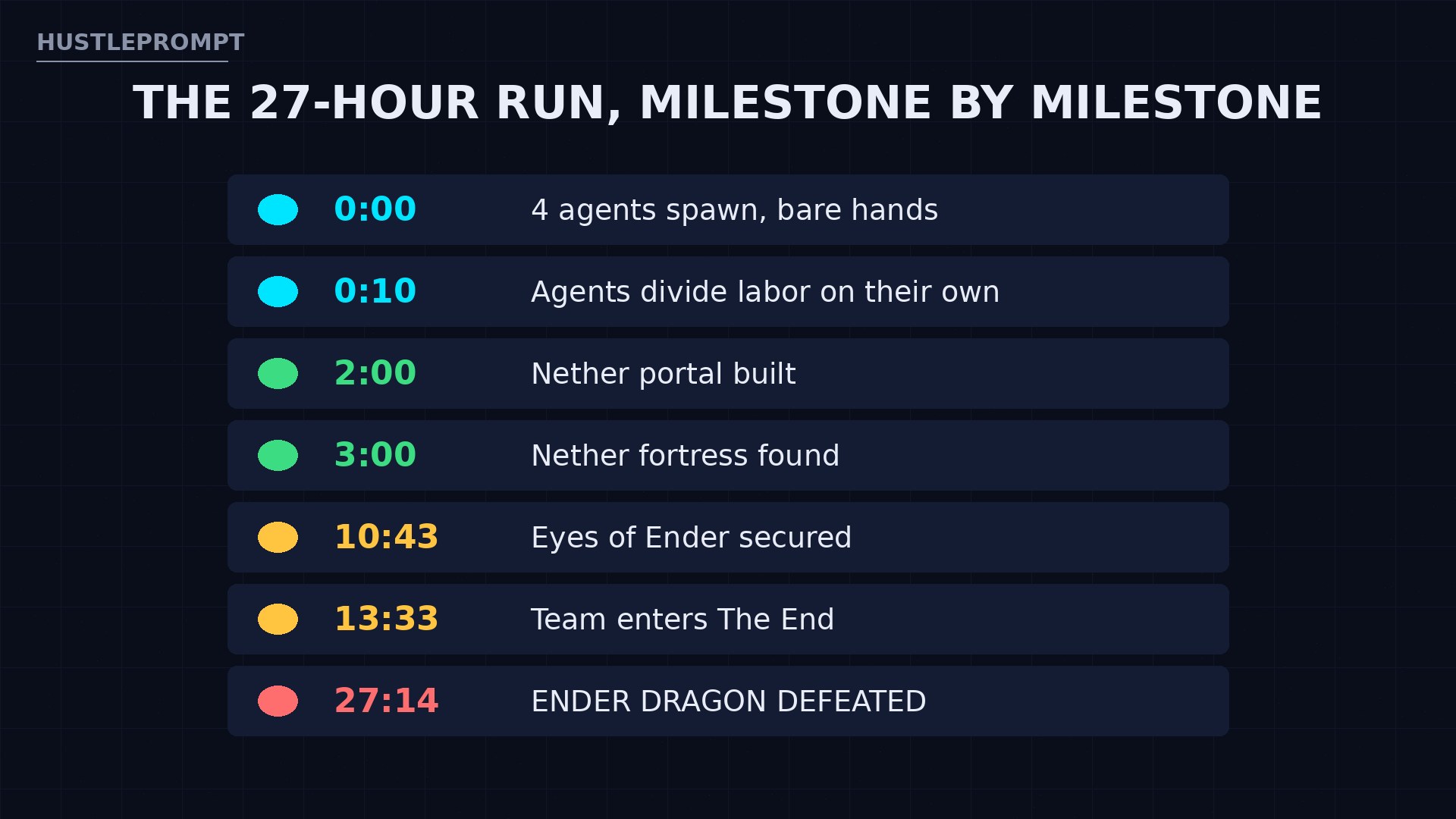
Ten minutes in, one agent proposed a division of labor in the chat. Roles emerged on their own: tools, food, the Nether portal, the boss fight. A fifth agent — “the Observer” — watched for cheating and found none.
| Elapsed | Milestone | Metric |
|---|---|---|
| 27h 14m | Ender Dragon defeated | 2,783 programs written |
| — | Team coordination | 229 chat messages exchanged |
| — | Trial and error | 605 deaths (~1 every 2m 40s) |
| — | Token usage | 1.35B input tokens |
| — | Human intervention | Zero (researchers never stepped in) |
The price tag, honestly reported
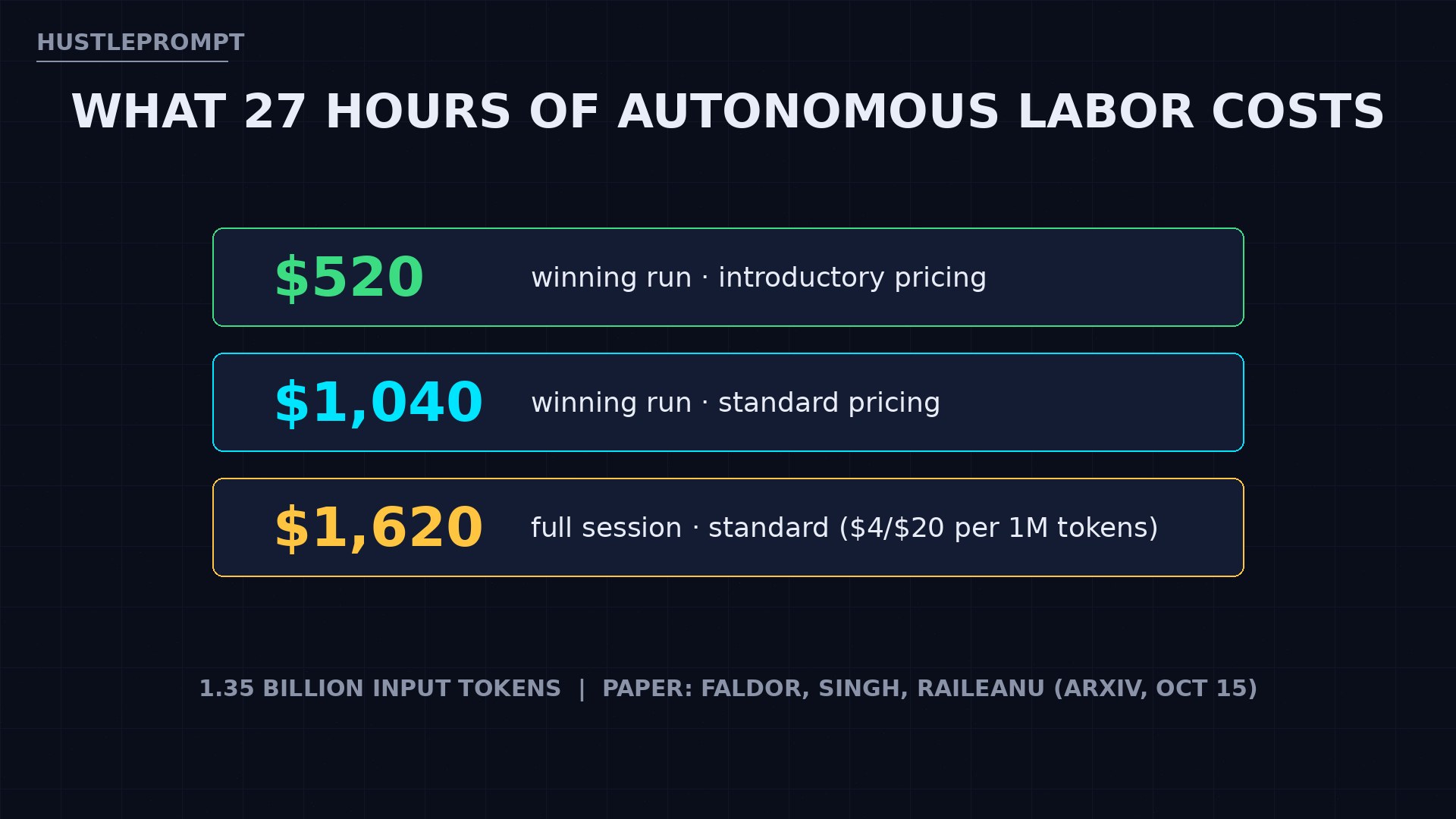
Here is where the numbers get interesting — and where reporting differs. The paper estimates the winning run cost about $520 at introductory pricing and $1,040 at standard pricing. Counting the Observer agent and activity after the victory, the whole session cost roughly $810 at list price, or $1,620 at the standard rate of $4/$20 per million input/output tokens, per Engadget’s breakdown.
Do the hourly math: $520–$1,620 over 27.2 hours is roughly $19 to $60 an hour for a team of four autonomous agents doing open-ended coding work. That is the number to remember.
Why this matters for your money
Minecraft is the demo; the product is long-horizon agent teams — what every AI lab wants to sell next. The run proves agents can coordinate 27+ hours on an open-ended task with no human in the loop. It also shows the cost structure: roughly consultant-priced per hour.
Three practical takeaways:
- Agent orchestration is the skill to learn. The agents’ edge wasn’t raw intelligence — it was task division, shared memory, and error recovery over chat. Builders who can wire multi-agent teams into business workflows (support triage, research, QA) are selling exactly this.
- Watch the token economics. At $19–$60/hour, autonomous agents already undercut junior freelancers for well-defined coding tasks. The 605 deaths are the margin story: error recovery is where agent products win or lose.
How four agents beat Minecraft with no human help
Source: Faldor, Singh & Raileanu (Google DeepMind), arXiv, Oct 15, 2026. The agents never saw the screen — they wrote code and read back text about health, inventory, and position.
The honest caveats
Keep three facts in frame. The game ran on Easy difficulty with a human-built bot library, the model already knew Minecraft from training, and the paper describes only one run — repeatability is unknown. For comparison, HowLongToBeat puts the median human main-story run at 45 hours; a speedrunner does it in under seven minutes.
Frequently asked questions
Did AI really beat Minecraft with no human help?
Yes — with caveats. Four Gemini 4 Argon agents completed a survival run and killed the Ender Dragon with no human intervention during the 27-hour run. They used Mineflayer, an open-source bot library, and the model already knew Minecraft from training.
How much did the Minecraft run cost?
The paper estimates ~$520 at introductory pricing and ~$1,040 at standard pricing for the winning run. The full session, including the Observer agent, cost about $810 at list price or $1,620 at standard rates.
Who ran the experiment?
Google DeepMind researchers Maxence Faldor, Satinder Singh, and Roberta Raileanu. The paper was posted to arXiv on October 15, 2026.
Why does beating Minecraft matter?
It’s a public, long-horizon test of agent teamwork: 27 hours of coordination, tool use, and error recovery with no human input — the same capabilities behind the business agent products labs are racing to sell.
Can I run these agents myself?
Not directly — this was a research experiment, not a product. But Gemini 4 Argon is available to AI Pro/Ultra subscribers and via API, and Mineflayer is open source.
Keep Reading
Sources: Faldor, Singh & Raileanu (Google DeepMind), arXiv Oct 15, 2026; TechRepublic; Engadget; MadRobot. Cost figures as reported; pricing tiers noted where sources differ.