
NVIDIA picked the day before its earnings report to show off its next science GPU. On November 16, 2026, at the SC26 supercomputing conference in Chicago, the company announced Rubin HPC, a new GPU in its Vera Rubin platform with more than 50,000 CUDA cores on a single chip — a record. It is built for the simulations AI agents run to test scientific ideas, and it is not expected to ship until 2028. NVIDIA reports third-quarter results after the market closes today.
The timing is the message. NVIDIA dropped nine newsroom items on November 16 — quantum decoding, a Vera CPU rack, science software, and this GPU — hours before the most-watched earnings call of the quarter. The hardware itself is two years out. The signal is now: NVIDIA wants the market to see its science pipeline before it sees its numbers.
This is what NVIDIA actually announced, how Rubin HPC differs from the Rubin GPU shipping today, what the company did not publish, and how a small builder can sell the work it enables.
What NVIDIA announced at SC26
Rubin HPC is a new GPU in the NVIDIA Vera Rubin platform, designed to accelerate simulation and data processing for science, engineering, and analytics workflows. NVIDIA frames it around a specific user: the AI agent that proposes a candidate material, molecule, or design, then calls a simulation to test whether the idea is worth building in a lab.
Three specifications are confirmed in NVIDIA’s announcement post. The GPU carries a record number of CUDA cores — more than 50,000 on a single GPU. It adds a sparse data acceleration capability that keeps those cores fed with data. And it connects GPUs with seventh-generation NVIDIA NVLink interconnect technology. Availability is expected in 2028.
“For agents tackling science and engineering, faster simulation means faster discovery,” said Ian Buck, vice president of hyperscale and high-performance computing at NVIDIA. “Rubin HPC accelerates the simulations agents use to test ideas and guide their next steps, helping scientists and engineers explore more possibilities and bring breakthroughs closer.”
Alongside the GPU, NVIDIA expanded its CUDA-X libraries — the optimized algorithm implementations agents call on — including the ones most relevant to simulation and analytics. The libraries are the software half of the announcement: Rubin HPC is the chip, CUDA-X is how agents actually use it.
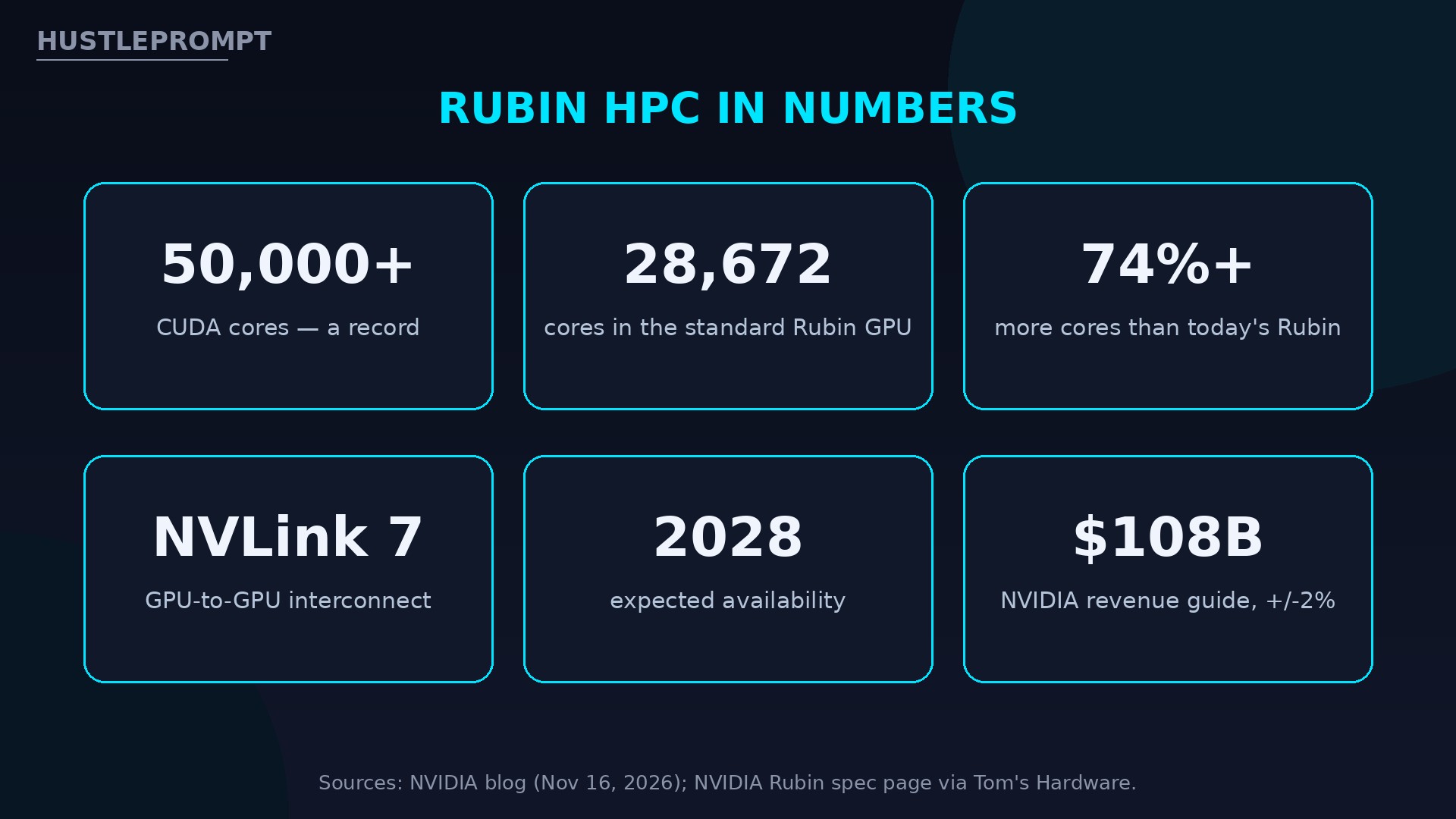
Rubin HPC in numbers. Sources: NVIDIA blog (Nov 16, 2026); NVIDIA Rubin spec page via Tom’s Hardware.
Rubin HPC vs the Rubin GPU shipping now
The name invites confusion. Rubin HPC is not the Rubin GPU — it is a second branch of the same platform, aimed at a different job. The standard Rubin GPU chases AI inference. Rubin HPC chases simulation.
| Rubin HPC (announced Nov 16) | Standard Rubin GPU | |
|---|---|---|
| CUDA cores | More than 50,000 | 28,672 |
| Interconnect | NVLink 7 (no bandwidth figure published) | NVLink 6 — 3.6 TB/s per GPU |
| Built for | Simulation and data processing: science, engineering, analytics | AI inference — 50 PFLOPS of FP4 compute |
| Availability | Expected 2028 | Shipping to hyperscalers in H2 2026 |
| Price | Not published | Not published |
Sources: NVIDIA blog — NVIDIA Announces Rubin HPC (Nov 16, 2026); NVIDIA Rubin spec page via Tom’s Hardware; NVIDIA DGX SuperPOD blog (NVLink 6); NVIDIA GTC 2026 keynote (FP4, H2 2026 shipments).
The core-count gap is the headline: more than 50,000 against 28,672 is at least 74% more cores on one chip, and Techstrong calls it nearly twice the standard Rubin GPU. But core count is the wrong number to celebrate on its own. Scientific codes spend most of their time waiting on memory, not on arithmetic — none of the top 10 systems on the November 2025 HPCG benchmark list got past 3% of peak performance, because those workloads gather scattered values from enormous datasets.
That is exactly what NVIDIA’s sparse data acceleration is supposed to fix: keep the record core count supplied with data so the cores compute instead of waiting. NVIDIA published no bandwidth or throughput figure to prove it yet, so treat the capability as a direction, not a measured result.
The agent loop it is built for
NVIDIA’s post describes a loop, not a chip. An agent proposes. A simulation tests. The results rank the ideas. Only the winners reach a lab. Rubin HPC exists to shorten that loop.
1 • PROPOSE
The agent suggests candidate materials, molecules, and designs to explore.
2 • SIMULATE
Rubin HPC runs GPU simulations to test each idea before anything is built.
3 • RANK
Results guide the agent’s next step — refine the idea, or drop it and move on.
4 • BUILD
Lab work targets only the most promising candidates, instead of every guess.
Hypothesis, simulation, refinement — faster feedback means faster discovery, in NVIDIA’s words.
Source: NVIDIA blog (Nov 16, 2026).
The workloads NVIDIA names all share the same shape: an application reaches into an immense dataset, gathers a handful of scattered values, calculates a result, and repeats that on an enormous scale. Climate models, engineering simulations, genomic analysis, and financial risk modeling all run that pattern — sparse matrix operations, stencil computations, sorting, and reductions. A GPU built for those patterns, rather than for token generation, is a different product from everything else in NVIDIA’s lineup.
What NVIDIA did not publish
A launch announcement is also a list of omissions. NVIDIA’s post gives no memory capacity or type, no double-precision (FP64) throughput, no power draw, no price, no benchmark results, and no launch partners or customers. Independent coverage the same day confirms the same gaps: no bandwidth figure for NVLink 7, no workload benchmarks, no system vendors named.
| Topic | Status at announcement |
|---|---|
| CUDA cores | Confirmed: more than 50,000 on a single GPU |
| Sparse data acceleration | Confirmed: named capability, no performance figure |
| Interconnect | Confirmed: seventh-generation NVLink; bandwidth not published |
| Availability | Expected 2028 |
| Memory capacity / type | Not published |
| FP64 throughput | Not published |
| Power draw | Not published |
| Price | Not published |
| Benchmarks | None at announcement |
| Launch partners / customers | None named |
Sources: NVIDIA blog (Nov 16, 2026); gaps corroborated by TechTimes and TokenPost (Nov 16–17, 2026). Do not copy the standard Rubin GPU’s 288 GB HBM4 from inference specs — NVIDIA has not confirmed memory for Rubin HPC.
The honest read: this is a roadmap announcement, not a product you can buy. Two years to availability, with the numbers that would let a buyer plan a 2028 system still unpublished. What it does tell you is where NVIDIA is aiming its next architecture — at agent-driven science, not just at bigger chatbots.
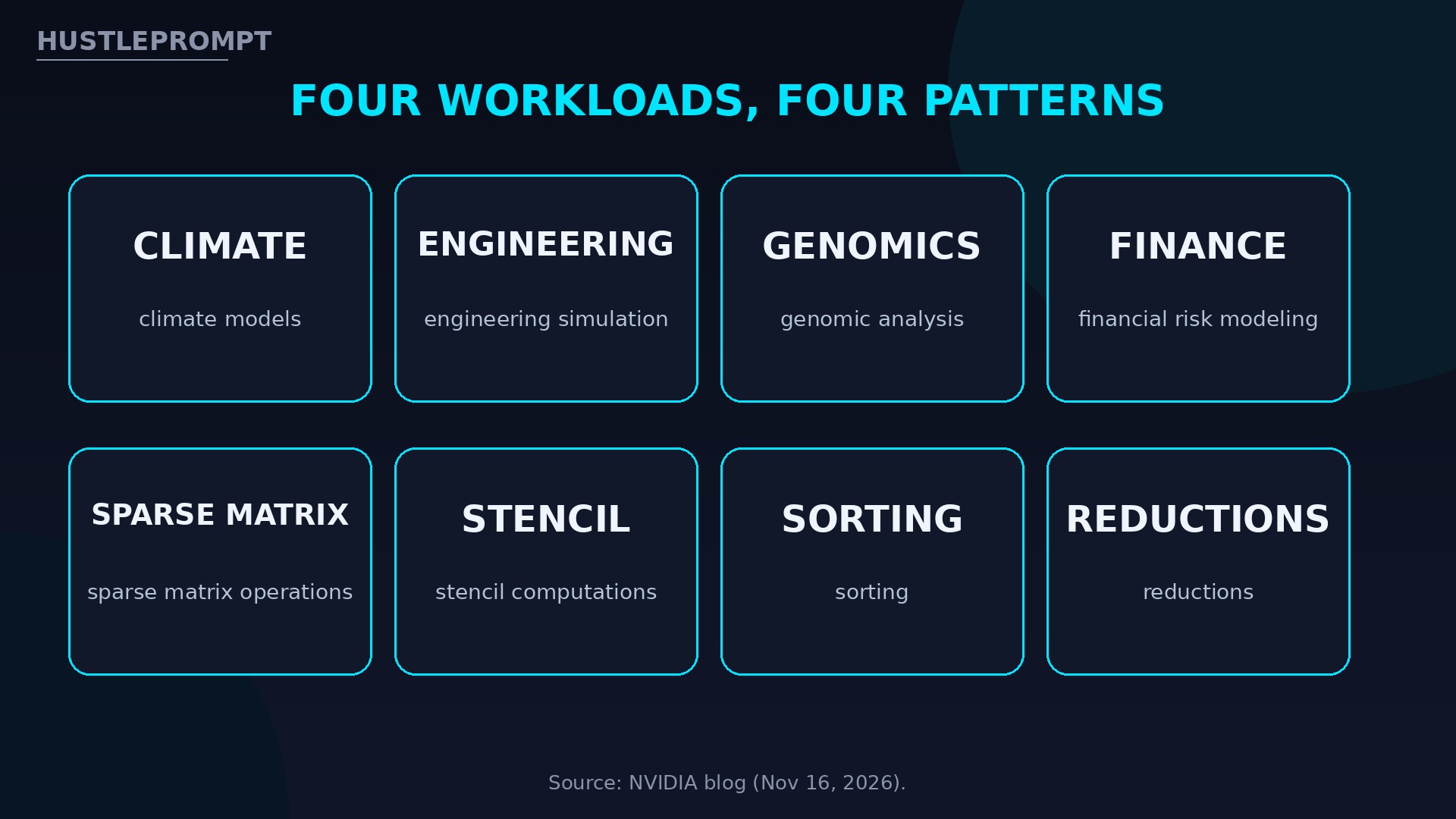
The four workloads and the four patterns Rubin HPC targets. Source: NVIDIA blog (Nov 16, 2026).
The earnings-day context
Rubin HPC did not arrive alone. NVIDIA posted nine items to its newsroom on November 16, the day before results. The slate included a CUDA-Q quantum decoding algorithm NVIDIA says runs up to 13,000 times faster, a Vera CPU rack platform with 192 Vera CPUs that NVIDIA says delivered 2.4 times the performance per watt of x86 systems in one test, and Nemotron for Science — the open AI-for-labs package this site covered separately.
The earnings numbers themselves are already framed. NVIDIA guided $108 billion in revenue, plus or minus 2%, at a 74% gross margin, and analysts expect roughly $109 billion. This is the first report under interim CEO Colette Kress, after the leadership turmoil this site has covered through the autumn.
There is one more number from the same day worth watching. NVIDIA says it swept every MLPerf Training v6.1 benchmark and that the Vera Rubin NVL72 system delivered up to twice the per-GPU performance of the GB300 NVL72 in its debut. NVIDIA’s own footnote says that result is provisional and pending MLCommons verification — the caveat belongs in the same sentence as the claim.
Put together, the pre-earnings slate is a story NVIDIA wants told before the call: the pipeline runs from software available today (Nemotron for Science) through systems shipping now (Vera Rubin) to a GPU in 2028 (Rubin HPC). Whether the quarter’s numbers support that story is what the call will decide.

The earnings frame. Sources: NVIDIA guidance; analyst consensus via reporting (Nov 17, 2026).
How to profit: sell the simulation loop
Rubin HPC ships in 2028. The work it enables is billable today, on hardware that already exists. Sell the loop, not the chip.
- Sell agent-driven simulation to labs. Materials, molecules, and designs are the three candidates NVIDIA names. Offer a service that runs an agent’s proposals through simulations and returns a ranked shortlist — the exact loop in the diagram above.
- Use Nemotron for Science as the wedge. NVIDIA’s open package — the Nemotron 3.5 Super VL model, post-training recipes, and the LitmusBench chemistry dataset — is free and available now. Build the service on it, and Rubin HPC becomes the upgrade path you sell later.
- Target the four patterns. Sparse matrix operations, stencil computations, sorting, and reductions recur across climate, engineering, genomics, and finance. Pitch HPC consulting to one vertical, with the pattern as your calling card.
- Watch the earnings call for demand signals. Hyperscaler orders and Vera Rubin ramp comments on today’s call tell you more about 2027 revenue than the Rubin HPC announcement does. Quote the call, not the press release, in client conversations.
- Do not sell the 2028 story today. Sell services on hardware clients can buy now — including the DGX Spark HPC developer kit NVIDIA showed at the same conference. A roadmap GPU is a reason to start the relationship, not a product to promise.
The buyers are already funded: national labs, engineering firms, and biotech companies run these simulations today on hardware that wastes most of its peak performance waiting on data. The pitch is a faster loop, not a faster chip.
What is still missing
Three gaps are worth naming before anyone plans a purchase around Rubin HPC.
First, 2028 is two years away. With no memory, FP64, power, price, or benchmark figures published, no buyer can plan a system around this GPU yet. The announcement is a direction, not a specification.
Second, do not confuse the three SC26 announcements. The DGX Spark HPC developer kit is a desktop cluster for developers, covered separately on this site. Nemotron for Science is free software for labs, also covered separately. Rubin HPC is the data-center GPU. Same conference, same day, three different products.
Third, there is no official launch video yet. No video on NVIDIA’s official YouTube channel covers Rubin HPC specifically. The GTC 2026 keynote covers the Vera Rubin platform generally, from March 2026. When NVIDIA posts a Rubin HPC video, it belongs in this article — until then, the blog post is the source.
Frequently asked questions
What is NVIDIA Rubin HPC?
A new GPU in NVIDIA’s Vera Rubin platform, announced November 16, 2026 at SC26, built to accelerate simulation and data processing for science, engineering, and analytics — the simulations AI agents run to test ideas before lab work.
How many CUDA cores does Rubin HPC have?
More than 50,000 on a single GPU, a record according to NVIDIA. That is at least 74% more than the 28,672 cores in the standard Rubin GPU shipping to hyperscalers now.
When will Rubin HPC be available?
NVIDIA expects it to be available in 2028. No firmer date, price, or system vendor has been named.
How is Rubin HPC different from the regular Rubin GPU?
The standard Rubin GPU is built for AI inference (50 PFLOPS of FP4 compute). Rubin HPC is built for scientific simulation, with sparse data acceleration and seventh-generation NVLink, aimed at climate models, engineering simulation, genomics, and financial risk.
What is sparse data acceleration?
Hardware that keeps the GPU’s cores supplied with data when applications gather scattered values from huge datasets — the pattern behind sparse matrix operations, stencil computations, sorting, and reductions. NVIDIA has published no performance figure for it yet.
What did NVIDIA not announce about Rubin HPC?
Memory capacity and type, FP64 throughput, power draw, price, benchmarks, and launch partners or customers. None of those figures appeared in the announcement, and independent coverage confirms the same gaps.
Why did NVIDIA announce Rubin HPC the day before earnings?
NVIDIA reports third-quarter results after the market closes on November 17, 2026, and posted nine newsroom items on November 16, including Rubin HPC. The slate frames the company’s science pipeline — software available now, systems shipping now, a GPU in 2028 — ahead of the call. The earnings numbers themselves will show whether the quarter supports that story.
Keep Reading
Sources: NVIDIA blog — NVIDIA Announces Rubin HPC (Nov 16, 2026); NVIDIA Rubin spec page via Tom’s Hardware; NVIDIA MLPerf results via MLQ (Nov 16, 2026); earnings consensus via reporting (Nov 17, 2026).