
How much would you pay to stop paying for AI? NVIDIA just answered that question: $2,599. Its new RTX Spark laptop lineup went on sale globally on October 16, 2026, packing up to 128GB of unified memory and a full petaflop of AI compute into slim Windows machines built to run AI agents locally, with no subscriptions and no per-prompt fees.
This is the first time NVIDIA has put its own silicon at the heart of a mainstream Windows laptop. The RTX Spark superchip fuses a Blackwell RTX GPU with up to 6,144 CUDA cores and a 20-core Grace CPU, co-developed with MediaTek, into a single processor. And the software story is just as aggressive: launch-day support for local AI agents, open models like Nemotron 3.5 Bolt, and a free open-source tool that spreads inference across every PC on your network.
What RTX Spark actually is
RTX Spark is not one laptop. It is a superchip platform: one chip combining NVIDIA’s Blackwell graphics and Grace CPU, linked by NVLink-C2C, sharing a single pool of up to 128GB of LPDDR5X memory. On a normal laptop, the GPU gets a small slice of its own VRAM. Here, the whole 128GB is one addressable pool, which changes what “running a model locally” means.
NVIDIA’s own product page puts it bluntly: “Run it locally and get the good stuff: instant iteration, no API bills, and data that stays on your machine.” The page also promises models up to 120B parameters with 1M token context running entirely on the laptop. Those are NVIDIA’s claims, and independent reviews are only starting to land, but the architecture is real.
The specs that actually matter
Forget the marketing. Here is the RTX Spark N1X configuration table from NVIDIA’s official product page, which is the part of the announcement that decides whether local AI on a laptop is a demo or a daily driver:
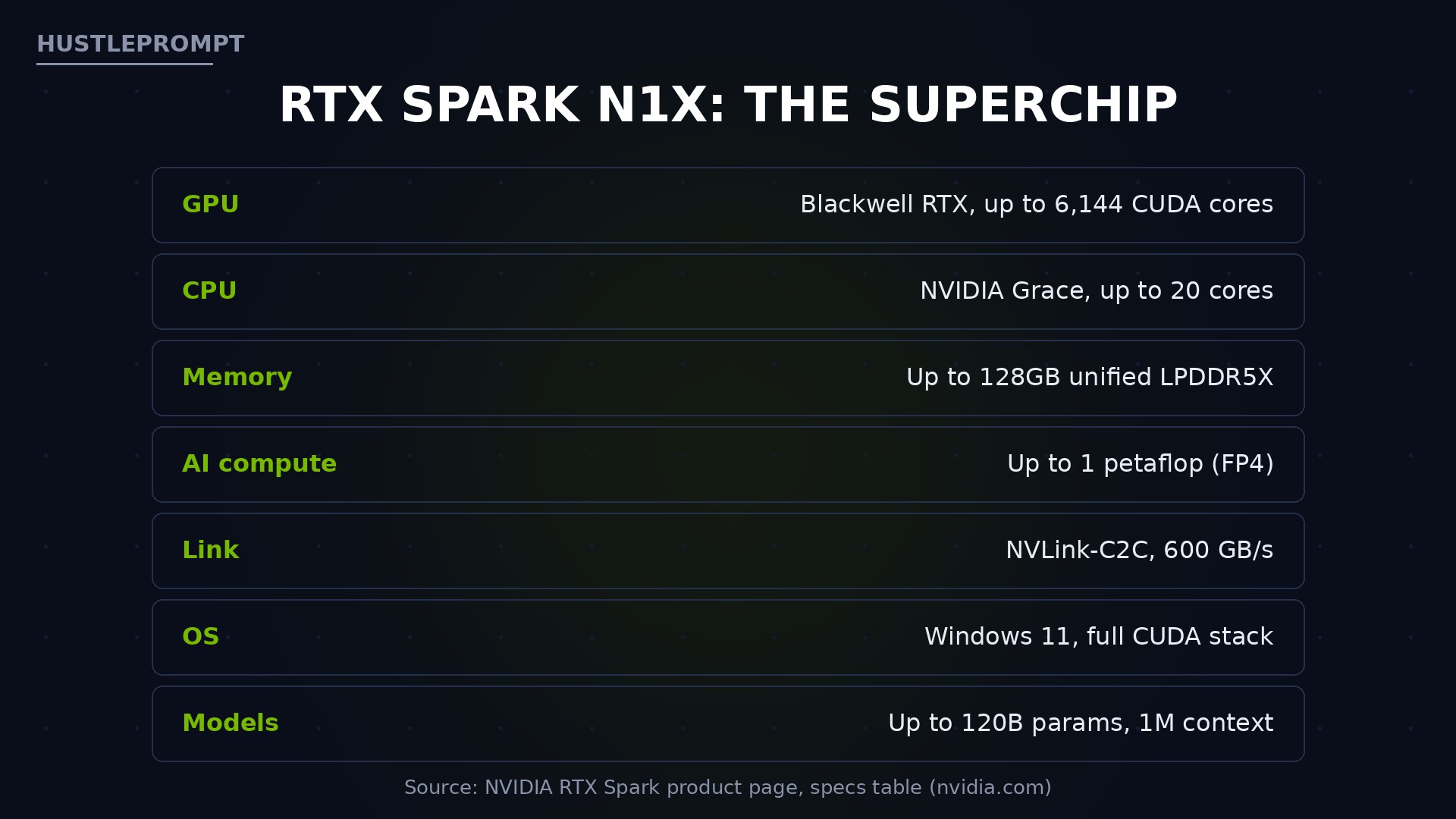
Two details matter most for buyers. First, there is also a smaller N1X variant with a 5,120-core GPU, an 18-core CPU, and up to 64GB of memory, so not every RTX Spark laptop hits the headline specs. Second, 128GB is total unified system memory, not 128GB of GPU memory; the GPU-addressable portion is less. Check the exact configuration before you order.
The October 16 lineup and what it costs
Six PC makers shipped RTX Spark laptops on launch day: ASUS, Dell, HP, Lenovo, Microsoft, and MSI. NVIDIA says additional systems will follow, and Acer and GIGABYTE are expected later. Pricing and configurations vary by region.
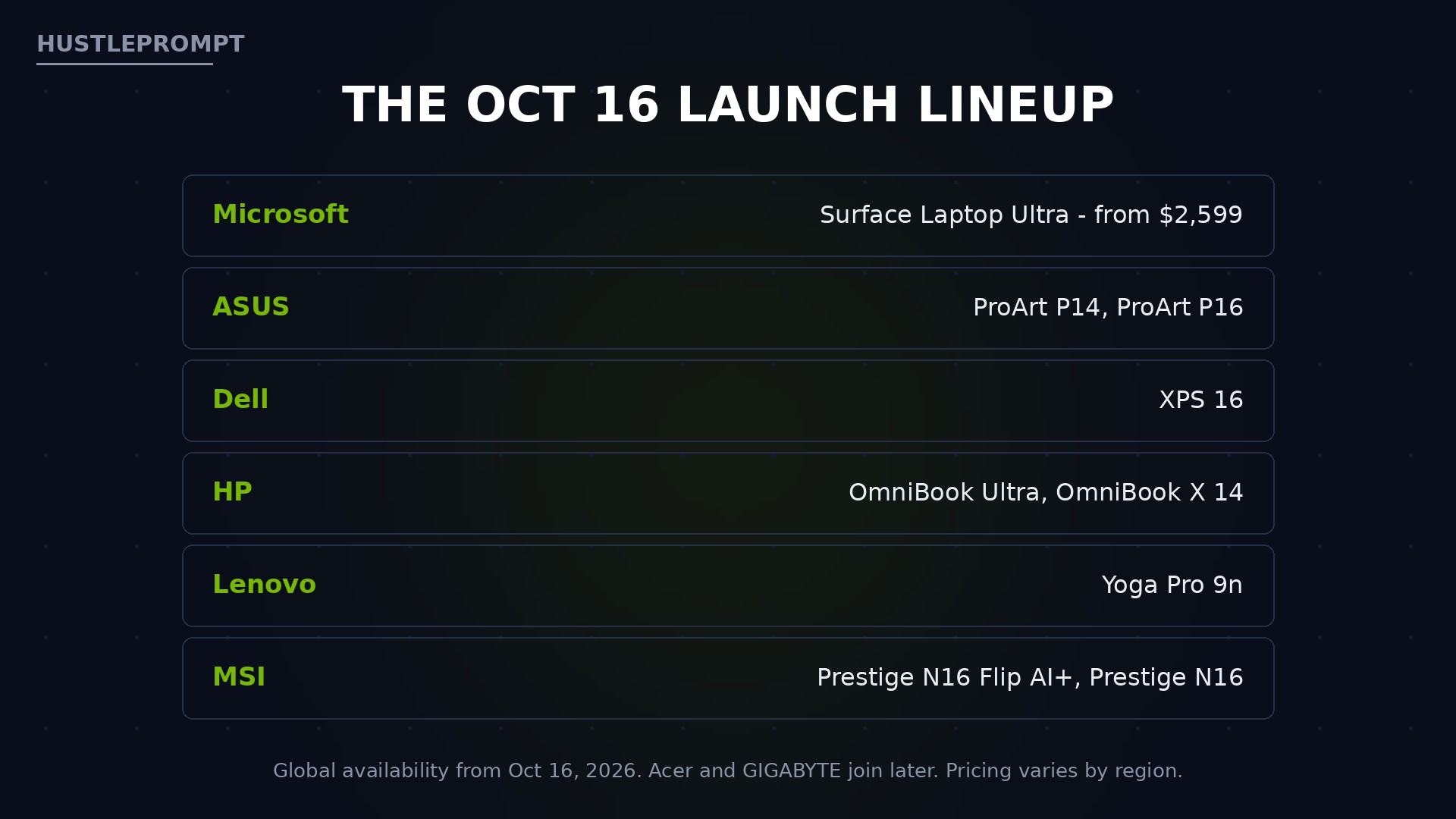
The price ladder is the real story. The entry ticket is $2,599, but the 128GB configuration, which is where serious local AI lives, reportedly pushes a maxed-out Surface Laptop Ultra to nearly $5,900. The memory is the invoice, as one launch-day analysis put it. Buy 48GB or 64GB as the floor; pay for 128GB only if the model you want is bigger than about 30GB.
NVIDIA is also running a limited-time promotion for new Perplexity users with the launch, and launch-day agent apps include GitHub Copilot, Hermes, OpenClaw, Perplexity, Pi, and WorkBuddy, with security handled through NVIDIA OpenShell and Microsoft Execution Containers.
Nemotron 3.5 Bolt: a 74B agent model that fits in 24GB
The hardware would be half the story without the model. On October 15, NVIDIA released Nemotron 3.5 Bolt 74B-A9B, a 74-billion-parameter mixture-of-experts model where only 9 billion parameters activate per token. Native 2-bit quantization-aware training compresses it into a 24GB footprint.
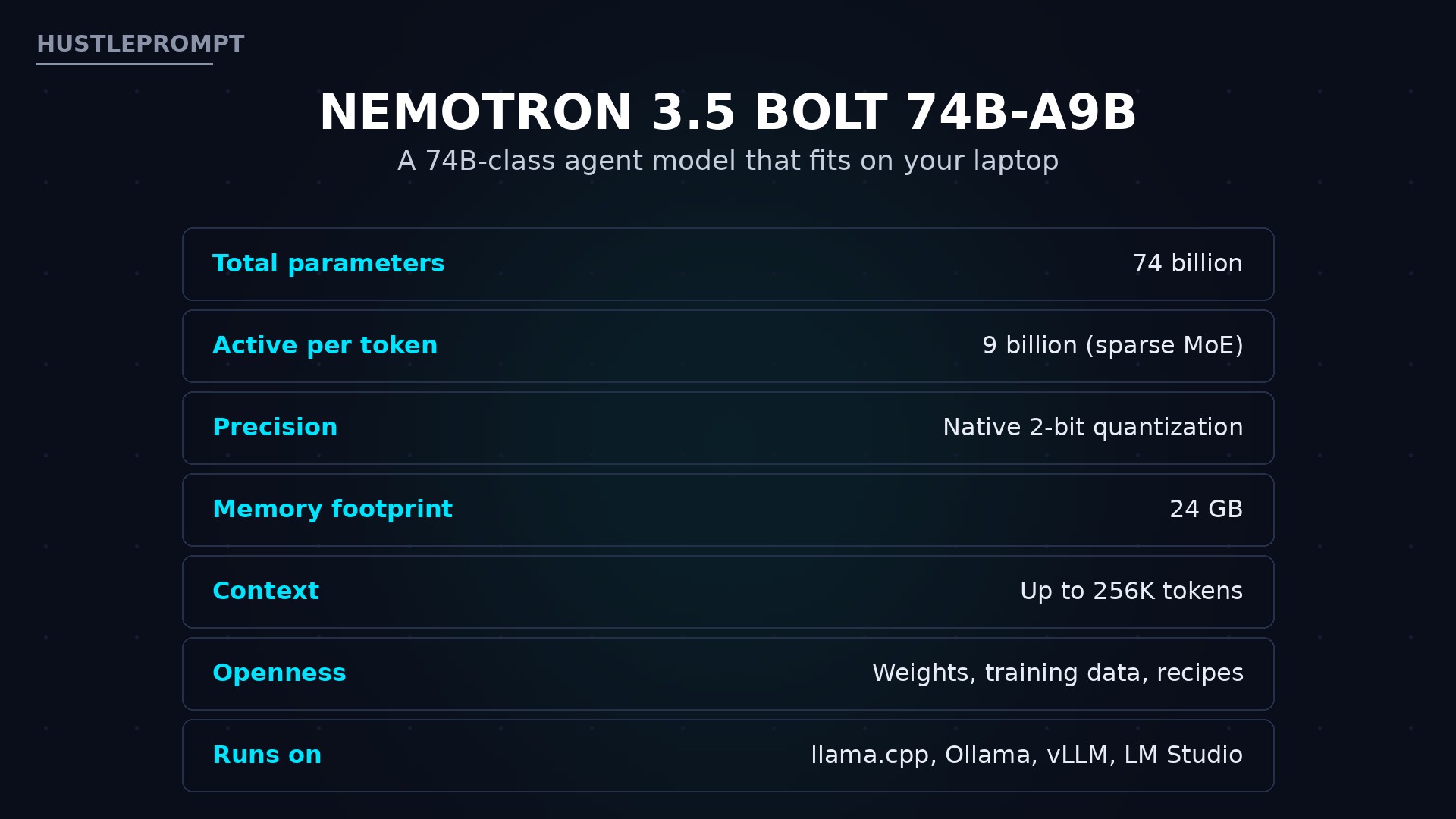
Two things make Bolt unusual. First, it ships fully open: weights, training data, and recipes, so developers can fine-tune their own agents on top of it. Second, it runs through llama.cpp, vLLM, Ollama, Unsloth, and LM Studio at launch, and plugs directly into agent frameworks like Hermes and OpenClaw. NVIDIA also moved PAIR, its free open-source Personal AI Router, out of beta on October 13, with llama.cpp support and direct Hugging Face downloads, so you can spread inference across every PC on your local network.
The money math: how a local AI laptop pays for itself
Here is the calculation that matters for developers, creators, and agencies. Cloud API bills scale with usage; a local machine is a fixed cost. Run the numbers before you dismiss a $2,599 laptop as expensive:
- Price your current API spend. A freelancer running heavy agentic coding sessions can burn $200 to $600 a month on API calls. At $400 a month, the entry RTX Spark pays for itself in under seven months, then runs at zero marginal cost.
- Move always-on agents off the cloud. Research agents, inbox triage, and content pipelines that run 24/7 are the worst cloud bills and the best local workloads. PAIR lets you distribute them across office machines for free.
- Sell client demos, not cloud demos. Agencies can walk into a pitch with a laptop running a 74B agent on the client’s own documents, with nothing leaving the room. Data sovereignty is a selling point enterprise clients pay a premium for.
- Fine-tune on open recipes. Bolt ships with training data and recipes. A niche fine-tune for legal, medical, or local-business documents becomes a product you own outright, with no per-token tax on every customer query.
- Fleet it. A five-person agency spending $400 a month each on APIs burns $24,000 a year. Five entry RTX Spark laptops cost about $13,000 once. The math gets better every year after year one.
Local vs cloud AI: the trade-off
- One-time cost from $2,599
- Zero per-token fees, forever
- Client data never leaves the machine
- Works offline, no rate limits
- You own the fine-tunes and the stack
- Low upfront cost
- Bills scale with every token
- Data transits third-party servers
- Rate limits and outages apply
- Pricing changes are out of your control
Rule of thumb: if your monthly API bill is heading past $300, a local machine starts paying for itself within the first year.
Watch: NVIDIA’s official RTX Spark overview
Frequently asked questions
When did RTX Spark laptops go on sale?
Global availability began October 16, 2026, from ASUS, Dell, HP, Lenovo, Microsoft, and MSI. NVIDIA hosted launch events the same day in Taipei, Seoul, Beijing, Istanbul, San Francisco, and Berlin.
How much does an RTX Spark laptop cost?
They start at $2,599, which is the entry price for the Microsoft Surface Laptop Ultra. A maxed-out 128GB Surface configuration reportedly approaches $5,900. Pricing and configurations vary by region, and not every model includes the top N1X chip.
What are the RTX Spark N1X specs?
The top configuration pairs a Blackwell RTX GPU with up to 6,144 CUDA cores and fifth-generation Tensor Cores with a 20-core NVIDIA Grace CPU, up to 128GB of unified LPDDR5X memory, up to 1 petaflop of FP4 AI performance, and a 600 GB/s NVLink-C2C interconnect, running Windows 11 with native CUDA.
Can it really run a 74B model locally?
That is the point of the 128GB unified memory pool. NVIDIA’s Nemotron 3.5 Bolt 74B-A9B uses a sparse mixture-of-experts design (only 9B parameters active per token) and native 2-bit quantization to fit in 24GB. NVIDIA claims models up to 120B parameters with 1M context run on the platform; independent benchmarks will confirm real-world speeds.
Is the software actually open?
Bolt 74B-A9B ships fully open: weights, training data, and recipes. PAIR, the local-network inference router, is free and open source. The models run on llama.cpp, Ollama, vLLM, Unsloth, and LM Studio, and plug into agent frameworks like Hermes and OpenClaw.
Should a freelancer buy one?
Do the math on your API bills first. If you spend $300 or more a month on cloud inference, an RTX Spark laptop can pay for itself within a year while giving you offline capability and data privacy. If your AI usage is light, the entry price is hard to justify.
Keep Reading
Official sources: NVIDIA RTX Spark product page and NVIDIA’s RTX Spark launch announcement. Launch pricing and model lineup as reported at launch; independent performance reviews were just beginning at publication time.