
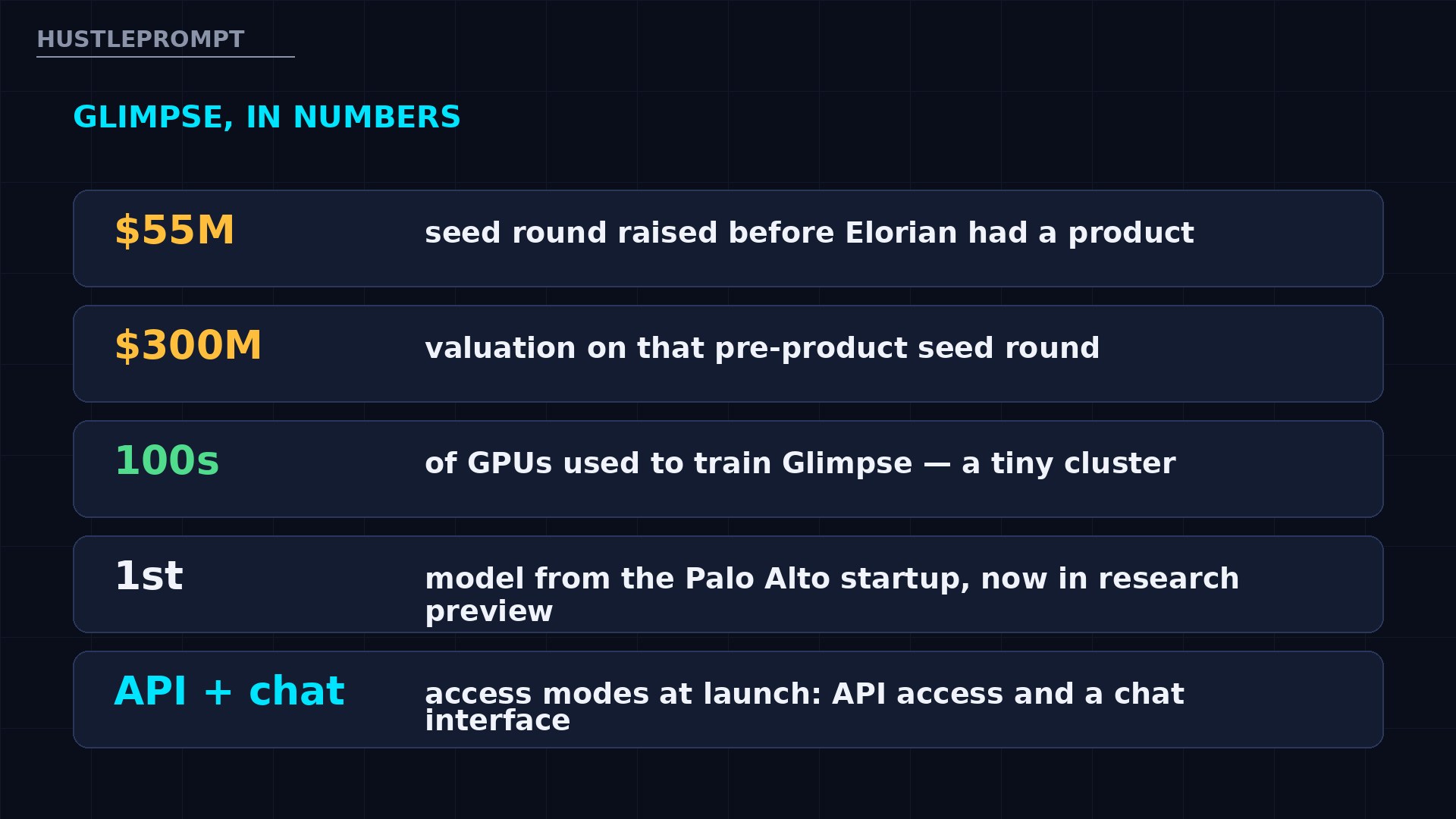
A Palo Alto startup raised $55 million at a $300 million valuation before it had a product. On Friday, Elorian Glimpse showed what the money was for: the company’s first AI model, launching as a research preview with API access and a chat interface, built around a simple thesis — today’s AI models can’t really see, and that is a trillion-dollar gap.
The problem: AI looks, but doesn’t see
Most multimodal models glance at an image once, convert it to tokens, and then reason about it in text — like describing a photo from memory. Elorian CEO Andrew Dai, a former Google DeepMind researcher, felt the gap on game night: he photographed a finished board game and asked a frontier model who was winning. It couldn’t say. Board games have “their own visual language, each have their own iconography, symbols,” he told TechCrunch. “Humans can look at Ikea diagrams, with no text, and assemble Ikea furniture, right? Why can’t AI models?”
How Glimpse works: the visual scratch space
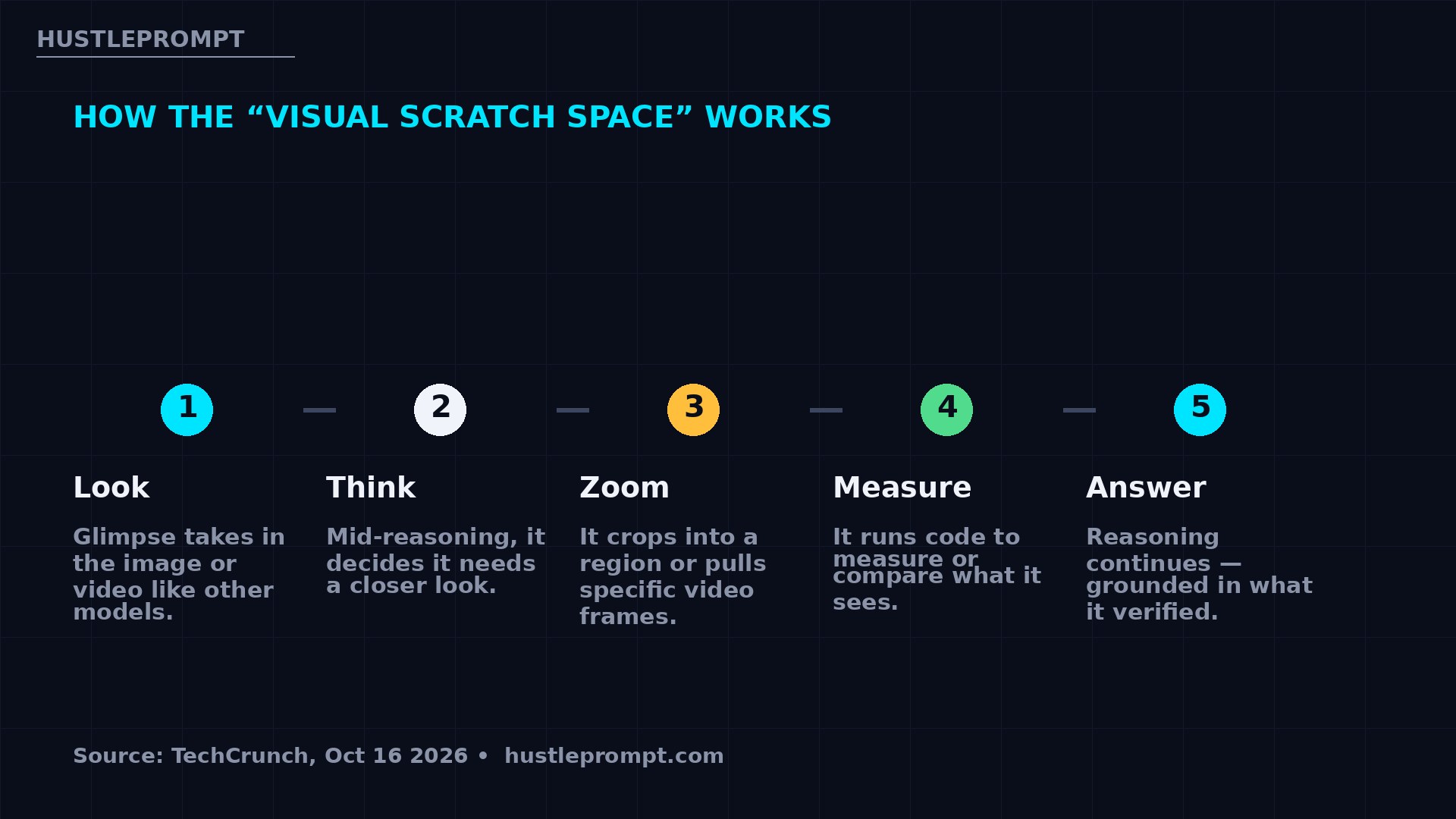
Glimpse keeps going back to the source. Mid-reasoning, it can crop into a region of an image, pull specific frames from a video, or run code to measure or compare what it is looking at — a mechanism Elorian calls a “visual scratch space.” Think of pinching to zoom on a phone photo to double-check what you thought you saw, except the model does it to itself, inside its own thought process.
The approach has precedent — OpenAI added crop-and-zoom during reasoning to its o-series models in 2025 — but Elorian’s pitch is that it built the whole model around the mechanism, and did it cheaply. A small team trained Glimpse on a few hundred GPUs, and the company says the model is substantially smaller than the frontier systems it benchmarked against.
Glimpse vs. typical multimodal models
| Typical multimodal model | Elorian Glimpse | |
|---|---|---|
| Image intake | Looks once, converts to tokens | Revisits the source mid-reasoning |
| Detail check | Reasons from memory of the image | Crops into regions on demand |
| Video | Samples frames up front | Pulls specific frames while thinking |
| Measurement | Estimates from pixels | Runs code to measure and compare |
| Training cost | Thousands of GPUs, frontier scale | A few hundred GPUs, small team |
Source: TechCrunch exclusive, Oct 16, 2026.
The visual scratch space, step by step
How to profit from AI that can actually see
Vision is where AI meets physical-world money. Every business that inspects, measures, or verifies things visually is a customer for this capability:
1. Sell visual inspection as a service
Manufacturing quality control, construction progress checks, and insurance claim photos all need an AI that can zoom into a defect and measure it, not just describe it. Glimpse’s measure-and-compare loop is exactly that workflow. Package it per-inspection and charge per report.
2. Build document-vision products
Invoices, receipts, floor plans, and engineering diagrams are visual languages like Dai’s board games. A tool that crops into the fine print, reads the table, and cross-checks the numbers beats generic OCR — and businesses pay monthly for it.
3. Copy the efficiency playbook
Elorian’s real lesson is economic: a small team on a few hundred GPUs shipped something frontier labs need thousands of GPUs to approximate. In the API era, efficiency is margin. Builders who pick lean, specialized models over frontier giants keep more of every dollar of revenue.
FAQ
What is Elorian’s Glimpse?
Glimpse is the first AI model from Palo Alto startup Elorian, launched as a research preview with API access and a chat interface. It is designed to reason with images — revisiting and manipulating visual input mid-thought — rather than just reasoning about them.
What is the “visual scratch space”?
Elorian’s term for Glimpse’s core mechanism: during reasoning, the model can crop into image regions, pull specific video frames, or run code to measure and compare what it sees — like pinching to zoom on a photo to verify a detail.
Who is behind Elorian?
CEO Andrew Dai is a former Google DeepMind researcher. The startup raised a $55 million seed round at a $300 million valuation before launching any product, according to TechCrunch.
How is this different from GPT or Gemini vision?
Current multimodal models typically convert an image to tokens once and reason from that snapshot. Glimpse is architected around re-examining the visual source throughout reasoning. OpenAI added a similar crop-and-zoom trick to its o-series in 2025, but Elorian built its entire model around it.
How much did it cost to train?
Elorian says a small team trained Glimpse on a few hundred GPUs — a fraction of frontier training runs — and the model is substantially smaller than the systems it was benchmarked against.
Can I try Glimpse now?
It is launching as a research preview with API access and a chat interface. Expect early-adopter pricing and rate limits typical of research previews.
Keep Reading
Source: TechCrunch, “Elorian’s first AI model wants to reason with images, not just about them” (Oct 16, 2026). All facts verified against this exclusive.