
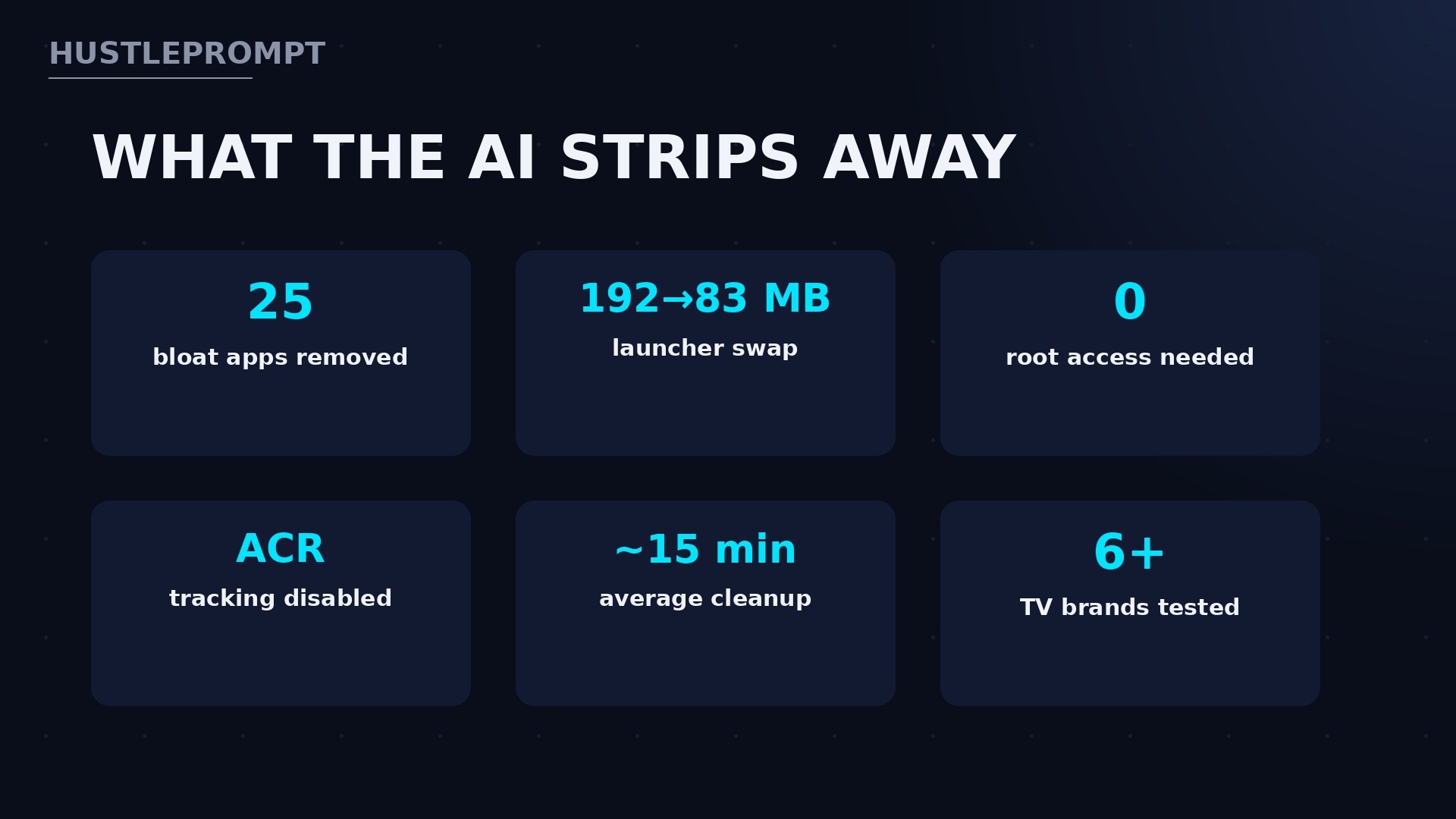
It started with a sponsored ad playing before Netflix would even open. On October 17, developer Gathin T. got tired of the ads on his parents’ Xiaomi TV — so he handed the TV’s model number to Claude Code, Anthropic’s AI coding agent. The agent found the TV on his home Wi-Fi, removed 25 bloatware packages, and wrote a brand-new launcher. “Looks like an Apple TV now,” he posted.
Thousands of people copied the trick within days. Two open-source projects — dumbtv and cleanyourtv — are now showing how anyone can use AI agents to strip ads, trackers, and bloatware from a smart TV, no root access required. Here’s how the dumb TV AI hack works, what your TV is secretly tracking, and how to turn the trend into money.
The two projects behind the trend
TechCrunch first reported the wave on October 19. Two projects are doing the rounds:
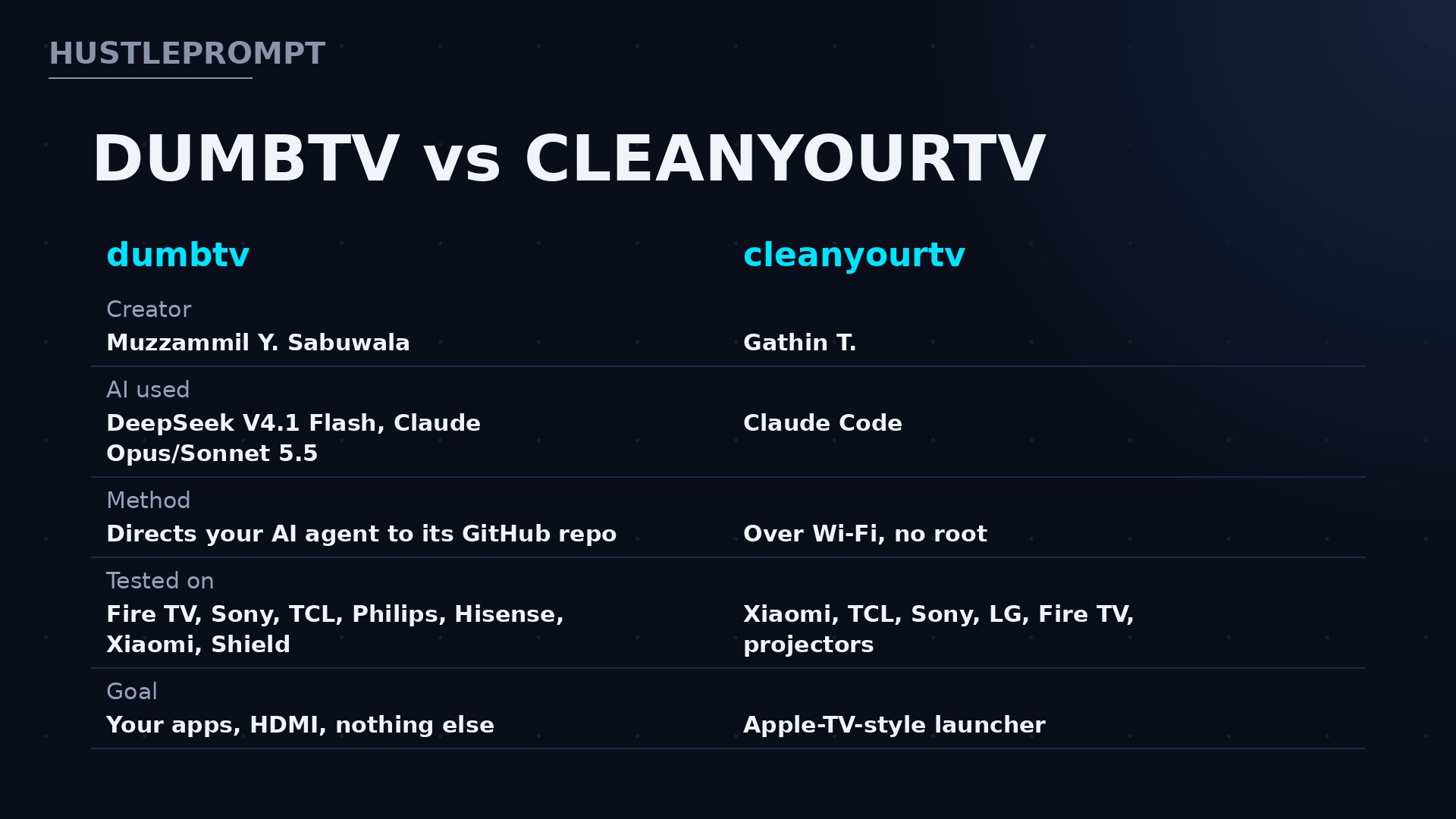
- dumbtv — built by Muzzammil Yasin Sabuwala using DeepSeek V4.1 Flash, Claude Opus 5.5, and Claude Sonnet 5.5. Tested end-to-end on a Fire TV Edition set and on Android/Google TV hardware from Sony, TCL, Philips, Hisense, Xiaomi, and Nvidia Shield. Its mission, stated on GitHub: “Your TV should do what you paid for: your apps, your HDMI inputs, and nothing else. No ads from the TV itself, no watch tracking, no update you did not ask for.”
- cleanyourtv — Gathin T.’s project, which promises to strip bloatware from any Android TV or Google TV over Wi-Fi, replacing the stock launcher with one that resembles Apple TV. No root required, and the TV can be returned to factory settings.
Real users are posting real results. Ryan Doyle asked Claude Code “Can you hack this?” and got the ads removed, a faster interface, and a custom screensaver. Mihir Gupta reported: “One afternoon with Claude Code: 25 bloat apps disabled, the 192 MB stock launcher replaced with a custom 83 MB one, plus rotating wallpapers.”
How the “dumb TV” hack actually works
You don’t need to be a hacker. The workflow, as reported, is startlingly simple:
Per reporting, a typical cleanup takes about 15 minutes following the published instructions — though the first attempt took its creator an afternoon.
The privacy angle: what your TV is secretly tracking
The deeper target here isn’t just ads — it’s ACR, automatic content recognition. Modern smart TVs ship with technology that identifies what’s playing on your screen using screenshots, audio clips, or other digital fingerprints. That viewing data can be sold to advertisers or used to serve personalized ads on the TV’s own interface.
| What your smart TV collects | How it works | Who profits |
|---|---|---|
| Viewing fingerprints | ACR screenshots + audio clips matched against content databases | TV makers, data brokers |
| Home-screen ad slots | Sponsored tiles and panels (on Android TV since 2019) | TV makers, advertisers |
| Preinstalled apps | Bloatware that phones home and slows the interface | App partners, manufacturers |
| Unasked updates | Firmware pushes that re-enable ads and tracking | TV makers |
If these hacks spread to everyday consumers, they could disrupt the smart TV ad industry — a business built on selling viewing data and ad inventory on hardware you already paid for.
The catches: what can go wrong
This isn’t risk-free. Be honest with yourself before trying it:
- People have bricked TVs. TechCrunch reports one user bricked an Android TV with Claude, another got stuck halfway through a Fire TV, and some found Claude would refuse a bare “hack my TV” request. Engadget cautions that letting an AI loose on your TV “isn’t the best idea.”
- It only works on some TVs. The method covers Android TV and Google TV sets — Sony, TCL, Xiaomi, Hisense — plus Fire TV via the separate dumbtv path. It does not work on Samsung, LG, or Roku models.
- The projects are young. Both are open-source works in progress, with users actively testing across platforms and feeding back fixes. Expect rough edges.
- Updates can undo it. A manufacturer firmware update can re-enable the bloat — the dumbtv mission statement explicitly lists “no update you did not ask for” as a goal, meaning updates remain an adversary.
How to profit from the dumb-TV wave
A viral frustration is a business waiting to happen. Three concrete plays:
1 · The $79 “TV declutter” service
Most people will never touch a terminal. Offer an in-home (or remote) service: debloat the TV, install a clean launcher, disable ACR, document what you changed. Charge $49–$99 per TV. Market it to parents and non-technical households — the exact people in Gathin’s original story.
2 · Content: “I de-advertised my TV with AI”
Before-and-after videos of the process are tailor-made for YouTube Shorts and TikTok. Link each video to your declutter service or a paid checklist.
3 · Privacy audits for small businesses
Bars, clinics, and offices run smart TVs that leak viewing data. Bundle TV decluttering into a small-business privacy audit ($150–$300).
Frequently asked questions
What is the dumb TV AI hack?
Using an AI coding agent (like Claude Code) to remove ads, bloatware, and tracking from a smart TV and install a minimal launcher — effectively making the TV “dumb” again. Two open-source projects, dumbtv and cleanyourtv, package the approach.
Do I need to root my TV?
No. Both projects work without root access, and cleanyourtv can restore the TV to factory settings afterward.
Which TVs does it work on?
Android TV and Google TV sets (Sony, TCL, Xiaomi, Hisense, Philips) plus Amazon Fire TV via dumbtv. It does not work on Samsung, LG, or Roku TVs.
What is ACR and why disable it?
Automatic content recognition identifies what’s on your screen via screenshots, audio clips, or digital fingerprints. That data can be sold to advertisers. Disabling it stops your TV from reporting your viewing habits.
Can this break my TV?
Yes — at least one user bricked an Android TV, per TechCrunch. The method is experimental; a factory reset can usually restore a stock TV, but there’s no guarantee. It also likely voids aspects of your warranty.
Will TV makers fight back?
Possibly. Firmware updates can re-enable bloat and tracking, and manufacturers have a financial incentive to protect their ad revenue. Expect a cat-and-mouse cycle.
Sources
- People are using AI to make their smart TVs dumb again — TechCrunch (Oct 19, 2026)
- Smart TV Owners Are Using AI to Strip the Ads Off Their Sets — Phandroid (Oct 20, 2026)
- Are people using AI to dumb down their smart TVs? — GovTech (Oct 19, 2026)
- Devs use Claude Code, DeepSeek to strip ads from smart TVs — AI Weekly