
Sell AI Press Release Services to Startups
Two out of three journalists now say they rely on PR-provided content for story ideas, yet most pitches they receive are irrelevant. That gap is your opening: startups need announcements journalists can actually use, and AI press release writing lets you produce them fast.
A press release is a short, factual announcement a company sends to journalists and news wires: a news story written by the company itself, in third person, news first and background last.
Startups announce launches, funding rounds, partnerships, and hires constantly. Most founders hate writing these announcements and cannot afford a PR agency retainer. That is your client.
What startups actually buy from you
Clients are not buying words. They are buying a finished, credible announcement plus a plan to get it seen.
Your core deliverable is a 400-to-600-word release in news style: headline, lead paragraph, one or two approved quotes, supporting facts, and a boilerplate. The boilerplate is the short “About” paragraph at the end.
Offer three clear add-ons around that core:
- Angle check: a blunt yes-or-no on newsworthiness, before anyone pays for distribution.
- Media list: 25 to 50 journalists on the startup’s beat, each matched to a recent story.
- Distribution setup: submitting the approved release to a wire and pitching the media list.
Never sell coverage itself. Distribution puts a release on a network; only a journalist can write a story.
What distribution really costs
Pricing shapes your whole offer, so learn it before you quote a client. Wires charge very different amounts for what looks like the same job.
Evidence: wire pricing, checked October 2026. A 2026 comparison of 21 services puts EIN Presswire at $149 for one release, $499 for five, and $999 for fifteen.
PR Newswire, which does not publish a rate card, is reported at about $805 for a 400-word US national release plus a $195 annual membership. PRWeb ranges from $120 to $480 per release. Source: ContentGrip, “Press release distribution services: 2026 pricing compared.” Confirm rates at checkout.
The lesson is simple. A budget wire keeps a startup announcement affordable, while a premium wire can cost more than the writing. Quote writing and distribution as separate lines.
Who to target first
Not every startup is a good first client. You want real news, a spokesperson, and a reachable decision-maker.
Start with these four groups:
- Pre-seed and seed startups announcing a launch, a beta, or a first funding round.
- Bootstrapped SaaS founders shipping features regularly.
- Local startups opening a store or hiring.
- Accelerator batches announcing together on demo day.
Avoid clients with no verifiable news, no quotable spokesperson, or news that depends on an event that may not happen.
The 6-step workflow, start to finish
Follow the same six steps for every client. A repeatable process turns a gig into a service.
- Angle and newsworthiness check. Ask what changed, why it matters, and who cares besides the founder. If there is no honest answer, suggest a better angle.
- Facts gathering. Collect every fact in writing: dates, names, numbers, links, exact claim wording. Never fill a gap from memory or an AI guess.
- Draft with AI. Feed the verified facts to your AI tool with a strict brief, then shape the output into news style.
- Human fact-check. Check names, titles, dates, and figures against the source material, then get written client approval.
- Distribution options. Present two or three wire options with honest prices, let the client choose, and send only the approved version.
- Follow-up and measurement. Pitch the media list personally, log every reply, and report pickups and responses separately.
The 6-step press release workflow
News?
In writing
News style
Checked
Wire + pitch
Honest report
How to draft with AI without inventing facts
AI is your drafting assistant, not your source of truth. Give it structure and keep the facts on a short leash.
Use a brief like this: “Write a 500-word press release in third person from these verified facts only. Add nothing outside the brief.” Then paste only client-approved material.
After the draft, run a separate check pass:
- Quotes: word-for-word from the spokesperson, with written approval.
- Figures: traceable to a client document, a public filing, or a linked source.
- Claims: cut “first,” “best,” or “revolutionary” unless the client can prove them.
- Tone: remove sales language. Journalists delete hype; they keep facts.
Keep the classic structure: headline, dateline, lead paragraph answering who, what, when, where, and why, then detail in descending importance. End with a media contact and boilerplate.

Distribution options, compared honestly
Clients often ask which wire to buy. The honest answer depends on budget, news value, and targeting needs.
| Option | Starting price* | Best for |
|---|---|---|
| EIN Presswire | $149 per release | Budget startups |
| PRWeb | $120–$480 per release | Small businesses |
| ACCESS Newswire | $475–$1,205 per release | Premium reach |
| PR Newswire | ~$805 + $195/year (reported) | Public companies |
| Direct journalist pitches | Your time only | Targeted stories |
*Prices as compiled in October 2026; confirm at checkout. PR Newswire and Business Wire publish no rate card, so their figures are reported estimates.
Evidence: journalists still need good PR, but relevance decides. Cision’s 2026 State of the Media Report, surveying nearly 2,000 journalists in 19 markets, found 66% rely on PR-provided content for story ideas.
The same report found 72% say fewer than a quarter of pitches are relevant. Distribution alone guarantees nothing: one analysis found only 19% of 250 wire releases cited by an AI engine within 90 days. Sources: Cision, 2026 State of the Media Report and Everything-PR, “Press Release Distribution: How to Choose a Service.”
How to profit: pricing and simple math
Price the writing, not your hours. Clients buy a finished release, and flat packages make buying easy.
| Package | Price (illustrative) | Includes |
|---|---|---|
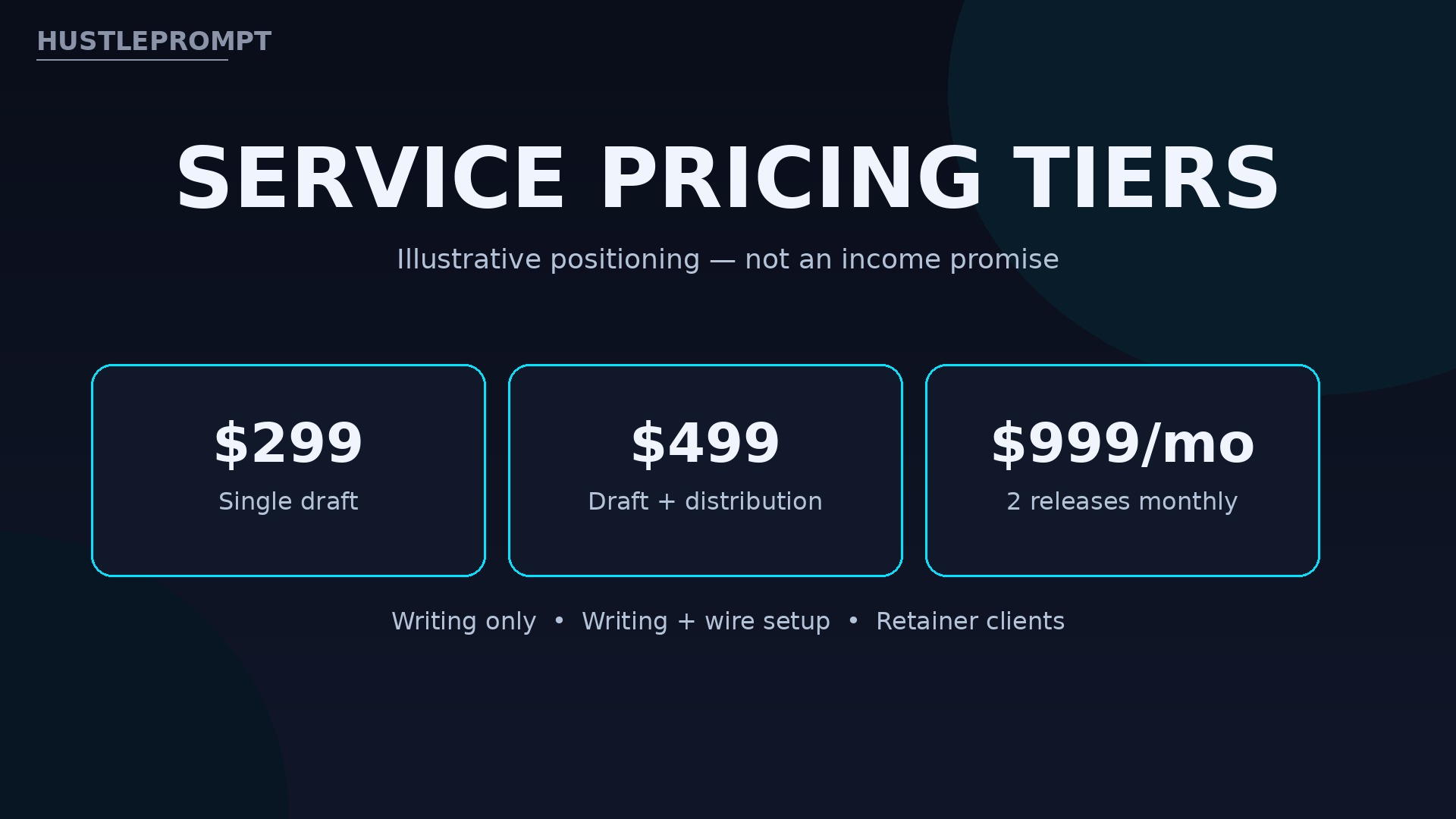
| Single draft | $299 | One release, 2 revisions |
| Draft + distribution | $499 + wire cost | Release, list, wire, pitches |
| Monthly retainer | $999 per month | 2 releases, monthly report |
These prices are illustrative positioning, not an income promise. Your rate depends on experience and market.
Gross math, before tool costs and taxes: four clients on the $499 package in one month equals $1,996. Wire fees pass through at cost, so they are not profit.
Keep tool costs low. One AI subscription and one media-list tool usually cover your first ten clients. Buy wire credits only after a client approves a release.
Finding your first three clients
Your first clients rarely come from ads. They come from visible work where founders already hang out.
- Rewrite one public release per week on LinkedIn, showing the before, the after, and the angle you fixed.
- Offer a free angle check to founders in startup communities, with no obligation to buy.
- Partner with fractional marketers and web designers who meet startups before launch.
- Pitch accelerator managers a batch rate for demo-day announcements.
Collect a short testimonial after each job. Never claim coverage you did not earn.
Honesty rules that protect your reputation
One invented quote can end this business. Journalists check facts, founders talk, and wires can pull releases.
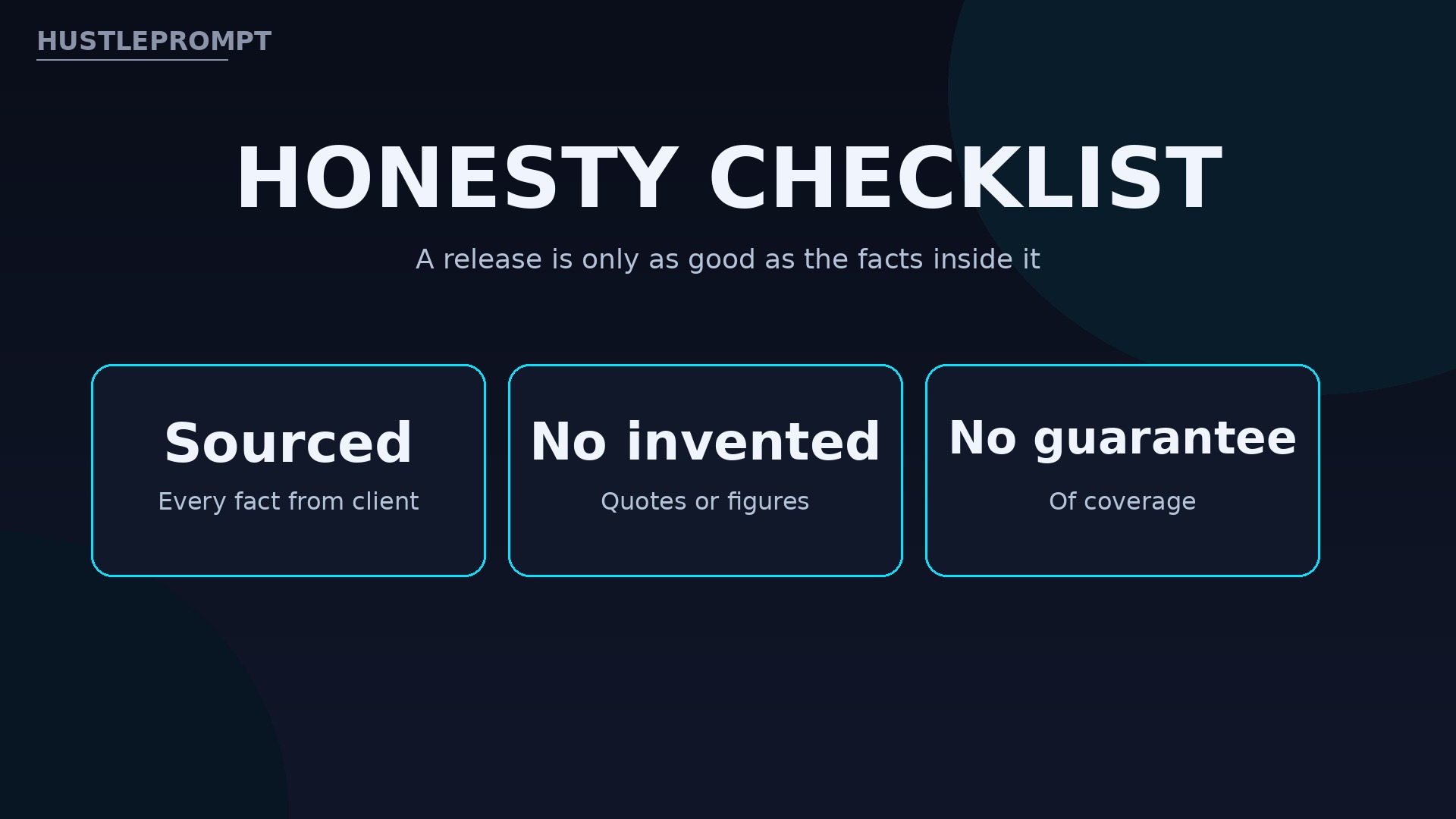
- Never invent quotes, funding figures, customer counts, or partnerships. If the client cannot source it, it stays out.
- Never promise coverage, backlinks, or rankings. Promise a checked release and honest reporting.
- Never reuse another client’s facts or present a template example as a real result.
- Disclose AI use to your client, and confirm a human fact-checked the final draft.
- Keep an approval trail: fact sheet, approved draft, and distribution receipt, filed per release.
Watch: how to write a press release, step by step
Video: How to Write a Press Release (Step by Step, with Example) — Media List’s step-by-step tutorial covers the headline, the lead paragraph, a realistic quote, the details, and sending the release to the right reporters — the same structure this service sells to startups. (Media List)
Frequently Asked Questions
How long should a startup press release be?
Aim for 400 to 600 words. Lead with the news and stop when the facts run out.
Can AI write the whole release for me?
AI can draft it, but a human must fact-check it. Every quote, figure, and claim needs a client-approved source first.
Which wire service should a startup choose?
Budget startups often start with a lower-cost wire such as EIN Presswire; public companies usually need a premium wire. Match the wire to the news value.
Does distribution guarantee media coverage?
No. Distribution places the release on a network. Coverage depends on the journalist and the angle, and no honest seller promises it.
How much should I charge for my first release?
Start with a flat package, such as a single draft around $299. Keep wire fees as a separate pass-through line.
What do I need from the client before I start?
A written fact sheet, an approved spokesperson and quote, a media contact, and sign-off. No facts, no release.
Keep Reading
- Sell AI Product Photo Services to Online Sellers
- Sell AI Spreadsheet Cleanup Services to Small Businesses
- Sell AI Cold Email Outreach Services to B2B Companies
Start with one founder, one honest angle, and one release you can defend word for word. That is how the service earns its second client, and its tenth.