
Leonardo AI hands you 150 free tokens every single day. That daily allowance is more generous than anything Midjourney offers — Midjourney has no free plan at all — and it is the reason Leonardo is the first AI image tool many creators actually stick with.
But free is not the whole story. Leonardo.Ai, now part of Canva, is a full creative studio: image generation, a layered Canvas editor, video from stills, and custom model training. The question is whether its token economy fits the way you work, and whether Essential at $10 a month billed annually is the right tier or just the cheapest door in.
This review breaks down the verified 2026 pricing, what Phoenix and Lucid Origin really do, how Leonardo compares with Midjourney, Ideogram, and Adobe Firefly, and whether it is worth paying for.
What Is Leonardo AI and How Does It Work?
Leonardo AI is a web-based creative platform that turns text prompts into images and video. You type what you want, pick a model tuned for that kind of image, and generate a batch of variations in seconds.
Think of it as four tools in one account. Image generation creates stills from prompts or reference images. Canvas edits those stills: refine a detail, extend the frame, or composite elements together. Motion and video models animate a still into a short clip. Model training teaches the system your own style or subject from a small set of images.
That breadth is the point. Most rivals do one thing well. Leonardo tries to carry a project from first idea to finished, client-ready asset without exporting to three other apps.
Key Features: What Leonardo AI Actually Does in 2026
Phoenix and Lucid Origin: the house models
Phoenix is Leonardo’s first foundational model, in versions 1.0 and 0.9. Its strengths are prompt adherence and legible text: it follows long, detailed prompts closely, and it renders words inside posters, labels, and branded graphics cleanly enough to use.
Lucid Origin is the newer flagship for high-detail, Full HD output — the pick for hero images, cinematic scenes, and work where fine detail matters more than strict prompt matching. When a prompt includes a sign or a headline, test it in both: Phoenix usually wins on accuracy, Lucid on polish.
Canvas: edit instead of regenerate
Canvas is Leonardo’s layered editor, and it is where the subscription starts paying for itself. Instead of re-rolling a whole image when one corner is wrong, you refine that area, extend the canvas, or blend elements from several generations into one composition. For client work, this is the difference between a tool and a toy: a good generation is a starting point, and Canvas is where it becomes deliverable.
Video: Motion plus third-party models
Leonardo animates stills with its own Motion models and hosts third-party video models — including Kling, Veo, Hailuo, Seedance, and Wan — inside the same account and token balance. Video costs far more tokens than images, because rendering frames takes far more GPU power, so treat video as a premium action, not a casual extra.
Train your own model
Upload a small set of images — Leonardo’s own help documentation says typically 10–20 — and train a personal model that recreates a specific style, character, or product. For a creator with a recurring mascot, a brand look, or a product line, this is Leonardo’s most defensible feature: no rival at this price makes a consistent style this easy to reuse.
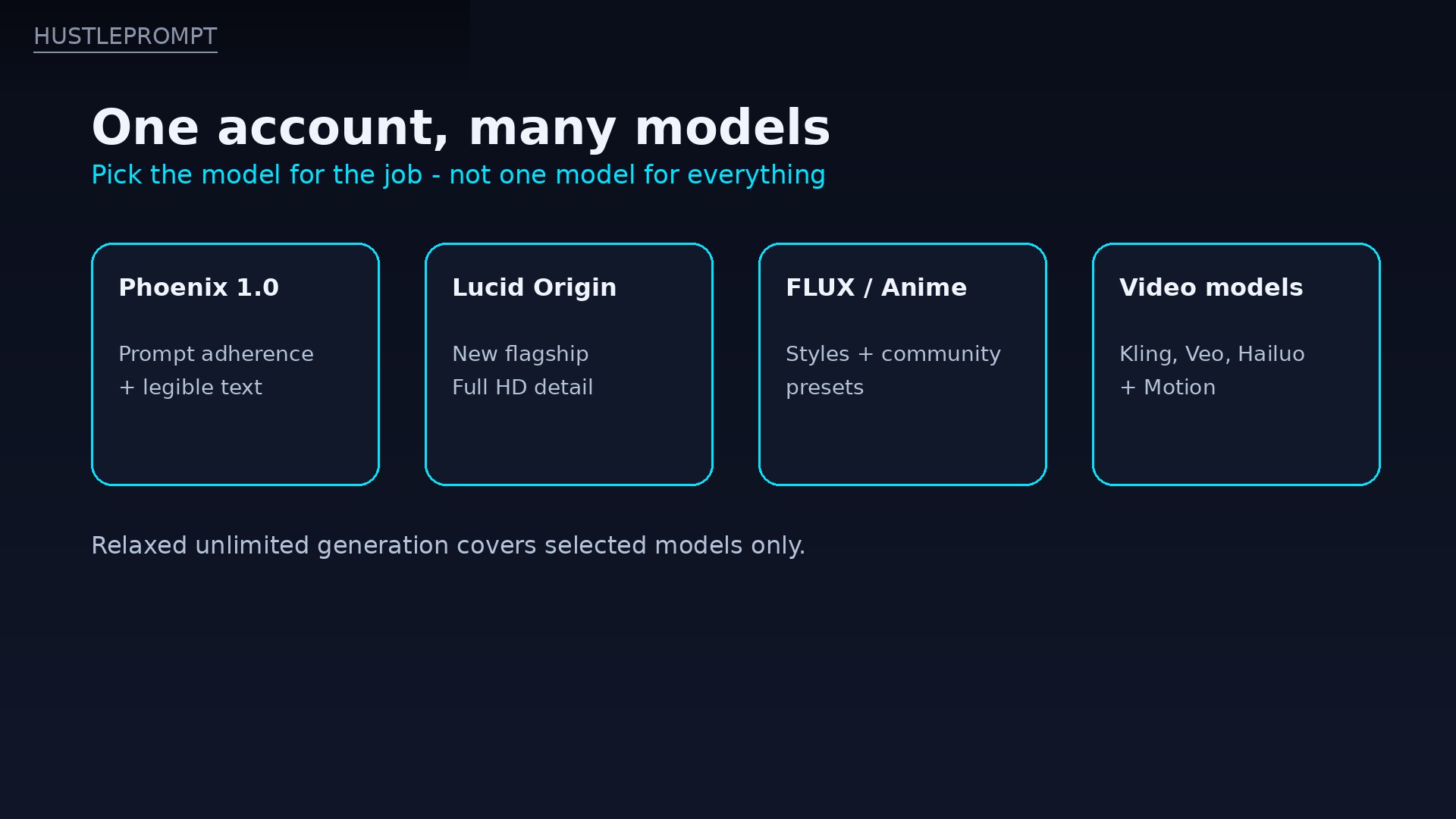
One account, many models: Phoenix for accuracy, Lucid Origin for detail, plus style models and video. HustlePrompt illustration (not a Leonardo screenshot).
How to Use Leonardo AI: The Workflow That Works
Leonardo rewards a short, disciplined loop. Random prompting burns tokens; a plan keeps them.
- Pick the model before you prompt. Phoenix for text-heavy or precise work, Lucid Origin for detailed hero images, a style preset for illustration.
- Write one scene, not a paragraph. Subject, setting, lighting, and style in that order — then let the prompt enhancer do the adjectives.
- Generate four, keep one. Judge the batch, then refine only the keeper in Canvas instead of re-rolling the set.
- Edit, don’t regenerate. Fix the wrong detail in Canvas; a targeted edit costs fewer tokens than a fresh batch.
- Upscale last, animate last. Upscaling and Motion are the most expensive steps, so spend them only on the final version.
That loop is the whole skill. Leonardo is easy to open and expensive to improvise in, so the model choice you make before generating matters more than the prompt you write after it.
Leonardo AI Pricing 2026 (Verified)
Prices below are in US dollars, excluding tax, as displayed on Leonardo’s official pricing page on October 30, 2026 — checked live in both monthly and annual billing views. Confirm on the official page before buying, because token allowances and model lineups change.
Leonardo AI plans — October 2026
| Plan | Price | Fast tokens | Key notes |
|---|---|---|---|
| Free | $0 | 150 / day | Public creations; no rollover; no top-ups |
| Essential | $12/mo monthly $10/mo billed annually ($120/yr) |
8,500 / mo | Private generations; 2 concurrent; rollover bank up to 25,500 |
| Premium | $30/mo monthly $24/mo billed annually ($288/yr) |
25,000 / mo | 3 concurrent; relaxed image generation on selected models; rollover bank up to 75,000 |
| Ultimate | $60/mo monthly $48/mo billed annually ($576/yr) |
60,000 / mo | 6 concurrent; relaxed image AND video generation; rollover bank up to 180,000 |
Team plans start separately, and API billing is pay-as-you-go apart from web-app subscriptions. Prices exclude tax, added at checkout via Stripe.
Three pricing details matter more than the headline numbers:
- Tokens are the budget, not images. Leonardo’s own pricing FAQ is explicit: a token does not equal one image. Cost depends on GPU intensity, so resolution, model, upscales, and video all burn at different rates. Track your first month before choosing a tier.
- Rollover is capped at three months’ worth. Unused tokens move to a Rollover Bank — 25,500 on Essential, 75,000 on Premium, 180,000 on Ultimate — instead of vanishing. That cap is exactly three times each monthly allowance, so banking a quiet quarter is possible but banking a year is not.
- Top-ups never expire, but need an active subscription. Paid users can buy token packs that do not expire and are spent after rollover and fast tokens. They are the safety valve for a heavy month — but they stop working if you cancel.
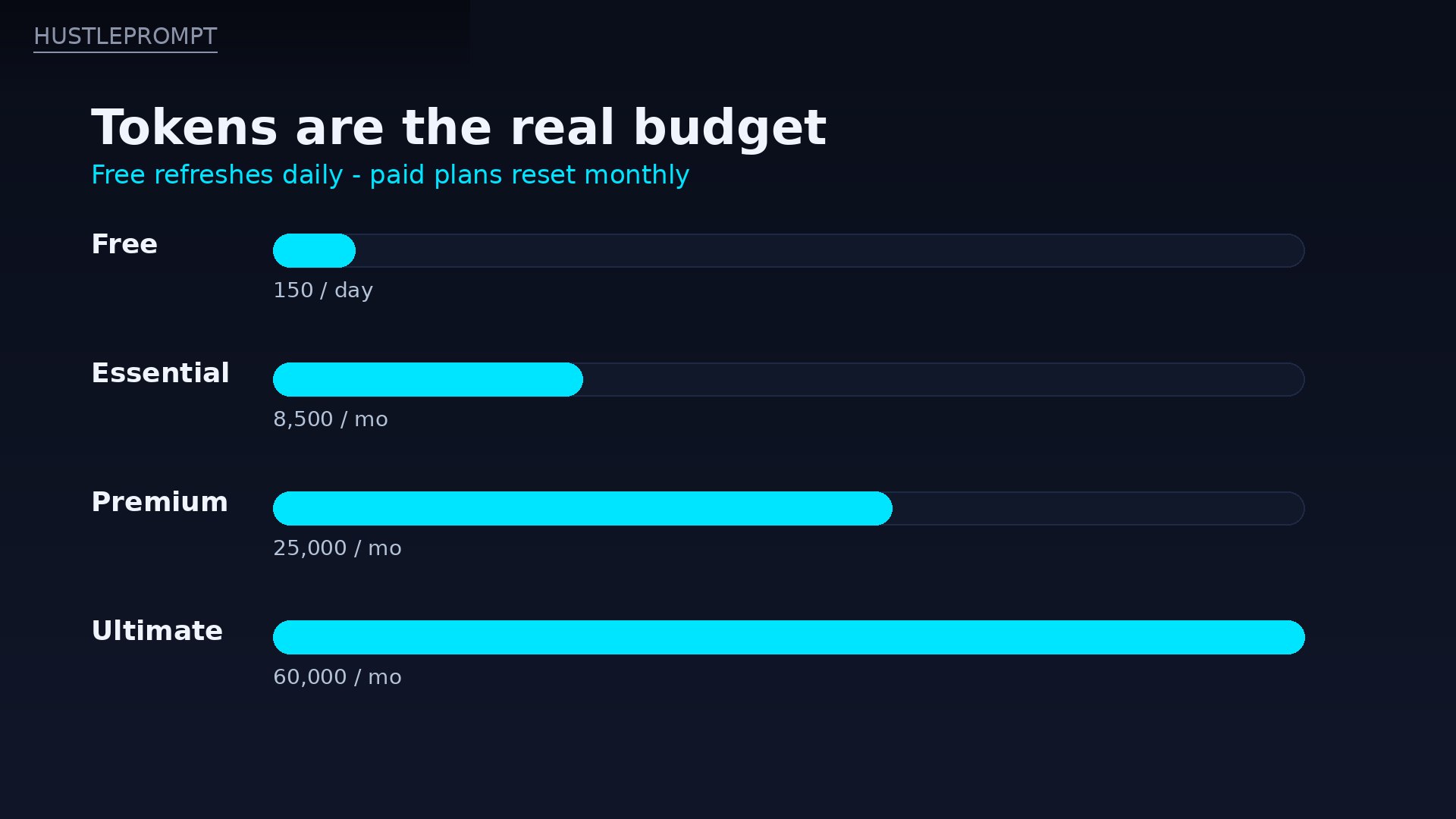
Tokens are the real budget: Free refreshes daily, paid plans reset monthly. HustlePrompt illustration (not a Leonardo screenshot).
Leonardo AI by the Numbers
What the official page actually says
Sources: Leonardo’s official pricing page and pricing FAQ, read October 30, 2026 (token allowances, rollover capacities, concurrency, top-up rules, relaxed-generation model lists). Commercial-use terms: paid subscribers retain full ownership and IP rights; free users receive a non-exclusive, royalty-free licence for commercial use.
The 60-Second Decision
Should you pay for Leonardo AI?
Just trying it?
Stay on Free. 150 tokens a day teach you the whole studio, though creations are public.
Regular creator?
Get Essential ($10–12/mo). Private generations and 8,500 tokens cover steady social and blog work.
Heavy daily volume?
Get Premium ($24–30/mo). Relaxed image generation means an empty token balance is not a hard stop.
Video + max volume?
Get Ultimate ($48–60/mo) — the only tier with relaxed video generation and 6 concurrent jobs.
Leonardo AI vs. the Alternatives
| Tool | Entry paid price | Free tier | The catch |
|---|---|---|---|
| Leonardo AI | Essential $10/mo annual ($120/yr), 8,500 tokens | 150 fast tokens/day | Token cost per image varies; relaxed mode covers selected models only |
| Midjourney | Basic $8/mo annual ($96/yr), 3.3 Fast GPU hours | None on the website | No free tier; private Stealth Mode needs Pro ($48/mo annual) |
| Ideogram | Plus $15/mo annual ($180/yr) | Weekly slow credits (amount varies) | Best at text in images, but no video product |
| Adobe Firefly | Standard $9.99/mo, 2,000 credits | Limited daily generations | Credits do not roll over; strongest inside Adobe apps |
Midjourney is the artistic pick. Its images still set the style bar, and Standard’s unlimited Relax mode is generous — but there is no free tier, and privacy costs Pro money. Leonardo wins on entry price and on the free on-ramp.
Ideogram is the text pick. If your work is posters, logos, and graphics where every letter must be right, Ideogram’s typography is its edge. It has no video product, though, and its free tier is a weekly slow allowance rather than a daily token budget.
Adobe Firefly is the Adobe pick. At $9.99 a month it undercuts Leonardo’s monthly price, and it is commercially safe by design — but its credits expire monthly with no rollover, and it shines brightest if you already live in Photoshop and Illustrator.
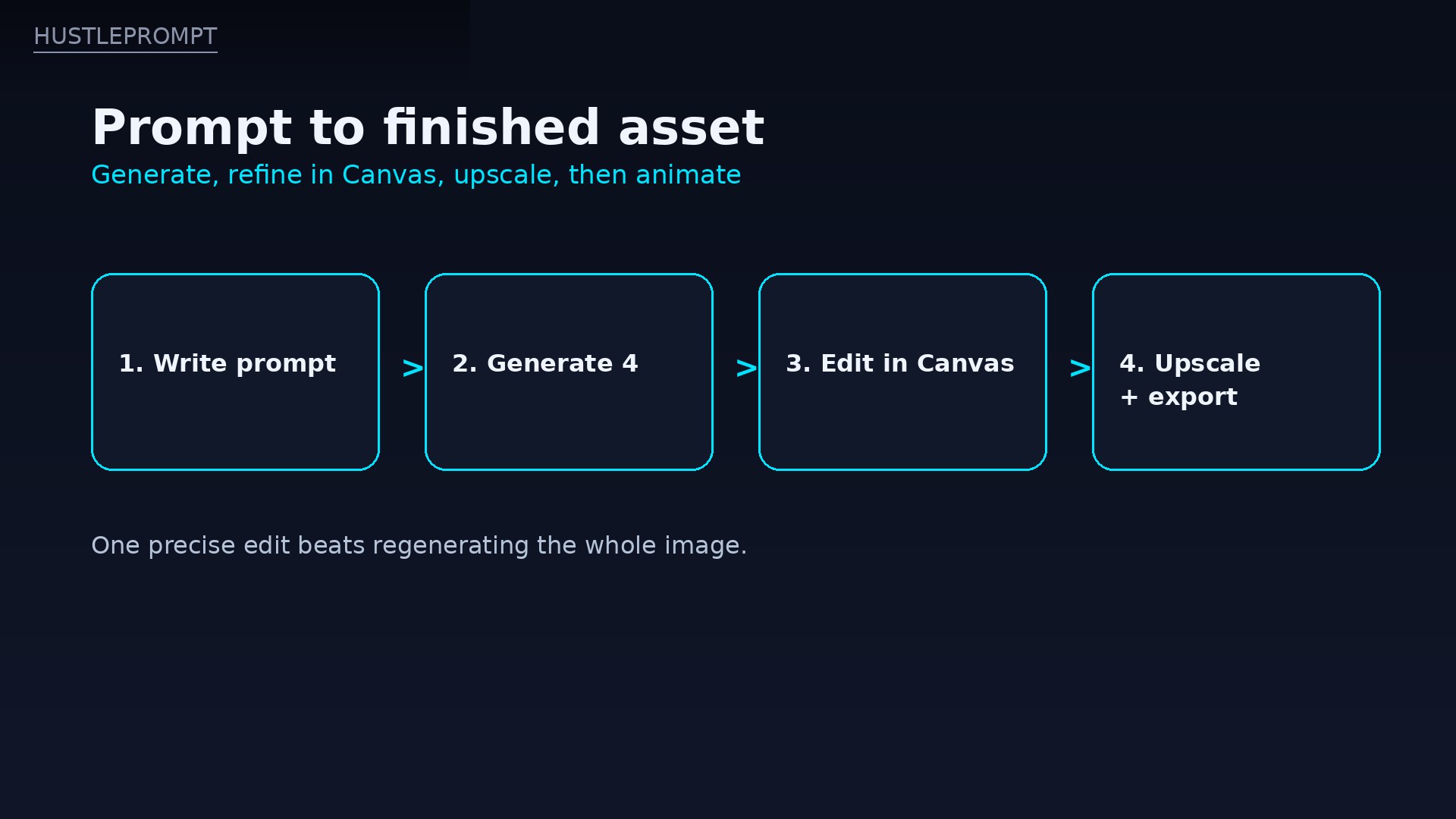
Prompt to finished asset: generate, refine in Canvas, upscale, then animate. HustlePrompt illustration (not a Leonardo screenshot).
Pros and Cons
| Pros | Cons |
|---|---|
| A real free tier: 150 tokens a day, every day | A token is not an image — costs vary by model, size, and task |
| Phoenix nails prompts and legible text; Lucid Origin adds Full HD polish | Relaxed unlimited generation covers selected models only — third-party models always cost tokens |
| Canvas editing, video, and model training in one subscription | Video burns tokens fastest; Ultimate is the only tier with relaxed video |
| Rollover bank up to 3x monthly tokens; top-ups never expire | Top-ups require an active subscription to use |
| Paid subscribers keep full ownership and IP rights | Free creations are public, and free users do not own the IP outright |
| Private generations from Essential up — no Pro-tier paywall for privacy | The model menu is large enough to confuse beginners |
Who Is Leonardo AI For?
- Content creators and bloggers: daily hero images, thumbnails, and social graphics without a designer.
- Freelancers and agencies: client visuals with a consistent, trainable style — and private generations from $10 a month.
- Game developers and indie artists: concept art, assets, and style exploration in one studio.
- Marketers and small brands: posters and product visuals where legible text matters.
It is not for anyone who wants a single perfect model and nothing else — Midjourney’s focused artistic engine may suit you better — or for pure video production, where a dedicated video tool stretches further per dollar.
How Freelancers Actually Profit With Leonardo AI
Essential at $10 a month billed annually is cheap enough that one small job covers the year. Four playbooks that work right now:
1. Blog and social image packs
Sell a monthly pack of 10–20 on-brand images to a blogger or small business for $150–$400 a month. Train one personal model on their style once, then every pack looks like theirs.
2. Product and poster visuals
Use Phoenix for posters and listings where the text must be right, and charge $40–$150 per finished visual. Legible text is the feature clients notice — and the one most free tools fail.
3. Thumbnails and ad creatives
Generate four variations per brief, refine the winner in Canvas, and sell thumbnail sets to YouTubers at $25–$75 each. Volume is the product: one creator can need 8–12 a month.
4. Short animated clips
Animate a still with Motion or a hosted video model and sell 5-second social loops for $50–$150 each. Keep video on Premium or Ultimate, where relaxed generation caps the cost of experimentation.
FAQ
Is Leonardo AI free?
Yes, with real limits. Free costs $0 and gives 150 fast tokens a day, refreshed daily. Creations on Free are public, and free users receive a commercial licence rather than full IP ownership.
How much does Leonardo AI Essential cost?
Essential is $12 per month billed monthly, or $10 per month billed annually ($120 per year). It includes 8,500 fast tokens a month, private generations, 2 concurrent generations, and a rollover bank of up to 25,500 tokens.
How many images do 8,500 tokens buy?
There is no fixed answer, and that is the point to understand before paying. Leonardo charges by GPU intensity, so model, resolution, upscaling, and video all cost different amounts. Treat the first paid month as a measurement month.
Do Leonardo AI tokens roll over?
Yes, up to a cap. Unused tokens move to a Rollover Bank capped at three times the monthly allowance: 25,500 on Essential, 75,000 on Premium, 180,000 on Ultimate. Token top-up packs never expire but require an active subscription to use.
What is Relaxed Generation?
When your tokens run out, Premium and Ultimate keep generating on selected models at lower queue priority — images on Premium, images and video on Ultimate. Third-party models like Kling, Veo, and Nano Banana are excluded, as is Flow State, so those always cost tokens.
Leonardo AI vs. Midjourney — which should I pay for?
Leonardo if you want a free tier, Canvas editing, video, and model training in one account from $10 a month. Midjourney if you want the most artistic single-model output and can live without a free plan — Standard at $24 a month annual is its sweet spot.
Is Leonardo AI worth $10 a month?
Yes, if you create images weekly. Essential’s private generations, 8,500 monthly tokens, and rollover bank make it a fair test price, and the free tier means you can prove the workflow before paying. If you only need a few images a month, stay on Free — 150 tokens a day already cover that.
Watch: Leonardo 103 — A Generative AI Masterclass
Leonardo’s own education-team masterclass on Phoenix, covering the ImageGen interface, prompt enhancement, and image-guidance workflows.
Verdict: Is Leonardo AI Worth $10/Month?
Yes — Essential at $10 a month billed annually is worth it for creators who actually make images. No rival at this price combines a daily free tier, private generations, Canvas editing, video, and trainable models in one account.
Skip Premium unless you generate daily and want relaxed image generation as your safety net. Skip Ultimate unless video is core to your work or you need 6 concurrent generations.
Bottom line: at $120 a year, Leonardo Essential pays for itself with a single small client job. Just remember the real rule of this tool: count tokens before you subscribe, draft on the free tier, and never let a token balance decide the quality of an image you send to a client.
Sources: Leonardo’s official pricing page and pricing FAQ, read live October 30, 2026 (plan prices in both billing views, token allowances, rollover capacities, concurrency, top-up rules, relaxed-generation model lists, commercial-use terms); Leonardo’s Phoenix model page (prompt adherence, legible text); October 2026 pricing summaries for Midjourney, Ideogram, and Adobe Firefly competitor figures. Prices change — confirm on the official sites before subscribing.