
On Friday, October 30, 2026, the AI boom got its first credit-market verdict. S&P Global Ratings revised Meta’s outlook to negative from stable, citing uncertainty over the company’s AI capital spending and free operating cash flow. The Nasdaq Composite fell 2.86% the same day.
That pairing — a ratings agency questioning the money, and the market selling the stocks — is the moment the AI trade changes character. For three years, the pitch was growth at any price. Now the question investors ask, out loud and with numbers attached, is simpler: when does this spending pay back?
For freelancers, creators, and small businesses, that question is not Wall Street gossip. It is the sales environment you now work in. Every client who bought AI tools on hype will soon be asked to justify them on returns — and the person who can prove the payback, or cut the waste, is about to be the most hireable person in the room.
What Is Actually Trending
An AI ROI reckoning is what happens when the bill for a technology arrives before the revenue it was supposed to create. The technology can be real and the spending can still be wrong — wrong in size, wrong in timing, or wrong in the projects chosen. The reckoning is the market repricing that gap.
Meta is the clearest case because its numbers are public and its monetization path is the murkiest. Last week, Meta forecast annual capital expenditure between $135 billion and $145 billion, after reporting a free cash flow deficit of $2.12 billion in the third quarter. S&P now forecasts free operating cash flow deficits of $39 billion in 2026 and $71 billion in 2027, with elevated spending possibly keeping cash flow negative beyond 2028.
Meta disputes the verdict. A spokesperson told Reuters the company “respectfully disagree[s] with S&P’s assertion about Meta’s AI monetization capabilities,” pointing to significant product and business opportunities ahead and a very strong credit profile. Both things can be true at once: Meta may eventually monetize, and the market may still refuse to wait on faith alone.
The selloff around it was broad, not a single-stock story. The Nasdaq 100 fell 3.5% on Friday, briefly entering correction territory, according to Bloomberg coverage. The iShares Semiconductor ETF fell 8.24% that day, and market data showed AI-focused ETFs down sharply over the month — Global X’s AIQ down 9.2% over one month to the October 30 close. When credit analysts and equity traders agree, even for a day, the mood has genuinely shifted.
The Evidence: Spending, Borrowing, and a Filing
Start with Meta’s own arithmetic, because it frames everything else. S&P’s concern is not one bad quarter. It is a multi-year pattern: leverage rising from about 0.1 times in 2025 toward above 1.0 times as early as 2027, the agency’s threshold for the AA- rating, with long-term debt already at $80.92 billion as of September 30.
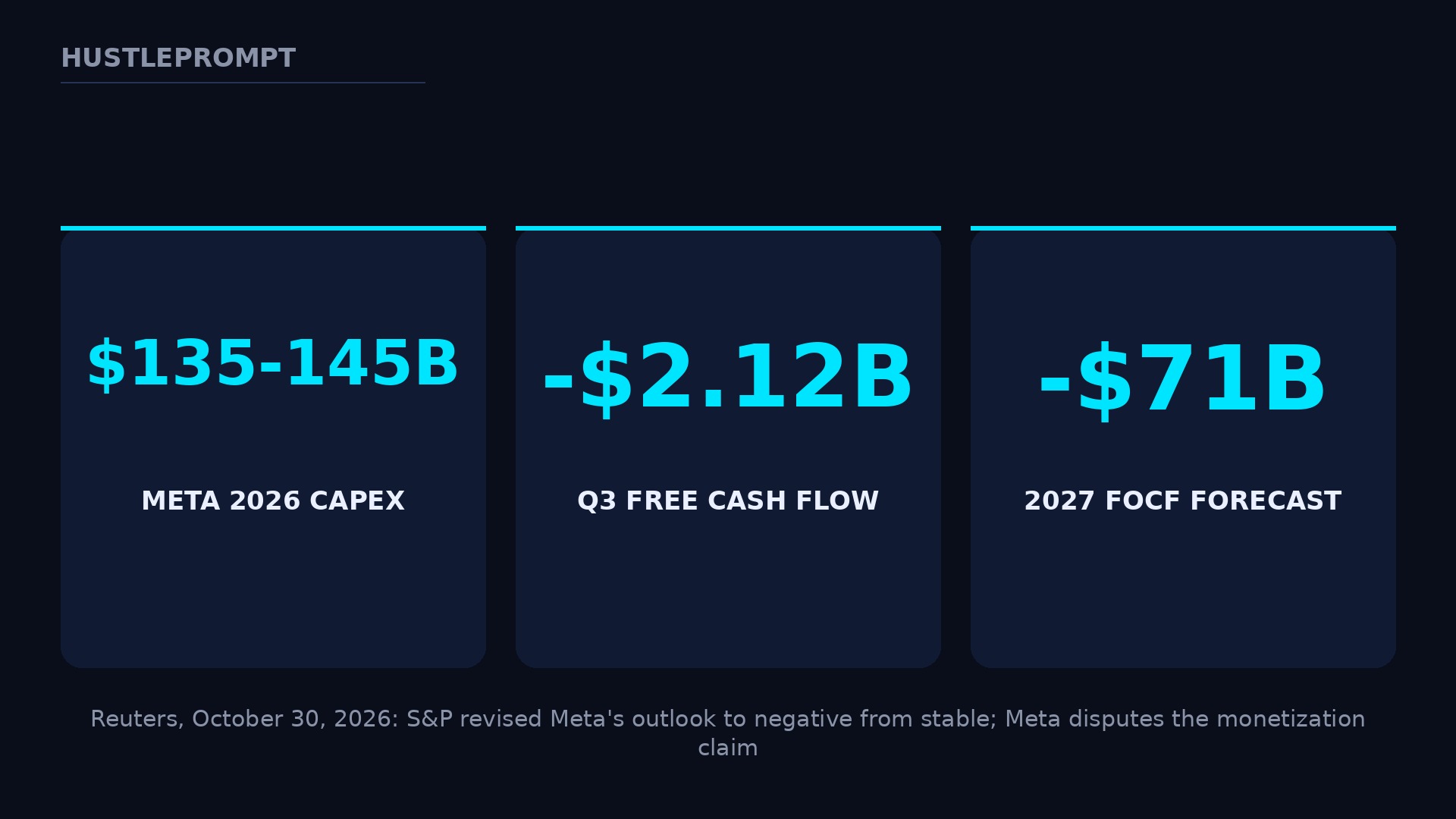
Sources: Reuters via WIXX, “S&P Global revises Meta’s outlook to ‘negative'” (Oct 30, 2026) · Bloomberg via CNBC TV18 on TradingView, Meta outlook coverage (Oct 31, 2026) · ActionForex, “AI Sell-Off Spreads Beyond Tech as Credit Risks Rise” (Oct 31, 2026).
Then look at Anthropic, because its week tells the other half of the story: even the winners now finance growth with staggering commitments. On October 26, 2026, Anthropic filed publicly for its IPO under the planned Nasdaq ticker ANT, reporting $16.3 billion in first-half 2026 revenue — up from $1.2 billion a year earlier — alongside an $80.7 billion net loss, about $72 billion of which was a non-cash accounting charge tied to convertible notes.
The same day, Bank of America, Citigroup, Morgan Stanley, and Blackstone unveiled a $63 billion financing package: a new company borrows the money, buys Broadcom chips and networking gear, and leases it to Anthropic, with deliveries expected from 2027. Roughly $43.5 billion of it is senior debt. Broadcom’s CEO spent nearly two months pushing banks to commit, agreeing to higher interest rates to keep them in — a detail that says more about the financing climate than any press release.
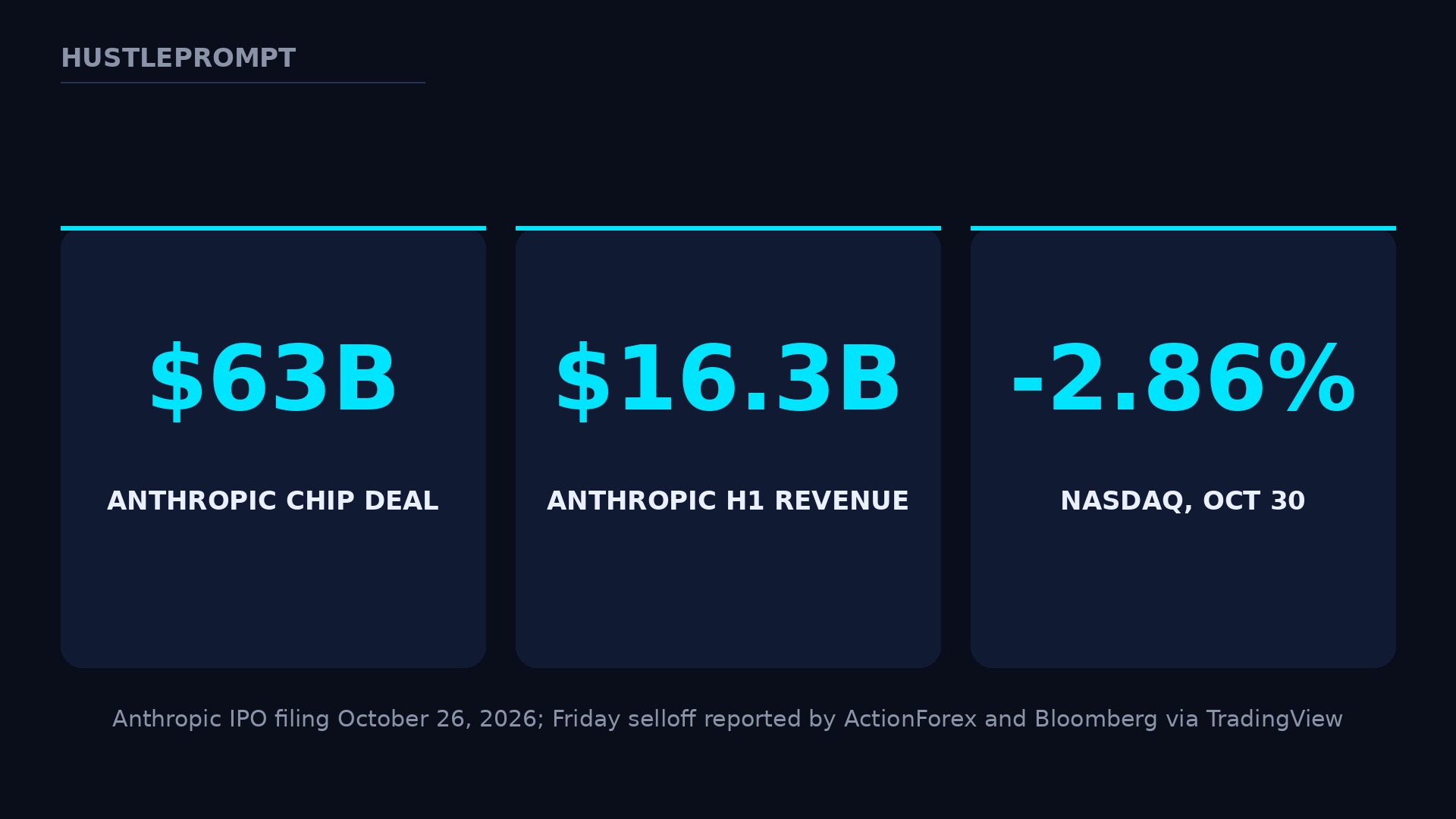
The pattern across both companies is the same, and it is the pattern to watch: revenue is genuinely exploding, and the financing required to keep it exploding is exploding faster. Anthropic’s filing also disclosed a five-year equipment lease arrangement involving approximately $125.2 billion in payments, excluding interest, and the ability to issue up to $42 billion in convertible notes to Broadcom or a financing partner. Growth this capital-intensive does not survive on enthusiasm. It survives on proof, delivered quarterly.
One more data point belongs in the picture, because it shows the reckoning is not only American. Reports on the same week put China’s STAR 50 index of AI and semiconductor leaders down around 40% in less than four months, wiping out roughly $480 billion in market value. The AI trade is global, the financing question is global, and the correction is arriving in every market that rode the boom.
The Reckoning, in Four Steps
Hype buys the tools. Proof keeps them. Waste is what gets cut first.
Capex explodes first
Data centers, chips, and power are bought years before the revenue they will serve exists.
Debt fills the gap
Stock sales, leases, and special-purpose vehicles fund the buildout while cash flow lags.
Analysts ask for payback
A ratings outlook, a downgrade warning, or a bad quarter turns spending into a headline.
Waste dies, proof survives
Unused tools, duplicate subscriptions, and unmeasured pilots are cancelled. Measured work keeps its budget.
How to Profit From This Trend
Here is the opportunity hiding inside the selloff: every business that bought AI tools in the last two years now has a drawer full of subscriptions nobody measures. The CFO, the owner, or the board will soon ask the question S&P just asked Meta — what is this spending actually returning? Most small businesses cannot answer it, because nobody ever set up the measurement.
The offer is an AI ROI audit: you inventory every AI subscription, seat, and API bill, attach each one to a real outcome (hours saved, leads answered, content shipped, support tickets closed), and produce a one-page verdict per tool — keep, cut, or renegotiate. The rebuild that follows cancels the waste, consolidates duplicate tools, and puts the survivors on a monthly payback report the owner can show a lender, a partner, or a board.
This is not investment advice, and it is not a stock call. It is a services business built on a budgeting shift: in a reckoning, the seller who documents returns beats the seller who promises magic. Your audit is the document.
Prices below are my estimates based on comparable freelance consulting and automation service rates, not market data:
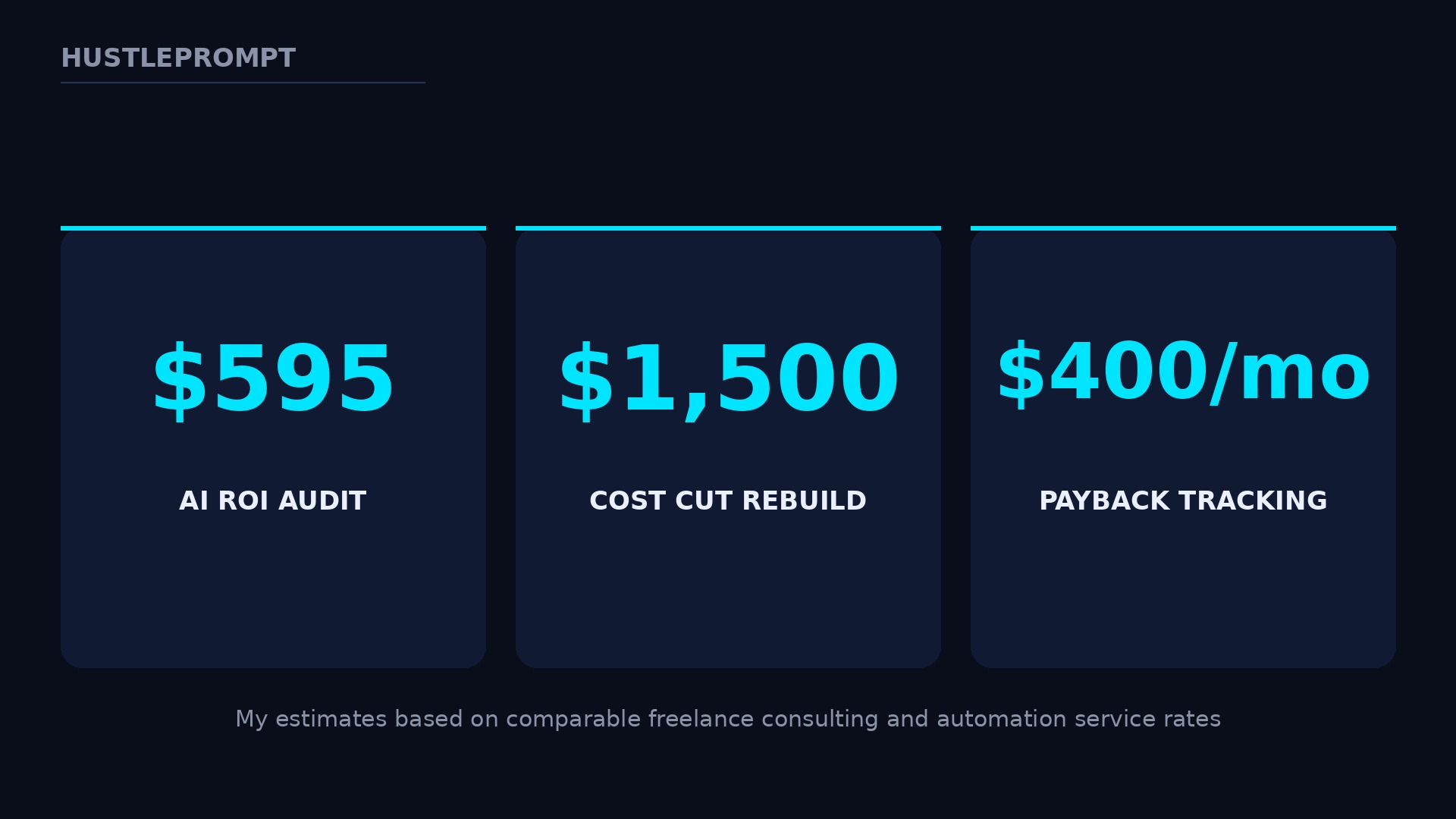
Lead with the S&P headline, not with your service list. “Meta just got its outlook cut over AI spending. When did you last audit yours?” Then show the math on the client’s own stack: three duplicate tools, two unused seats, one API bill nobody owns. The audit pays for itself in the first cancellation round — and that sentence closes the sale.
What to Do This Week
- Audit your own AI stack first. List every subscription, seat, and API bill, and attach each to one measured outcome. Cancel one tool yourself before you sell the audit.
- Build the one-page verdict template. Tool, monthly cost, outcome it serves, keep / cut / renegotiate — one row per tool, no jargon, no appendix.
- Pitch three businesses that bought AI on hype. Agencies, realtors, and e-commerce sellers are the warmest leads: visible AI spend, thin measurement, and an owner who feels the squeeze.
- Offer the monthly report as the retainer. The audit is the entry product; the payback report is the recurring revenue, because spending drifts back up without it.
Watch: why borrowing, not stock prices, is the real weak point in the AI buildout — and what the dot-com era actually teaches about surviving a correction. Watch on YouTube.
Where This Is Heading
Payback reporting becomes standard. Just as cloud bills got FinOps, AI bills will get ROI reporting. Businesses that can show cost per outcome will keep their budgets; businesses that cannot will lose them in the next review cycle.
The winners split from the spenders. Anthropic’s revenue growth shows real demand exists. The correction will not kill AI spending — it will concentrate it on tools with proven returns, and starve the rest. That concentration is good news for sellers of measured work.
Financing terms tighten before spending falls. Higher rates on deals like Anthropic’s $63 billion package are the early signal: capital is still available, but at a higher price and with more scrutiny. Expect every AI budget to face the question Meta just faced — and expect the auditors to be busy.
Frequently Asked Questions
What is the AI ROI reckoning?
The moment investors and lenders stop funding AI spending on growth promises alone and start demanding measured payback — visible in Meta’s outlook cut, the October 30 selloff, and tighter financing terms.
Why did S&P cut Meta’s outlook to negative?
S&P cited uncertainty over Meta’s capital spending and free operating cash flow: a $135–145 billion 2026 capex forecast, a $2.12 billion Q3 free cash flow deficit, and forecast deficits of $39 billion in 2026 and $71 billion in 2027. Meta disputes the monetization claim.
What did Anthropic’s IPO filing reveal?
Filed October 26, 2026, for a Nasdaq listing under ticker ANT, it showed $16.3 billion in first-half revenue, up from $1.2 billion a year earlier, and an $80.7 billion net loss driven mostly by non-cash convertible-note accounting charges.
What is the $63 billion Anthropic chip deal?
A financing package unveiled October 26, 2026, in which a new company borrows $63 billion, buys Broadcom chips and networking gear, and leases it to Anthropic, with deliveries from 2027. About $43.5 billion is senior debt.
Does the selloff mean AI is a bubble about to pop?
Not necessarily. A correction reprices spending and financing; it does not erase real demand, as Anthropic’s revenue growth shows. The distinction that matters is between tools with measured returns and spending with none.
How do I profit from the reckoning without giving investment advice?
Sell measurement, not market calls: audit a business’s AI spend, cut the waste, and report payback monthly. You are documenting a client’s own costs and outcomes, not advising anyone on stocks.