
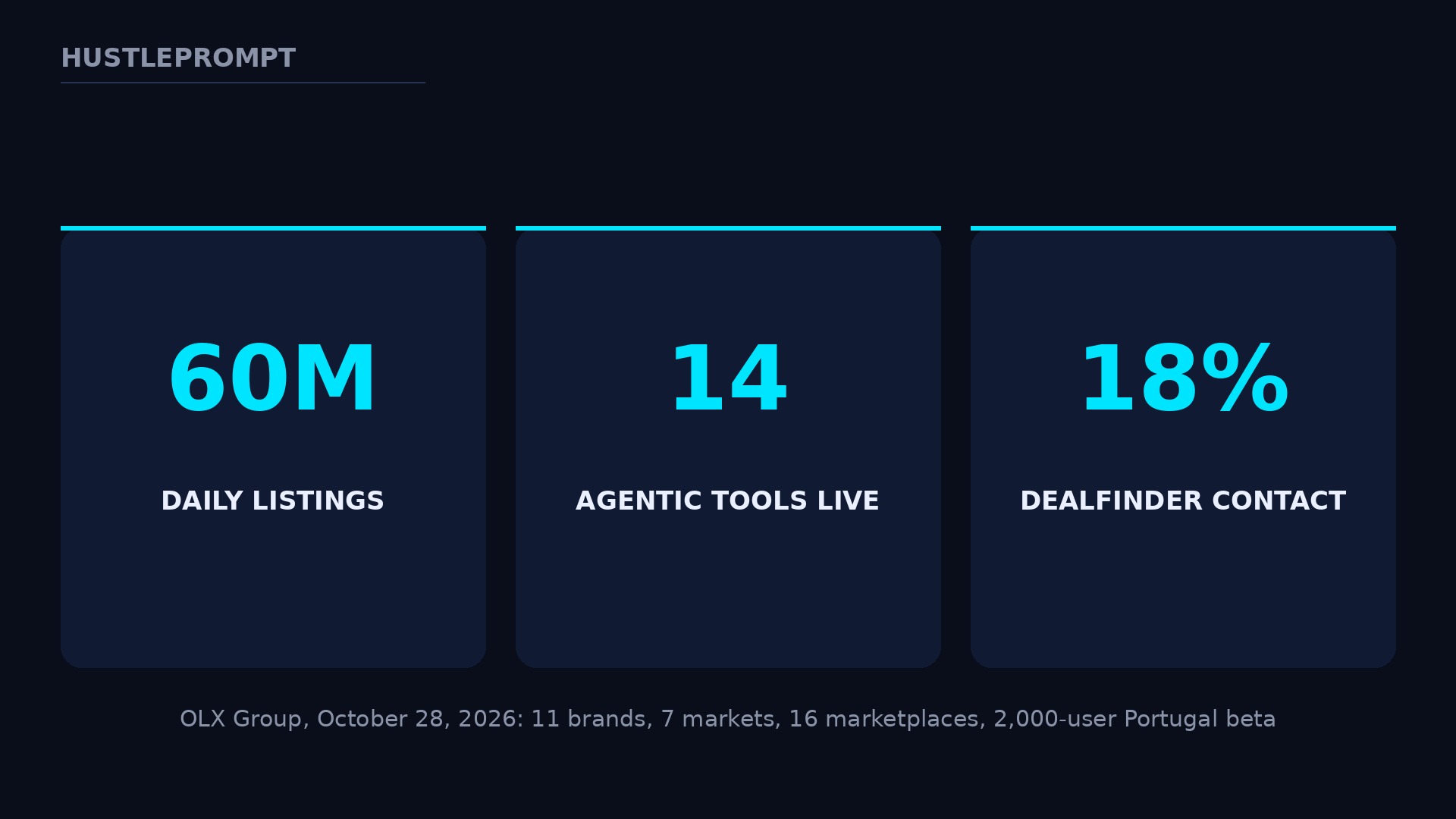
A marketplace with nearly 60 million daily listings just showed its hand. OLX Group, the classifieds giant behind 11 brands in seven markets, launched two AI agents at once on October 28, 2026: one that helps people sell, and one that helps people buy.
That pairing is the story. Most AI commerce coverage follows a single agent — a chatbot, a shopping assistant, a listing writer. OLX put an agent on both sides of the same transaction, then published the numbers that explain why: buyers want help finding deals, sellers want help finishing listings, and neither side trusts an agent to make the final call.
For US resellers, realtors, and dealers, the lesson travels even though OLX does not operate here. Agent-assisted selling plus alert-driven buying, with a human keeping the price decision, is about to be the default shape of every marketplace you sell on.
What Is Actually Trending
OLX unveiled Agentic Selling and DealFinder at CLAIM Online 2026, its future-of-marketplaces summit, on October 27, with the announcement published October 28. Agentic Selling guides property sellers from valuation to posting. DealFinder is a buyer-side assistant on WhatsApp that finds items, sets price and item alerts, and takes searches by text, image, or voice.
The rollout is deliberately staged, not a big-bang launch. Agentic Selling is live for 20% of private sellers on Otodom, OLX’s property platform in Poland. DealFinder is being scaled after a beta test in Portugal with 2,000 users. Staged rollouts are how marketplaces test trust: a bad agent experience at 20% is a fixable experiment, while the same experience at 100% is a headline.
The scale behind the launch is easy to miss. OLX has built AI into its marketplaces for more than eight years and now reports 86 live machine-learning use cases, 28 live generative-AI use cases, and 14 agentic solutions in market across 16 marketplaces. Agentic Selling and DealFinder are not a startup pilot. They are the next layer on an already-agent-heavy platform.
The US parallel is already visible. Google’s Business Agent inside YouTube ads — a conversational helper that lets viewers ask product questions without leaving the video — is in beta for eligible US retailers, as part of Google’s agentic-commerce push. Different market, same direction: the agent moves to the point where the shopper is already looking, and the seller’s job becomes feeding it clean, trustworthy listings.
The Evidence: Scale, Conversion, and a Trust Gap
Start with the beta number, because it is the one a reseller can actually use. In DealFinder’s Portugal beta, with 2,000 users, the assistant achieved an 18% conversion rate to contact — meaning nearly one in five assisted searches ended with the buyer contacting a seller. That is a beta on a new tool, not a mature-channel average, and OLX reports it as its own result. Treat it as a signal of what alert-driven buying can do, not as a promise for your listings.
Sources: OLX Group press release via PR Newswire, “OLX Group launches Agentic Selling and DealFinder” (Oct 28, 2026) · Unite.AI, “OLX Group Unveils Agentic Selling and DealFinder at CLAIM Summit”.
Then comes the number that should change how every seller writes a listing. In OLX’s October 2026 real-estate survey of 2,819 home seekers in Poland, Portugal, and Romania, 78% want AI-altered listings disclosed, and only 5% would trust an AI valuation over a human agent’s estimate, against 36% who trust the realtor’s estimate. The most requested AI features were alerts for matching listings and side-by-side comparison tools — help finding and comparing, not help deciding.
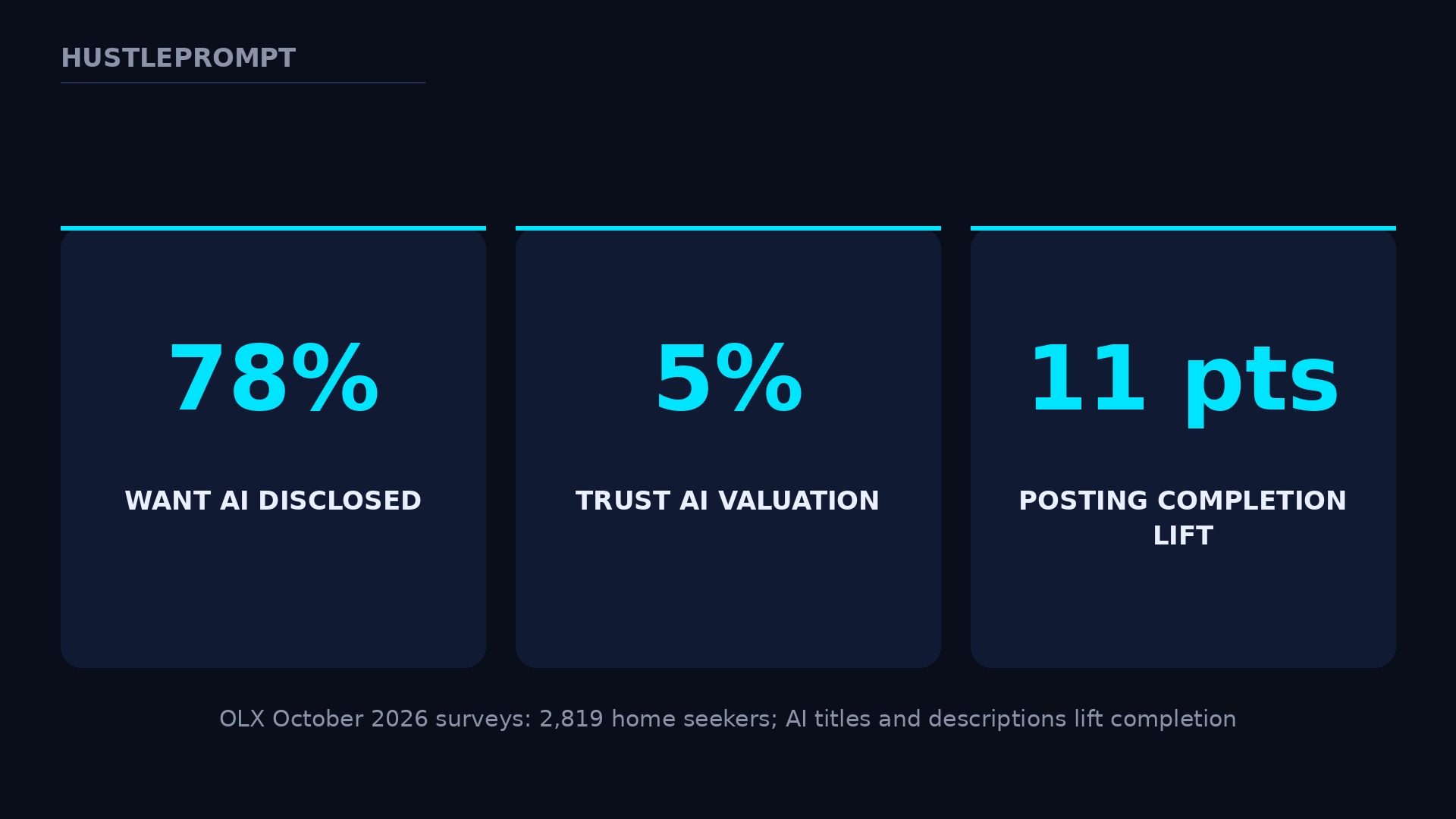
That trust gap is the whole business opportunity in one chart. Buyers will let an agent do the chasing and the comparing. They will not let it set the price or hide its own edits. OLX’s chief data officer, Andreas Merentitis, put the design rule in one sentence: “AI should handle the complexity, while people make the decisions that matter.” CEO Christian Gisy added the warning behind it: adoption shows who has tried AI, not whether they trust the outcome.
The jobs survey tells the same story from the other side of life’s big decisions. Among 1,510 people aged 18 to 29 in five European countries, 92–96% use AI tools personally, yet fewer than 41% feel ready for labour-market changes, and Poland is the most cautious market at 37% reporting high or very high concern. OLX’s own career agents score well inside that caution — 88% of users found the CV Optimiser useful, 90% said they love the AI Interviewer, which runs more than 1,000 practice interviews a month. Useful and loved — but still supervised.
One more measured result matters for dealers. In Motors, more than 70% of dealers accept AI-made videos of their cars, and AutoIQ, OLX’s dealer agent, is live with all dealers in Poland and Portugal. When a tool saves time without taking the sale away, adoption stops being a debate.
The Agentic Sale, in Four Steps
The agent chases, compares, and drafts. The human prices, discloses, and closes.
The buyer agent watches
Price and item alerts, searched by text, image, or voice, surface matches the moment they appear.
Side by side, not sold to
The most requested feature is comparison. Shoppers want the trade-offs visible, not a single pushy recommendation.
18% reach the seller
DealFinder’s beta turned nearly one in five assisted searches into seller contact. That contact is the conversion.
Price stays human
Only 5% trust an AI valuation over a human’s. Disclose AI edits, show the reasoning, and let the seller set the price.
How to Profit From This Trend
There are two ways to make money from agentic marketplaces. The first is selling better listings to sellers. The second is buying better with alerts as a reseller. Sell the first to fund the second.
On the seller side, the offer is a disclosure-first listing system: AI-drafted titles and descriptions that a human checks, photos with AI edits labelled, a price range with the reasoning shown, and a comparison sheet against similar sold listings. OLX’s own data justifies the pitch: AI titles and descriptions lift posting completion by 11 percentage points, and AI ad posting halves time-to-post in real estate. Your version of that system, sold to realtors, dealers, and high-volume resellers, is a service, not a tool recommendation.
On the buyer side, the offer is alert sourcing: a standing watch over a narrow niche — one car model, one sneaker line, one furniture category — with price, condition, and location criteria written down, so undervalued listings get flagged within minutes. DealFinder’s 18% contact rate is the benchmark to beat in your own reporting, not a guarantee: your monthly report shows alerts sent, contacts made, and items bought below target price. The niche matters more than the tool. Broad alerts are noise; narrow alerts are inventory.
Prices below are my estimates based on comparable freelance listing and reselling service rates, not market data:
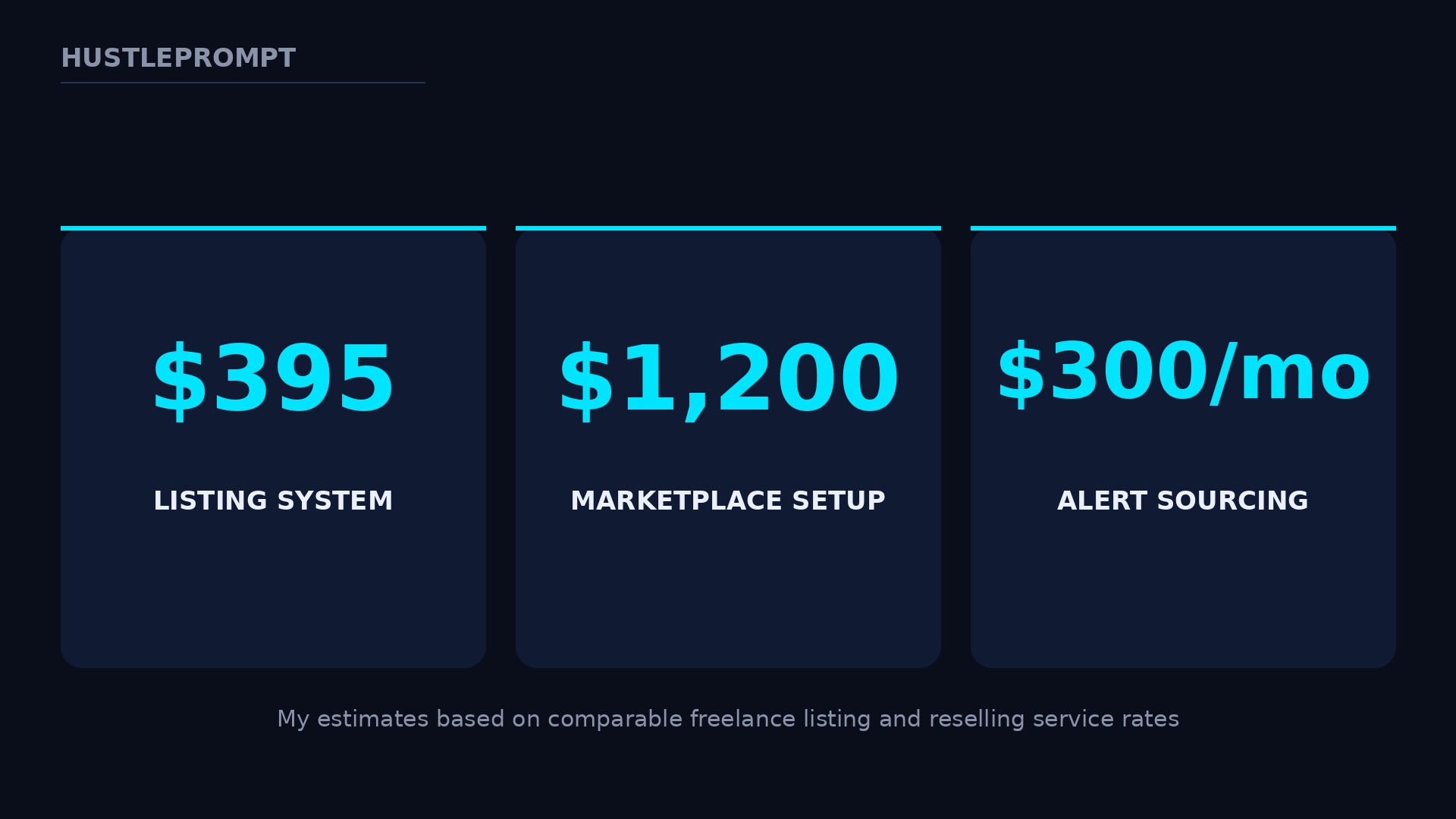
Lead with the trust line. “Every AI edit in your listings is labelled, every price shows its reasoning, and you set the final number.” Where 78% of surveyed home seekers want disclosure, that sentence is why a buyer picks your client’s listing over an identical, undisclosed one.
What to Do This Week
- Pick one narrow niche. One car model, one product line, one neighbourhood. Alert sourcing only works when the criteria are tight enough to act on.
- Rewrite five listings disclosure-first. AI draft, human check, labelled edits, price reasoning shown. Measure completion and inquiry rate against the old versions.
- Set three alerts and log them. Price, condition, and location criteria in writing; every hit logged with outcome. Your log is next month’s sales report.
- Never let an agent set the price alone. Show the comparable sales, state the range, and keep the final number a human decision — in the listing and in your contract.
Watch: from eCommerce to AI commerce, where buyer and seller both arrive with an agent — and why the agent is a supervised assistant, not a magician. Watch on YouTube.
Where This Is Heading
Every major marketplace adds both agents. OLX runs 14 already, and the seller-agent-plus-buyer-agent pattern is too obviously right for rivals to ignore. Expect Facebook Marketplace, eBay, and property portals to follow it.
Disclosure becomes a ranking advantage. When most shoppers want AI edits labelled, platforms will eventually reward listings that already label them — with placement, a badge, or buyer preference. Build disclosure in now, not later.
The human premium grows. Only 5% trust an AI valuation over a human’s. That gap closes slowly, listing by listing, as agents prove they save time without taking the decision away. Verified condition, honest pricing, and fast human replies are the one thing the agent cannot fake.
Frequently Asked Questions
What are OLX Agentic Selling and DealFinder?
Agentic Selling guides property sellers from valuation to posting, live for 20% of private sellers on Otodom in Poland. DealFinder is a WhatsApp buyer assistant that finds items, sets price and item alerts, and searches by text, image, or voice.
What did DealFinder’s beta actually prove?
In a 2,000-user beta in Portugal, DealFinder achieved an 18% conversion rate to seller contact. That is a beta result reported by OLX, not a mature-channel average or a guarantee for other marketplaces.
Why does trust matter more than the technology here?
OLX’s surveys show 78% of home seekers want AI-altered listings disclosed and only 5% trust an AI valuation over a human agent’s. Buyers accept agent help with finding and comparing, but keep pricing and final decisions for humans.
Does OLX operate in the United States?
No — its brands operate in Europe and South Africa. The transferable pattern for US sellers is the two-sided agent design, which parallels Google’s US-beta Business Agent in YouTube ads and similar marketplace tools.
How do I profit as a reseller, not a platform?
Two ways: sell disclosure-first listing systems to sellers, and run narrow alert sourcing for yourself or clients — one niche, written criteria, and a monthly report of contacts and below-target buys.
Should an agent ever set the final price?
Not alone, on current buyer trust. Show comparable sales, state the reasoning and the range, label AI edits, and keep the final number a human decision — in the listing and in your client contract.