
For fifteen years, the deal was simple: you opened the app, you typed the question, and the AI answered. That deal just broke. In the last six weeks, the biggest AI companies on earth have all shipped the same new product — an assistant that messages you first.
Anthropic’s Claude Duet checks your email and calendar, then hands you a morning brief. Meta’s Muse watches your business tools and pings you when something changes. OpenAI’s Dots keep working in the background while you sleep. Ant Group’s Lingguang 2.0 follows a task across days, not minutes.
This is not another chatbot upgrade. It is a change in who starts the conversation — and the assistant is now competing for the job of being on top of things first.
What Is Actually Trending
A proactive agent is an AI that does not wait for a prompt. A reactive chatbot sits idle until you speak. A proactive agent has standing permission to look, check, and follow up on its own, then interrupt you only when a decision is needed.
That sounds small. In practice, it flips the product: a chatbot sells answers, while a proactive agent sells attention — deciding what deserves yours, drafting what it can, and holding the rest for approval.
The wave arrived in a cluster, which is itself the signal. Meta launched Muse on September 8, 2026. OpenAI launched Dots at its DevDay on September 29. Anthropic opened the Claude Duet research preview on October 21. Ant Group announced Lingguang 2.0 on October 27, rolling it out in China. Four launches, three countries, one design: give the agent its own computer, connect it to your apps, and let it come to you.
Why now? Three ingredients lined up: agents got their own cloud computers, app connectors matured into the thousands, and checking got cheap enough to run every few hours. None of that was true at consumer scale two years ago.
The Evidence: Four Launches, One Pattern
Start with the timeline, because the clustering is the story. Within about seven weeks, xAI’s Grok Bot (beta since August 11), Meta Muse, OpenAI Dots, and Claude Duet all offered the same thing: a persistent agent with its own machine, memory across sessions, and permission to act between conversations.
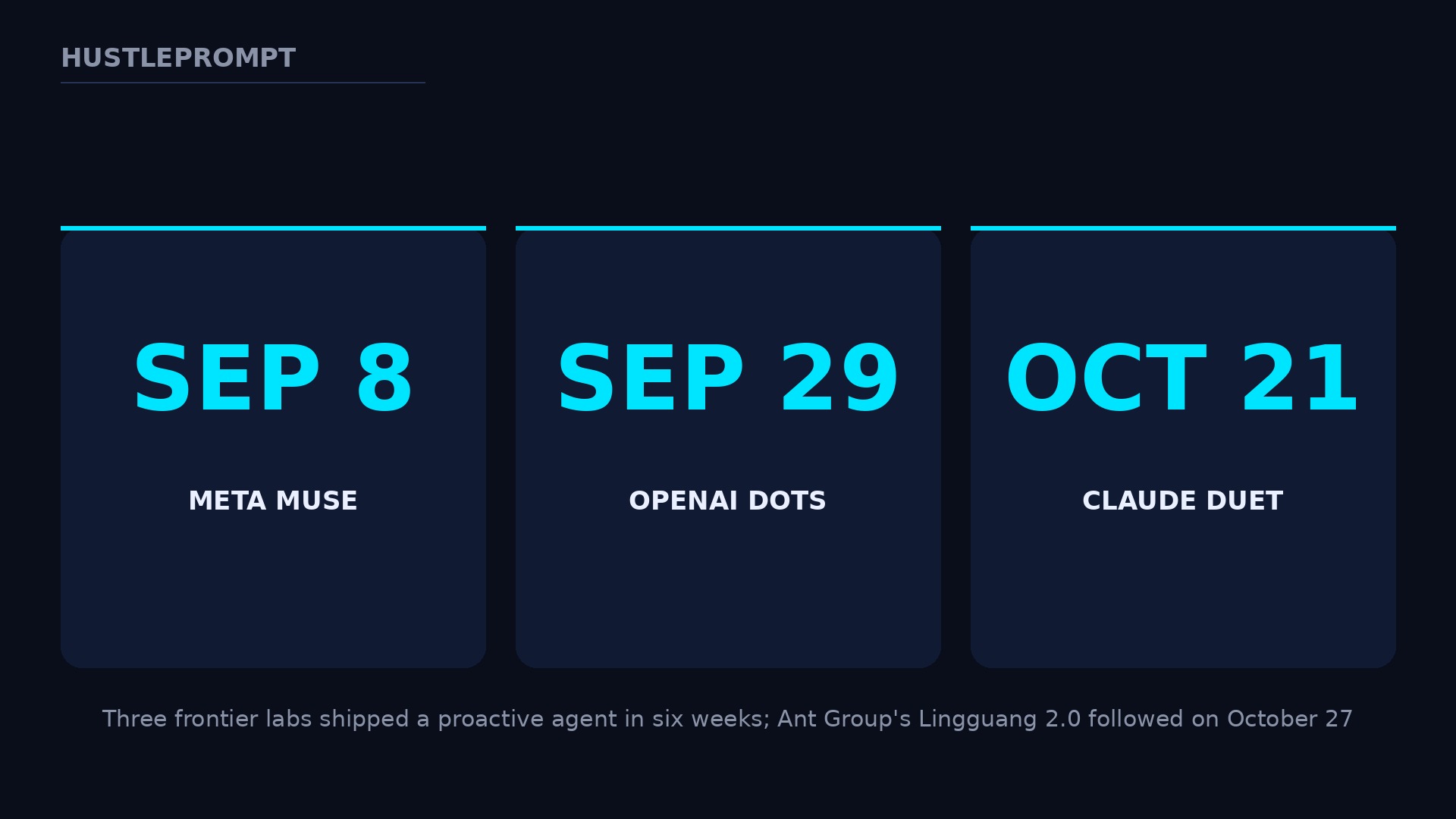
Sources: Octomind, “Claude Duet vs ChatGPT Dots vs Meta Muse” (checked Oct 22, 2026) · Times of AI, “Anthropic Previews Claude Duet” (Oct 22, 2026) · Ant Group via Business Wire, “Ant Group Upgrades LingGuang to 2.0” (Oct 27, 2026).
The products differ in the details that matter for a business. Duet is the most cautious: it asks before it sends a message, makes a payment, signs a document, or deletes anything, and some moves — trading securities, moving money between accounts — are blocked even with approval. Dots take the opposite approach with user-set Custom Rules: act without asking, act if pre-approved, ask first, or hand the task back. Muse sits between them, with its Sentinel system approving network actions and user approval for sensitive ones.
Access differs just as sharply. Duet is a waitlisted research preview for US Pro and Max subscribers only — no Team or Enterprise plans yet — and its background checks draw on the subscriber’s existing plan limits. Dots need ChatGPT Pro (reported from $100 a month) or Business Premium; Muse has a free tier inside WhatsApp, so it reaches ordinary users first.
Claude Duet: The Cautious One Worth Copying
Duet deserves the closest look because Anthropic aimed it at professionals and small-business owners — the exact people who buy freelancer services. It runs on Claude Opus 5.5, carries over a user’s Claude memory, skills, and connected apps, and lives as a standalone app on iOS, Android, and claude.ai.
Its daily loop is the template every service seller should study. Each morning it sends a short brief on the most important items across connected apps, then checks those accounts every few hours — deliberately not continuously, Anthropic says, to avoid burning plan limits faster. It runs on its own virtual machine, so tasks continue after the laptop closes, with a notification when work needs review.
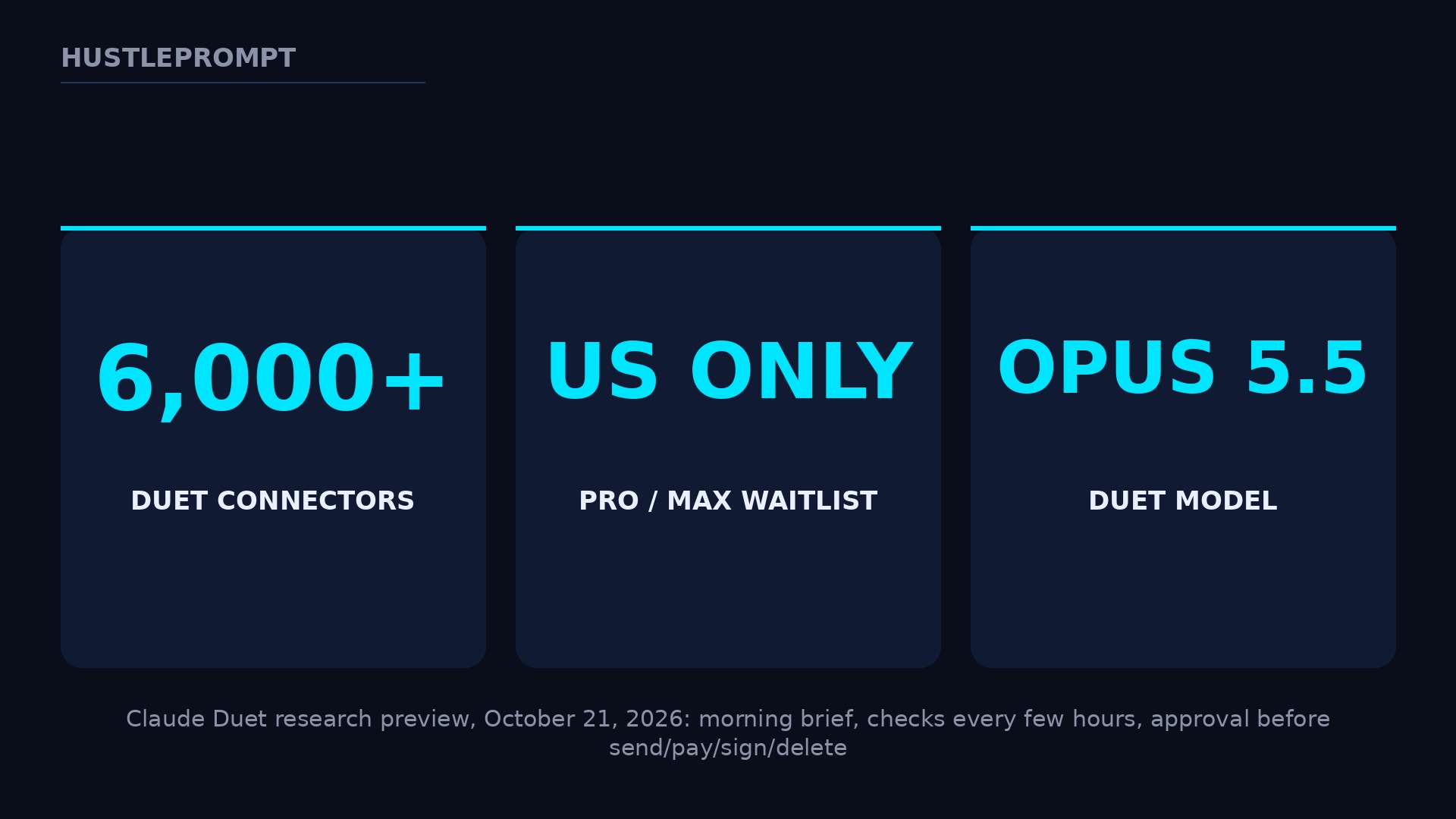
The connector count needs honest reading. Anthropic cites more than 6,000 connectors and plugins in the Claude Marketplace, but its named examples are business tools: Gmail, Slack, Calendar and Drive, QuickBooks, Stripe, Shopify, HubSpot, Gusto, DocuSign, Notion, Canva, Microsoft 365, and Ramp. Anthropic admits Duet is weaker at personal errands like booking tickets and may misjudge urgency. That is the key failure mode: a wrong interruption, not a wrong answer.
That failure mode is the business opening: within weeks of turning Duet on, a small business gets a false alarm, a missed item, or a draft it distrusts — and looks for someone who can tune it.
What Dessa and Lingguang Add to the Picture
Block’s Dessa, announced October 23, 2026, attacks the other end of the interaction: the voice itself. It is a speech-to-speech model trained from scratch only on recorded human conversation — no text, no pretrained model — that listens and talks at the same time. It can interrupt naturally, laugh mid-sentence, and respond to tone, and Block says it runs locally on a MacBook Pro with an M4 Max chip or better, faster than real time.
Dessa is not a product yet: early access is limited to a small group of AI safety researchers, with no public weights, API, pricing, or benchmarks. The lesson is directional — voice agents will soon sound human enough that customers stop noticing, raising the bar for every phone script a small business uses.
Lingguang 2.0, rolling out in China, shows the task layer at full stretch: with explicit authorization, it spots forgotten auto-renewing subscriptions in Alipay records, monitors flight and hotel prices after booking, and coordinates across email, DingTalk, Lark, and Mi Home — running on independent cloud instances with Ant’s APASS service managing permissions.
Together, the pattern sharpens: Duet owns the work brief, Dessa owns the voice, Lingguang owns the long task. No single product covers all three yet — and that gap is where a service business fits.
The Proactive Loop: Notice, Draft, Approve, Act
The agent chases. The human keeps the irreversible decisions.
The agent checks first
Inbox, calendar, and store are scanned every few hours.
Work prepared, not sent
Replies and follow-ups are drafted, then queued for a human yes.
One morning decision batch
Send, pay, sign, and delete always stop for approval.
The loop learns the misses
False alarms and misses are logged, so next week’s brief interrupts less.
How to Profit From This Trend
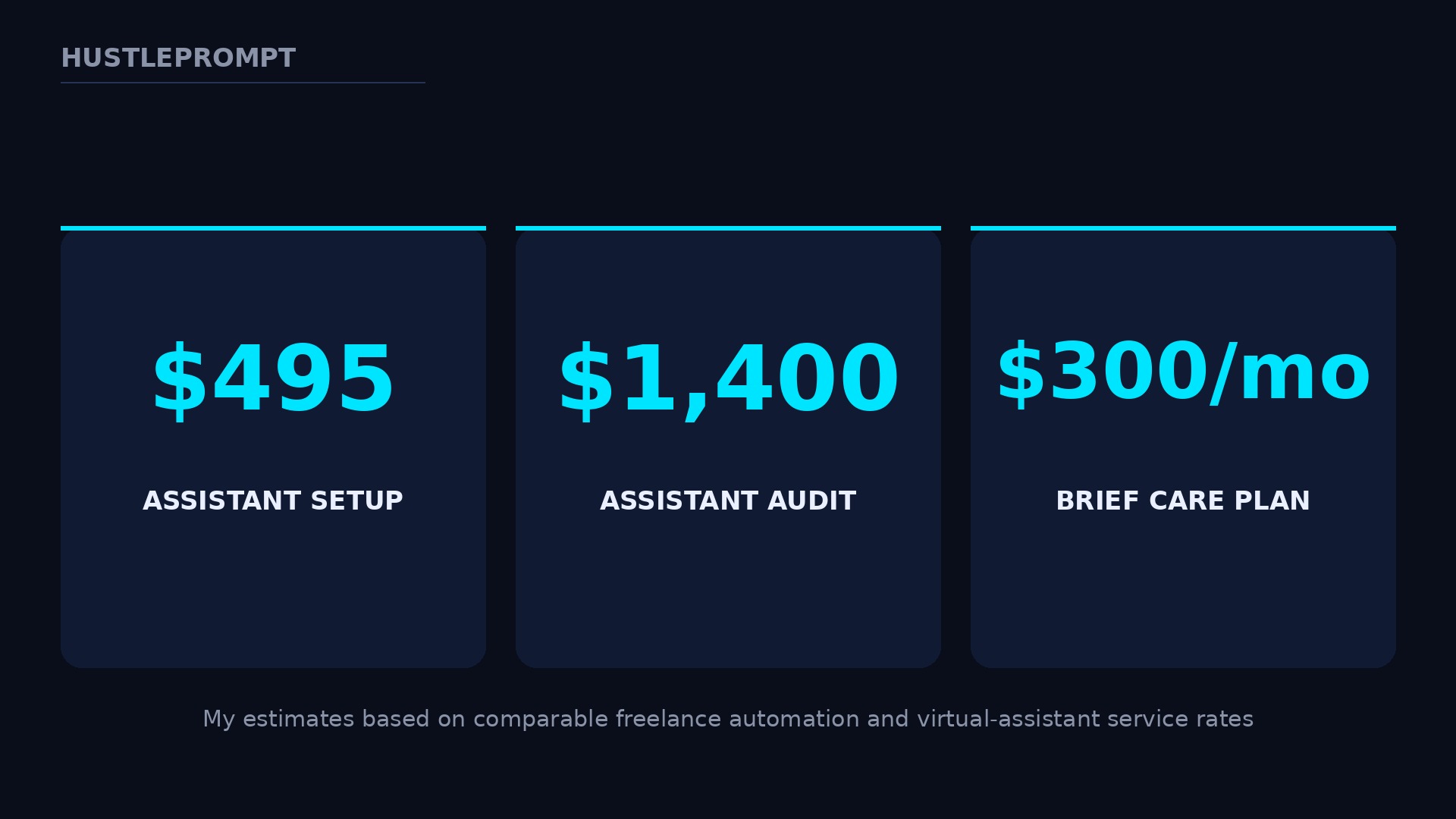
Do not sell “AI setup” in general. Sell the morning brief, tuned: a proactive-assistant setup and audit service where you connect the owner’s real tools, write the rules for what the agent may do alone, run it for two weeks, and hand over a brief the owner actually reads.
The audit is the repeatable product: most owners connect everything, get noisy briefs, and quietly stop reading them. Your audit finds the noisy connectors, duplicated alerts, and approval rules that are too loose or too tight — then fixes them and proves it with before-and-after briefs.
Prices below are my estimates based on comparable freelance automation and virtual-assistant service rates, not market data:
Lead with the missed-item story: “Your assistant already checks your inbox. Who checks that it checked correctly?” Then show the audit — false alarms killed, real leads rescued, a brief read in four minutes instead of skimmed for twenty.
What to Do This Week
- Run one workflow proactively for yourself first. Morning brief, follow-up drafts, subscription checks — live with the agent for a week before selling the setup.
- Write the approval rules before you connect anything. Send, pay, sign, and delete always require a human yes. Everything else gets a written rule, not a feeling.
- Log every false alarm and every miss. Your log is the audit product. Without it, you are selling opinions; with it, you are selling proof.
- Sell the audit to one existing client first. A business already using a chatbot is the warmest buyer: its agent is already noisy.
Watch: what Duet does and four ways freelancers can use it. Watch on YouTube.
Where This Is Heading
Proactive becomes the default. Within a year, an assistant that waits silently for a prompt will feel like a phone that never rings, and the brief becomes the product surface users judge.
Approval design becomes a profession. The valuable skill is not prompting — it is writing the rules for what an agent may do alone, proving it followed them, and fixing the misses.
The voice layer and the brief layer merge. Dessa’s voice, Duet’s brief, and Lingguang’s long tasks describe one future assistant: it notices, calls you, and remembers across weeks. Sellers who own the tuning of that loop keep the client when tools change.
Frequently Asked Questions
What is a proactive AI assistant?
An AI agent that checks your connected apps on its own, follows tasks over time, and messages you when something needs a decision — instead of waiting for you to open it and ask.
What is Claude Duet, and who can use it?
Duet is Anthropic’s proactive agent, opened as a waitlisted research preview on October 21, 2026, for US Claude Pro and Max subscribers. It runs on Claude Opus 5.5, sends a morning brief, checks apps every few hours, and asks before sending, paying, signing, or deleting.
How are Meta Muse and OpenAI Dots different?
Muse launched September 8, 2026, with a free tier inside WhatsApp, and a Small Business version for ad accounts and Pages. Dots launched September 29, 2026, with their own cloud computer and user-set Custom Rules for what they may do without asking.
What are Dessa and Lingguang 2.0?
Dessa is Block’s speech-to-speech model, announced October 23, 2026, trained only on human conversation and still in restricted research access. Lingguang 2.0 is Ant Group’s proactive personal agent, announced October 27, 2026, rolling out in China with cross-session memory and long-task follow-up.
Is it safe to let an agent act without being prompted?
Only with written approval rules. Keep send, pay, sign, and delete behind a human yes, log every action, and test with non-sensitive data first — because a proactive agent’s failure is usually a wrong interruption or a missed item, not a wrong answer.
How do I start selling proactive-assistant services?
Run one workflow proactively for yourself for a week, write the approval rules down, and sell the audit — not the setup — to a client whose current chatbot already produces noise they ignore.