
In October 2026, nine companies that developers trusted with their secrets were breached — one after another, in a single month. The attackers did not want code. They wanted the keys that pay for AI.
Cloud security firm Wiz, which published its roundup on October 30, gave the month a name: Black October. The nine incidents were separate, with different causes. What they shared was a target — stored environment variables, especially the API keys that unlock paid AI models — and a motive that turns a stolen password into a stolen budget.
A stolen AI key is not like a stolen password. A password opens one account. A key spends money with every call, and it can be resold to strangers who spend even more. That difference is why October matters, and why key hygiene just became a service business.
What Is Actually Trending
An API key is a secret string that lets an app call a paid service — OpenAI, Anthropic, Google, or Amazon Bedrock — and bills the key’s owner for every call. Developers store keys in environment variables: configuration values that live alongside code on a hosting or development platform, so the app can read them without hard-coding them.
That convenience created a single point of failure. AI developer platforms hold thousands of customers’ keys in one place. Break into the platform’s credential store, and one breach yields keys belonging to many companies at once. Wiz’s finding is that attackers spent October doing exactly that, platform by platform.
The downstream abuse has a name: LLMjacking. Attackers use a stolen key to run large volumes of model calls billed to the victim — for their own projects, for resale through discounted-access brokers, or to generate outputs used to train a competing model, a practice called distillation. The victim discovers it as a bill, not as a break-in.
The Evidence: Nine Breaches, One Target
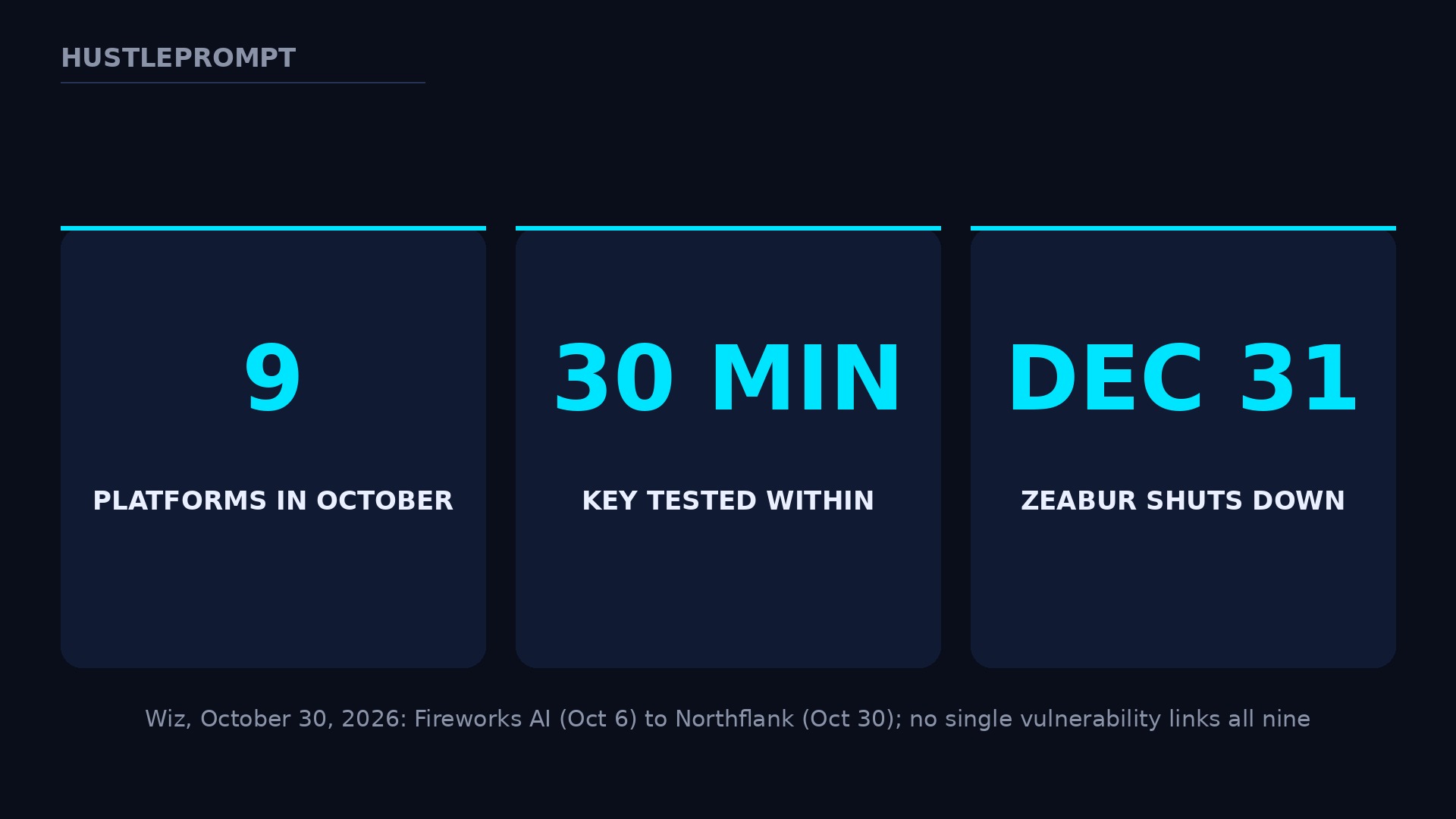
Wiz lists nine platforms that disclosed security incidents in October 2026, from Fireworks AI on October 6 to Northflank on October 30. The details vary widely, and most investigations were still open when Wiz published. The pattern, not any single incident, is the evidence.
Sources: Wiz, “Black October for AI developer platforms” (Oct 30, 2026) · The Injection, “Black October: nine AI developer platforms disclosed credential breaches” (Oct 30, 2026) · AICoder, “Wiz Black October report” (Oct 30, 2026).
What happened to the stolen keys is where the story turns from embarrassing to expensive. Wiz traced two enterprise key compromises to Amazon Bedrock abuse, and in both cases the first unauthorized call came within 30 minutes of the reported credential access — a single test call from a residential IP, sweeping stolen keys across multiple organizations.
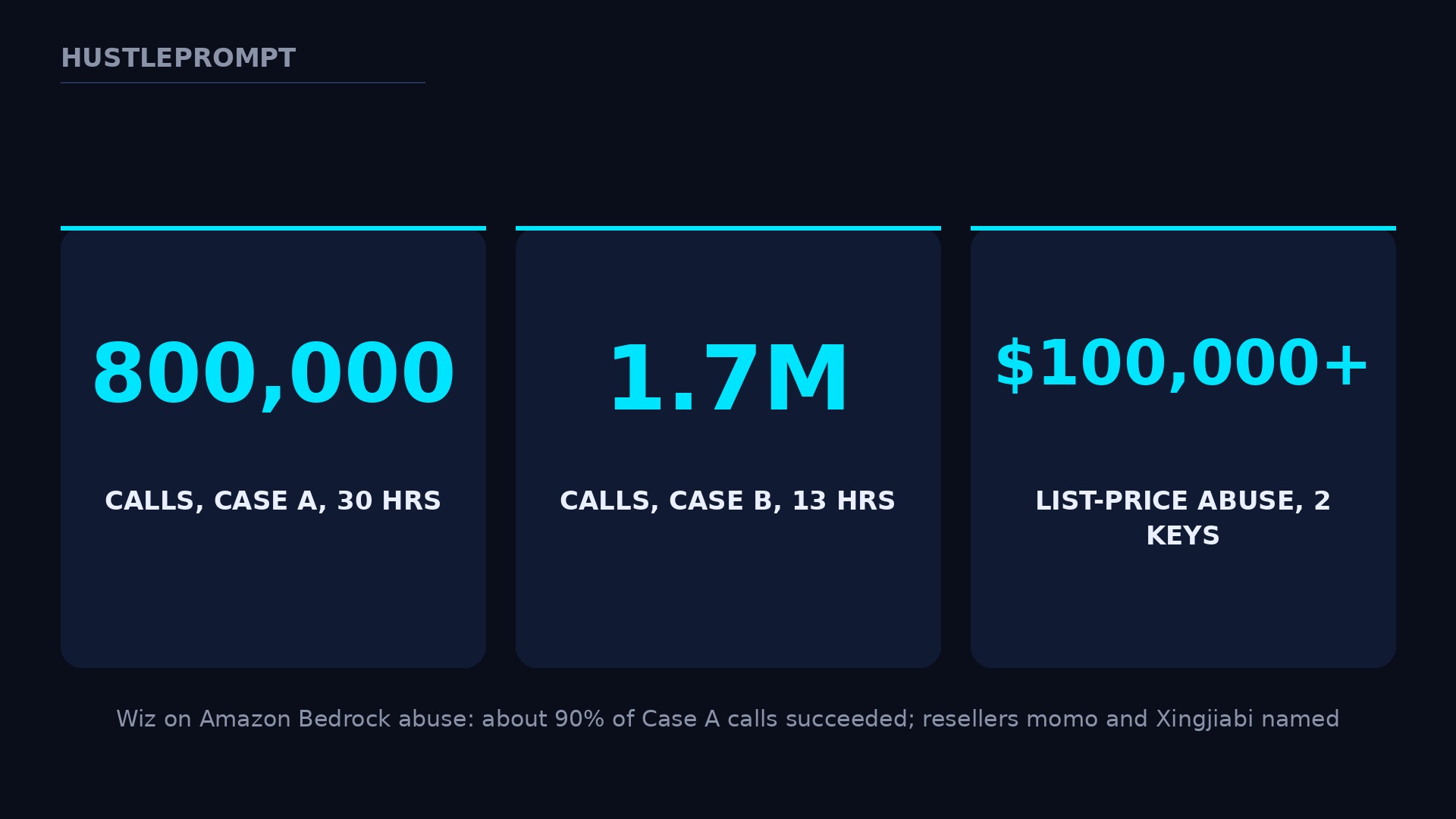
One case ran about 800,000 calls over roughly 30 hours, with about 90% succeeding, and Opus models making up about three quarters of the successful calls. The other ran about 1.7 million calls over roughly 13 hours, with over a million succeeding. At list price, Wiz estimates the two cases alone likely ran up over $100,000 in usage. Wiz also names two resale operations, momo and Xingjiabi, that tested the stolen keys — the brokers that turn a breach into a storefront.
Honesty requires the other half of Wiz’s finding: there is no single villain here. Wiz reports no single vulnerability or shared dependency linking all nine incidents, and no vendor has publicly tied them to one actor. Fireworks, Zeabur, and Lightning AI point to credential access; Railway points to privilege escalation in build infrastructure; Warp points to a third-party dependency; OpenCode points to a legacy system. The shared fact is the target, not the technique — and that makes the fix a matter of key custody, not of patching one bug.
Why a Stolen Key Burns Faster Than a Stolen Password
Three properties make AI keys uniquely costly when stolen. First, they are bearer tokens: whoever holds the key spends with it, with no password or second factor asked at call time. Second, the meter runs at machine speed — 1.7 million calls in 13 hours is not a human thief working overtime, it is automation spending someone else’s budget. Third, the spending is resalable: a broker can sell discounted frontier-model access to buyers who never know, or care, where the key came from.
Distillation adds a second motive beyond resale. OpenCode and CommandCode both described their incidents as distillation attempts: using stolen model access to generate outputs for training a competing model. In that case the victim pays twice — once in the bill, and again in a rival trained partly on their budget.
Individual developers felt the same pattern smaller: reporting on OpenCode cites users posting unauthorized bills of $449, $700, and $1,700 charged overnight. The enterprise cases are the same story with more zeros.
The Key Kill Chain: Steal, Test, Burn, Bill
The breach is the slow part. Everything after it happens in minutes.
The platform is the prize
One credential store holds thousands of customers’ environment variables and keys.
Validated in 30 minutes
A single test call from a residential IP checks which stolen keys still work.
Resold or run at scale
Brokers resell access; automated runs burn hundreds of thousands of calls in hours.
The victim pays first
The invoice lands on the key owner, before any refund or attribution arrives.
How to Profit From This Trend
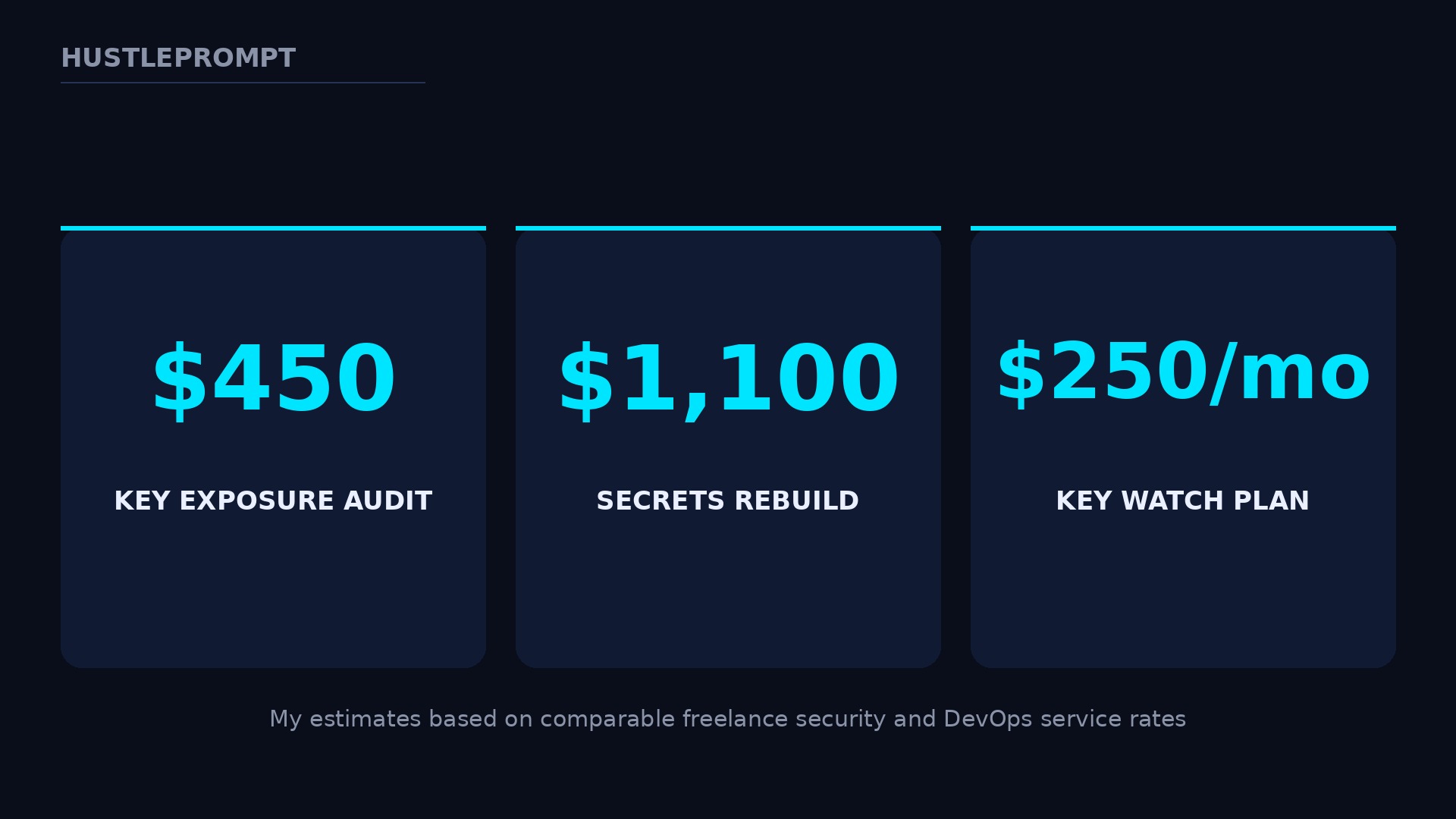
Every team that builds with AI now has a question it cannot answer: who holds our keys, where, and with what limits? The offer is a key exposure audit: you inventory every platform that stores a team’s AI keys, check each against the October disclosures and the team’s own usage dashboards, and produce a list of keys to revoke, keys to cap, and keys to move into a secrets manager.
The rebuild is the larger sale: replace long-lived, all-purpose keys with short-lived, per-project keys that can only do what one app needs, each with a spending cap and an owner. Add usage alerts that fire on the first unusual spike — not at the end of the month, when the bill already exists. The retainer is monthly key watch: new platforms checked, new keys reviewed, and one rotation drill per quarter.
Prices below are my estimates based on comparable freelance security and DevOps service rates, not market data:
Lead with the 30-minute number, not with a tool list. “Wiz found stolen keys tested within 30 minutes. When did you last list every service holding yours?” Then show the team’s own inventory — the prototype key, the pipeline key nobody reviewed since the original developer left, the platform key from a vendor breached in October. The audit sells itself the moment the list is longer than the client expected.
What to Do This Week
- Rotate at the provider, not just on the platform. Deleting a key from a breached platform is not enough: if the key is still valid at the provider that issued it, it can still be used elsewhere. Revoke it at the source.
- Give every project its own key, with a spending cap. One key per project means one stolen key cannot drain the whole budget, and a cap turns a breach into a bounded incident.
- Move keys into a secrets manager. Keys in chat logs, shared docs, and old build configs are the next breach waiting for a disclosure. One vault, one owner, one audit trail.
- Turn on usage alerts for the first spike. A sudden jump in calls, a new model in the usage mix, or calls from an unfamiliar region should page someone the same hour — not at month-end billing.
- Write down every key holder before you need the list. The inventory is the product: teams that can list their key holders in minutes rotate in minutes. Teams that cannot, do not.
Watch: how October’s supply-chain attacks exposed developer secrets in about three weeks, why environment variables were the prize, and five habits that close most of the doors. Watch on YouTube.
Where This Is Heading
Key custody becomes a compliance question. When a platform breach can generate a six-figure bill in a day, clients and insurers will start asking vendors where keys live, who can read them, and how fast they rotate. Teams with an answer win deals; teams without one lose them.
Short-lived keys become the default. Long-lived, all-purpose keys are the habit October punished. Expect providers and platforms to push scoped, capped, and expiring keys — and expect the teams that adopt them early to sell the migration to everyone else.
The resale market does not go away. As long as frontier-model access costs money, stolen access has a buyer. The defense is not to make theft impossible — it is to make a stolen key worthless fast: capped, scoped, monitored, and rotated before the 30-minute test becomes a 13-hour burn.
Frequently Asked Questions
What is Wiz’s Black October?
Wiz’s name for October 2026, when at least nine AI developer platforms disclosed security incidents in a single month — Fireworks AI, Andromeda, Zeabur, Lightning AI, OpenCode, Railway, Warp, CommandCode, and Northflank — with attackers hunting stored credentials, especially AI API keys.
What is LLMjacking?
The abuse of stolen cloud or AI API credentials to run large-scale inference workloads at the legitimate account holder’s expense. The attacker consumes or resells model access; the victim pays the bill.
How fast were stolen keys used?
In the two enterprise cases Wiz traced to Amazon Bedrock abuse, the first unauthorized call came within 30 minutes of the reported credential access. One case then ran about 800,000 calls in 30 hours; the other about 1.7 million calls in 13 hours.
How much did the abuse cost?
Wiz estimates the two traced cases alone likely ran up over $100,000 at list price. Individual developers in the OpenCode breach reported unauthorized bills of $449, $700, and $1,700.
Is there a single hacker or vulnerability behind all nine breaches?
No — and Wiz is explicit about that. The incidents had different reported causes, from credential access to build-infrastructure privilege escalation to a legacy system. What they shared was the target: stored environment variables holding AI keys.
What should I do if my key was on one of the nine platforms?
Revoke the key at the provider that issued it, not just on the platform; check usage and billing for calls you cannot explain; then replace it with a per-project key that has a spending cap. If you were on Northflank, assume every stored secret was compromised, as the company advised.