
A live phone agent just got a voice that costs $15 per million characters, comes with a library of more than 4,000 voices, and requires no annual contract and no concurrency tier. AssemblyAI’s TTS-1 went generally available on October 29, 2026 — and it quietly removes the last cost excuse for not selling voice agents to small businesses.
That matters because voice was the one AI service where the economics never quite worked for freelancers. The models were good, but the pricing stacks were a maze: hosting per minute, models at cost, telephony separate, concurrency tiers to negotiate before the first call. A $15 voice with unlimited concurrency does not make voice agents easy. It makes them quotable.
This is an analysis of what TTS-1 actually changes, where its own numbers hold up against independent testing, and how to sell phone agents now that the voice layer costs cents per call.
What Is Actually Trending
Voice agents have been “about to break out” for two years. The technology kept improving while the buying stayed hard. A business owner who wanted an AI receptionist faced a stack, not a product: speech-to-text from one vendor, a language model from another, text-to-speech from a third, an orchestrator to glue them together, and a phone carrier on top.
Each layer billed differently. AssemblyAI’s own October 20 pricing guide laid the maze out plainly: platform hosting from $0.05 a minute before models, all-in platform rates from about $0.07 to more than $0.30 a minute depending on setup, and telephony billed separately. Vapi charged $0.05 a minute for hosting with models at cost. Retell ranged from $0.07 to $0.31 a minute. ElevenLabs sold minutes on plans with $0.08 per additional minute.
TTS-1 attacks the mess from one side: the voice layer itself becomes a simple, usage-priced API from the same vendor that already sells the listening layer. AssemblyAI’s speech-to-text and text-to-speech now sit on one API key, one bill, and one integration pattern — HTTP for one-shot synthesis, WebSocket for a live session, or an OpenAI-compatible endpoint.
The second trend inside the launch is architectural. Most speech models turn audio into discrete tokens. AssemblyAI says TTS-1 works on continuous audio representations instead, which it claims improves realism and cuts the time to first spoken audio. Whether that claim holds in every deployment matters less than the direction: vendors are now competing on the first 100 milliseconds of a call, because that is where a caller decides whether to stay on the line or hang up.
The Evidence: Price, Voices, and Two Latency Numbers
Start with the price card, because it is the only part of this story that is not a benchmark claim:
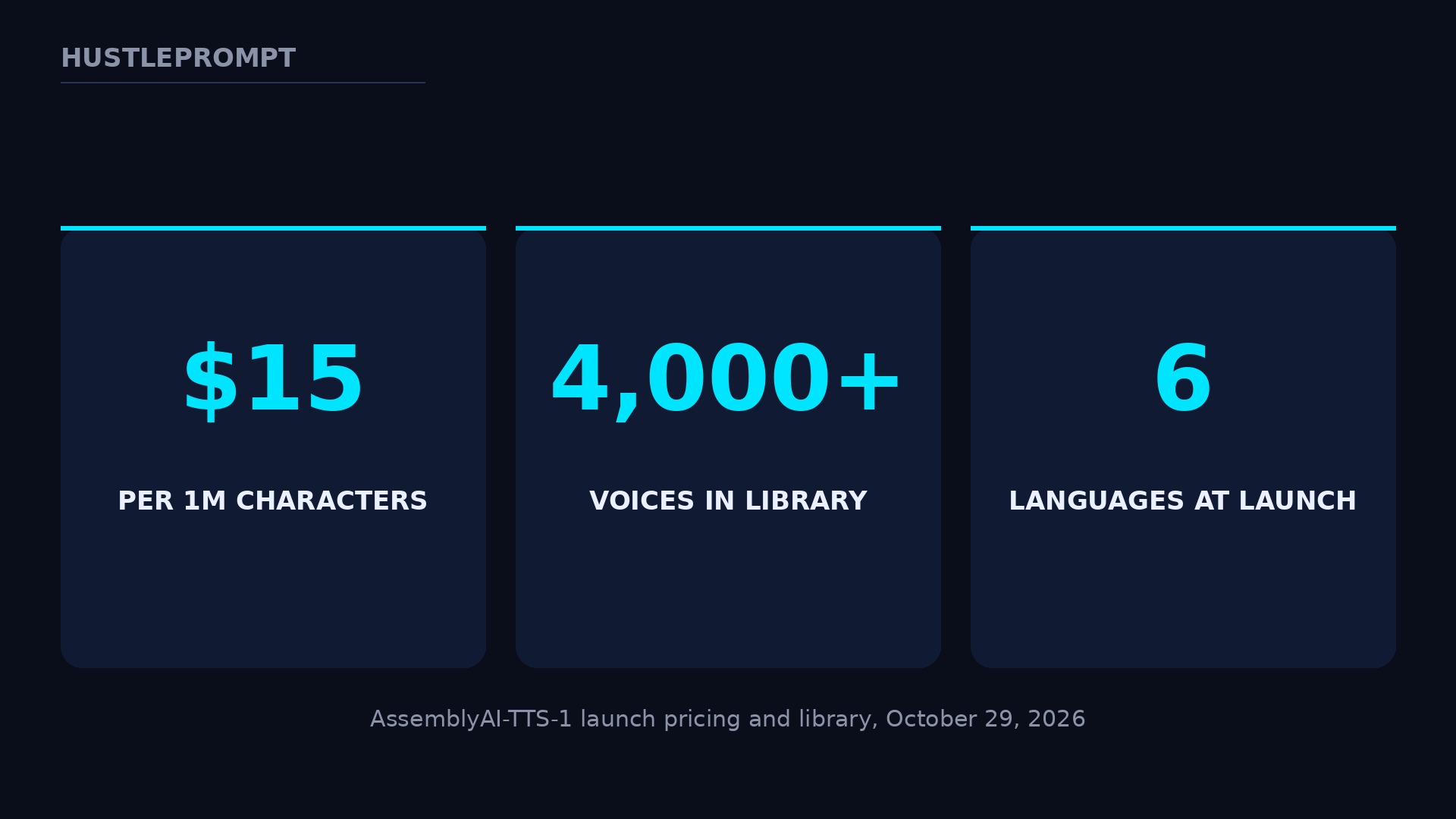
Sources: AssemblyAI, “Text to Speech” (TTS-1 pricing and features) · MarkTechPost, “AssemblyAI Ships AssemblyAI-TTS-1” (Oct 29, 2026) · AssemblyAI, “Speech AI for Voice Agents”.
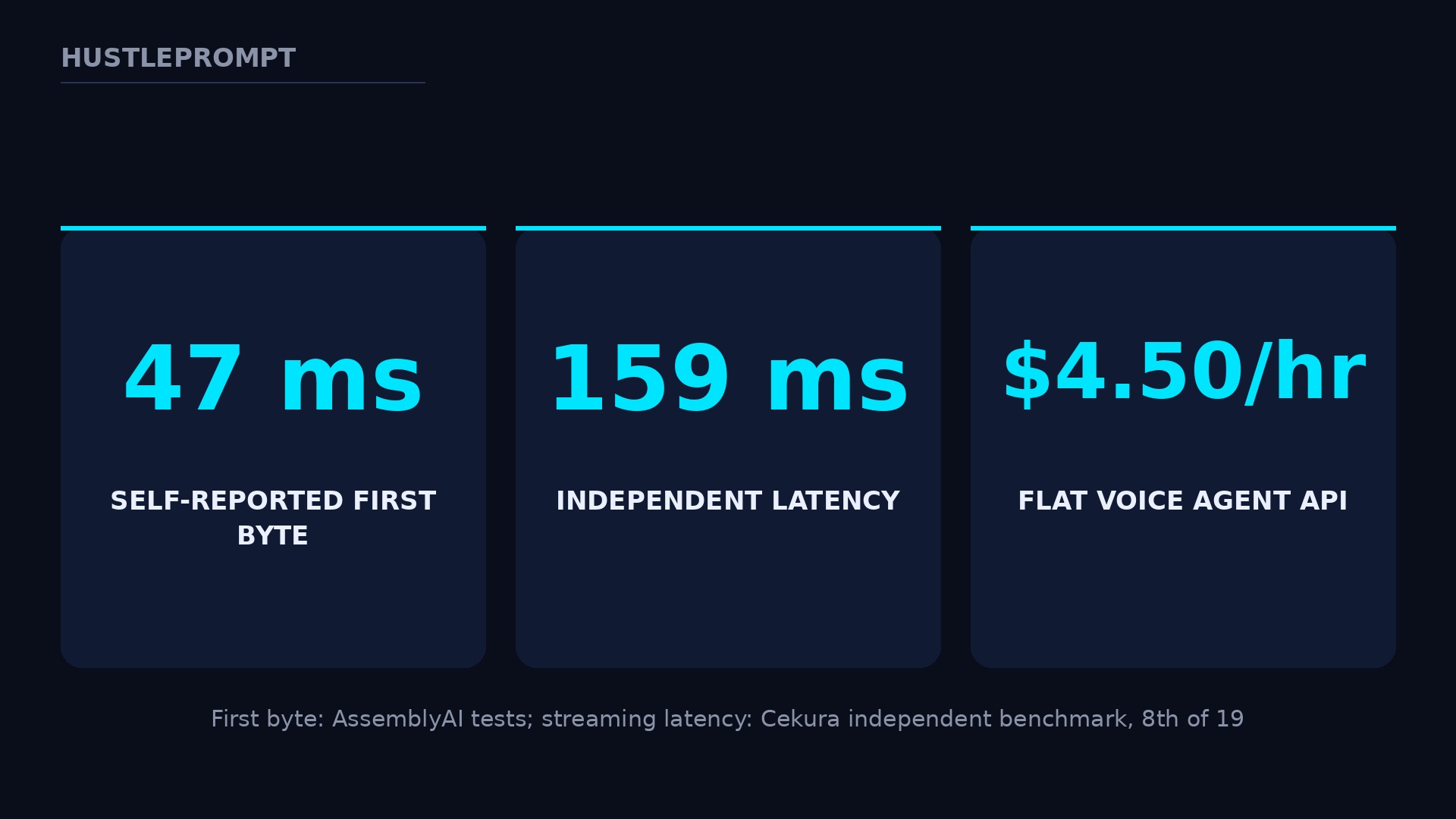
Now the latency numbers — and here the honest analysis is to print both, because they disagree in an instructive way. AssemblyAI’s own tests report a 47 millisecond median time to first byte across six models, and 93.7% entity accuracy, tying ElevenLabs v4 on entity accuracy at under one-fifth of its price, on AssemblyAI’s account.
Independent benchmark firm Cekura measured something different: 159 milliseconds median streaming latency, 8th of 19 timed models, and 81.5% reading accuracy. Those are not the same measurement — time to first byte vs. streaming latency, entity accuracy vs. reading accuracy — but the gap is the point. Vendor benchmarks are a starting line, not a verdict, and a voice seller who quotes only the vendor number will lose the first client who tests the call themselves.
The gaps at launch are equally concrete, and they decide which clients to take. TTS-1 ships without SSML, speed control, pronunciation dictionaries, or emotion tags. If a client’s brand depends on a specific pronunciation, a dramatic pause, or an expressive read, this is the wrong voice today. If the client needs a receptionist who answers, books, and confirms — the bulk of small-business phone work — those gaps barely matter.
Finally, the flat-rate sibling product frames the whole sale. AssemblyAI’s Voice Agent API charges a flat $4.50 an hour ($0.075 a minute, billed per second) including speech-to-text, language-model reasoning, voice generation, turn detection, interruption handling, recordings, transcripts, hosting, and orchestration. Telephony stays separate — the client’s Twilio account bills carrier minutes with no markup in between, per AssemblyAI’s guide. That $4.50 is the number to build a quote around: the voice layer inside it, at $15 per million characters, is now a rounding error in the hourly rate.
A Phone Call, in Three Steps
Listen, think, speak — and the part that just got cheap is the last one.
Speech to text
Universal streaming transcription turns the caller’s words into text in real time, with endpointing that knows when they finished speaking.
The agent decides
The language model checks the calendar, the price list, or the booking rules, and writes the reply — plus what to do if the caller interrupts.
TTS-1 answers
$15 per million characters, streaming over WebSocket, from a 4,000-voice library. The caller hears an answer, not a robot reading a script.
How to Profit From This Trend
Do not sell “a voice agent.” Sell a phone that gets answered. The buyers who move first are the businesses that lose money on every missed call: trades, clinics, salons, restaurants, and property managers. Their pitch is one sentence: “Every call you miss is a job your competitor takes.”
Price the build around the flat hourly rate, not the character rate. The client does not care that synthesis costs $15 per million characters. They care that an hour of answered calls costs $4.50 in platform fees plus telephony, and that your build turns that into bookings. Quote the outcome — answered calls, booked appointments — and keep the character math in your own cost sheet.
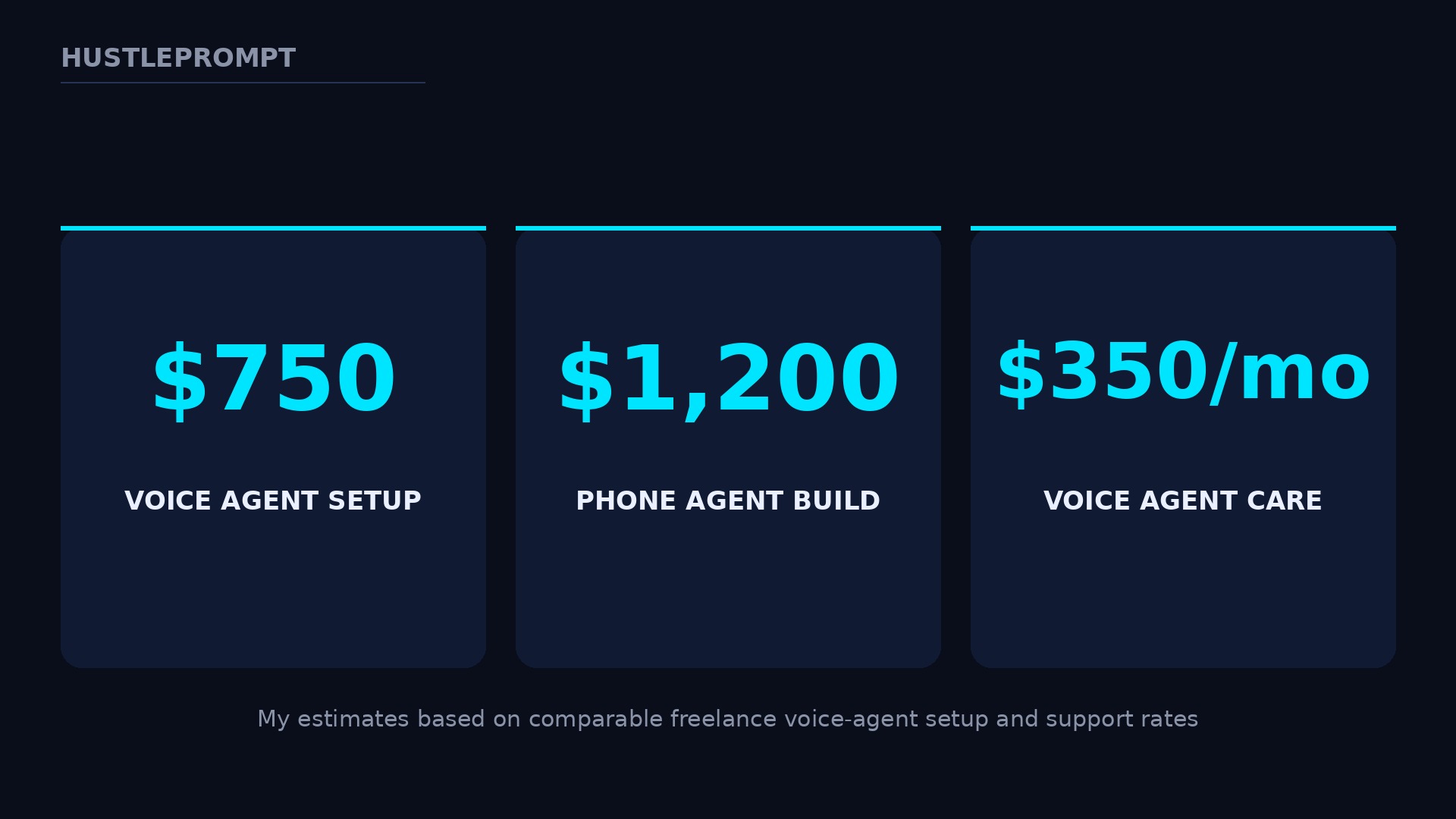
Prices below are my estimates based on comparable freelance voice-agent setup and support rates, not market data:
Lead with a live demo on the client’s own phone number. Call it, let it book a fake appointment, then let it hand off to a human mid-call when you ask something it cannot answer. The interruption handling — the agent stopping, listening, and recovering — is the feature that closes the sale, because every business owner has been trapped in a phone tree and hated it.
What to Do This Week
- Build one agent for yourself first. A booking agent for your own services, on TTS-1, with one language and one workflow. Measure the real per-call cost, including telephony.
- Test the latency claim on a real call. Do not quote 47 ms. Time your own first-byte and streaming latency on a phone call, and write the numbers down. Your measured number is your credibility.
- Pick one missed-call niche. Trades, clinics, or salons — businesses where a missed call is a lost job, not a minor annoyance. One niche, one script, one price.
- Write the handoff rule in the contract. Money, medical advice, and angry callers always go to a human. The agent books and informs; it never improvises where a mistake costs a client.
Watch: AssemblyAI’s own walkthrough of building a voice agent — the listen, think, and speak pipeline this article prices out. Watch on YouTube.
Where This Is Heading
The voice layer becomes a commodity. At $15 per million characters with no concurrency tier, the voice itself stops being a differentiator. The product moves up the stack: the script, the booking logic, the handoff design, and the monthly tuning. Sellers who compete on voice quality alone will be undercut by the next $15 model.
One-vendor voice stacks win the small-business sale. A freelancer can now quote a phone agent with one vendor’s listening and speaking layers, one bill, and one integration pattern. That simplicity is worth more to a small client than a marginally better voice from a three-vendor stack.
The missing features decide the next launch. SSML, speed control, pronunciation dictionaries, and emotion tags are the obvious gaps, and the first vendor to add them at this price point takes the expressive-voice clients TTS-1 cannot serve today. Watch the next AssemblyAI release notes like a price list.
Frequently Asked Questions
What is AssemblyAI-TTS-1?
A streaming text-to-speech API built for live voice agents, generally available October 29, 2026. It turns an agent’s written replies into spoken audio during phone calls, over HTTP, WebSocket, or an OpenAI-compatible endpoint.
How much does TTS-1 actually cost?
$15 per million characters, billed on input characters, with cloned voices included and no annual contract or concurrency tier. The separate Voice Agent API is a flat $4.50 an hour, billed per second, including transcription, reasoning, and voice generation — telephony is billed separately by the carrier.
Is 47 ms or 159 ms the real latency?
Both are real measurements of different things: 47 ms is AssemblyAI’s median time to first byte in its own tests; 159 ms is Cekura’s independent median streaming latency, ranking 8th of 19 models. Test on a real call before quoting either number to a client.
What languages does TTS-1 speak at launch?
Six: English, Spanish, French, German, Italian, and Portuguese, hosted in US and EU regions. There is no open-weights or on-premises option at launch.
What can TTS-1 not do yet?
It ships without SSML, speed control, pronunciation dictionaries, or emotion tags. For a receptionist or booking agent, that rarely matters. For expressive narration or brand-precise pronunciation, it is a reason to wait or choose another voice.
Can I clone a client’s voice with TTS-1?
Yes — instant voice cloning from a short recording, with a confirmation of the speaker’s permission. The launch example used a 24-second clip. Always get that permission in writing before cloning anyone’s voice.