
A support agent that costs $0.99 only when it actually resolves a ticket is now a published price, not a pitch. Intercom’s Fin AI Agent charges per outcome. Zendesk charges per automated resolution. Salesforce’s Agentforce charges per conversation — or per action through credits.
Three vendors, three different billing units, one direction: the seat is dying as AI’s unit of value. That sounds like a pricing footnote. It is actually a career signal for every freelancer and agency owner still billing by the hour.
When software did the work of a person, charging per person made rough sense. When an agent does the work without a person, the seat stops tracking value — and vendors know it. The sellers who reprice first, around outcomes clients can count, will take the work that hourly sellers leave on the table.
What Is Actually Trending
For decades, software-as-a-service meant seats. You paid per user, per month, whether that user did ten things or ten thousand. The model survived because headcount roughly tracked usage.
AI agents break that link on purpose. Their whole pitch is doing work without adding people. A vendor that charges per seat for an agent is charging less as its product gets more useful — fewer humans needed, fewer seats sold. No vendor will run that math for long.
So the unit moved. What is interesting is that vendors did not all move it to the same place, and the differences are not cosmetic. They decide who carries the risk when the agent fails.
Intercom’s Fin bills per outcome: a resolved conversation, at most once per conversation, with plain handoffs free. Zendesk bills per automated resolution: the agent must finish the job without a human. Salesforce’s Agentforce bills per conversation — or per action via Flex Credits — which means the attempt bills even if a human finishes the job.
That last difference is the whole story in one line. Under outcome pricing, a failed agent costs the vendor the sale. Under conversation or action pricing, a failed agent costs you twice: once for the agent, once for the human who rescued it.
The Evidence: Three Price Cards, One Shift
Start with the published prices, checked in October 2026. These are list prices for support agents, not enterprise quotes behind a sales call:
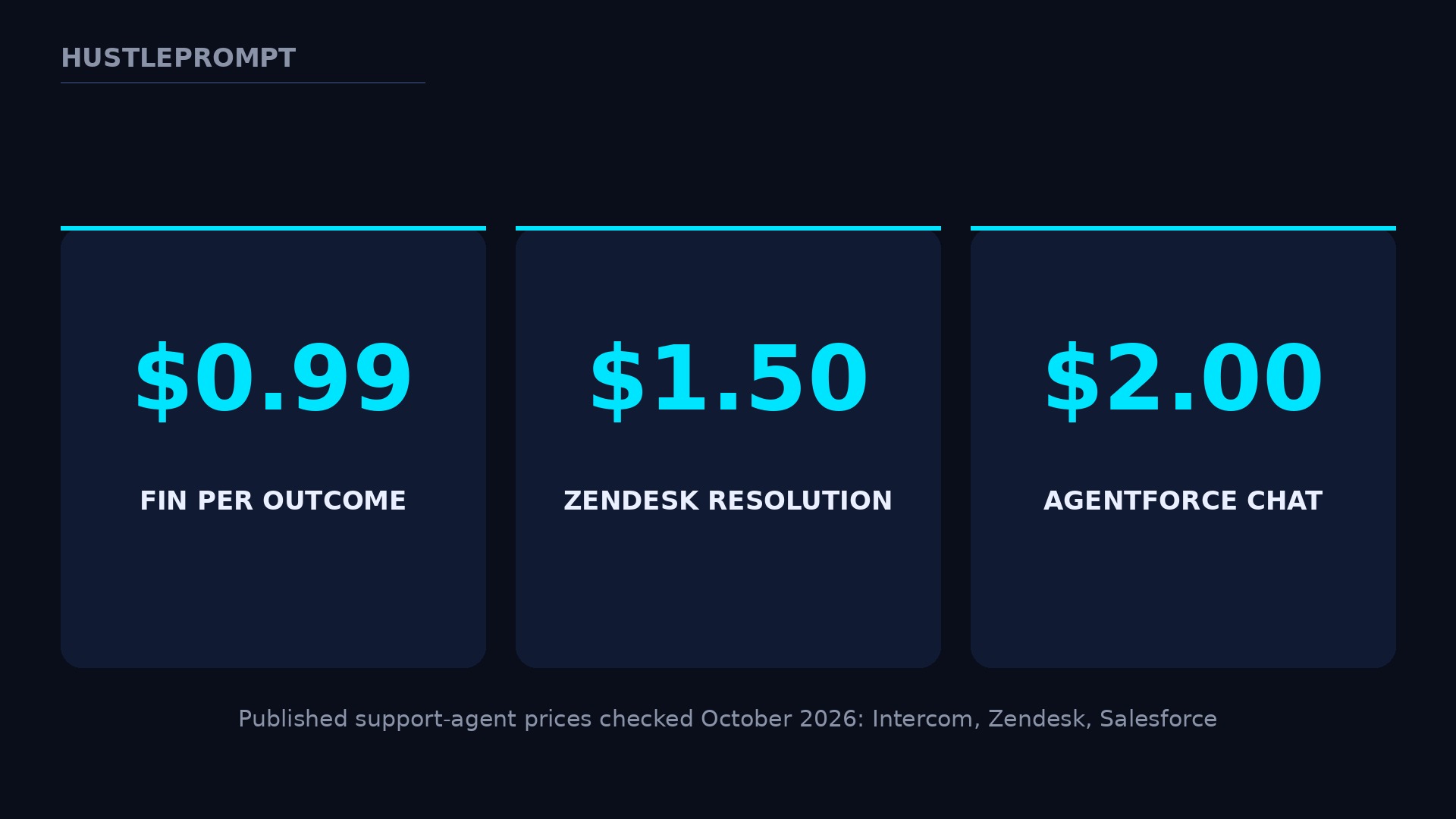
Sources: Waveup, “AI Pricing Models” (prices checked October 18, 2026) · Tech Insider, “Intercom Fin vs Zendesk AI vs Agentforce Pricing 2026” · Agents Index, “What each costs per resolved chat” (verified against vendor sources August 13, 2026).
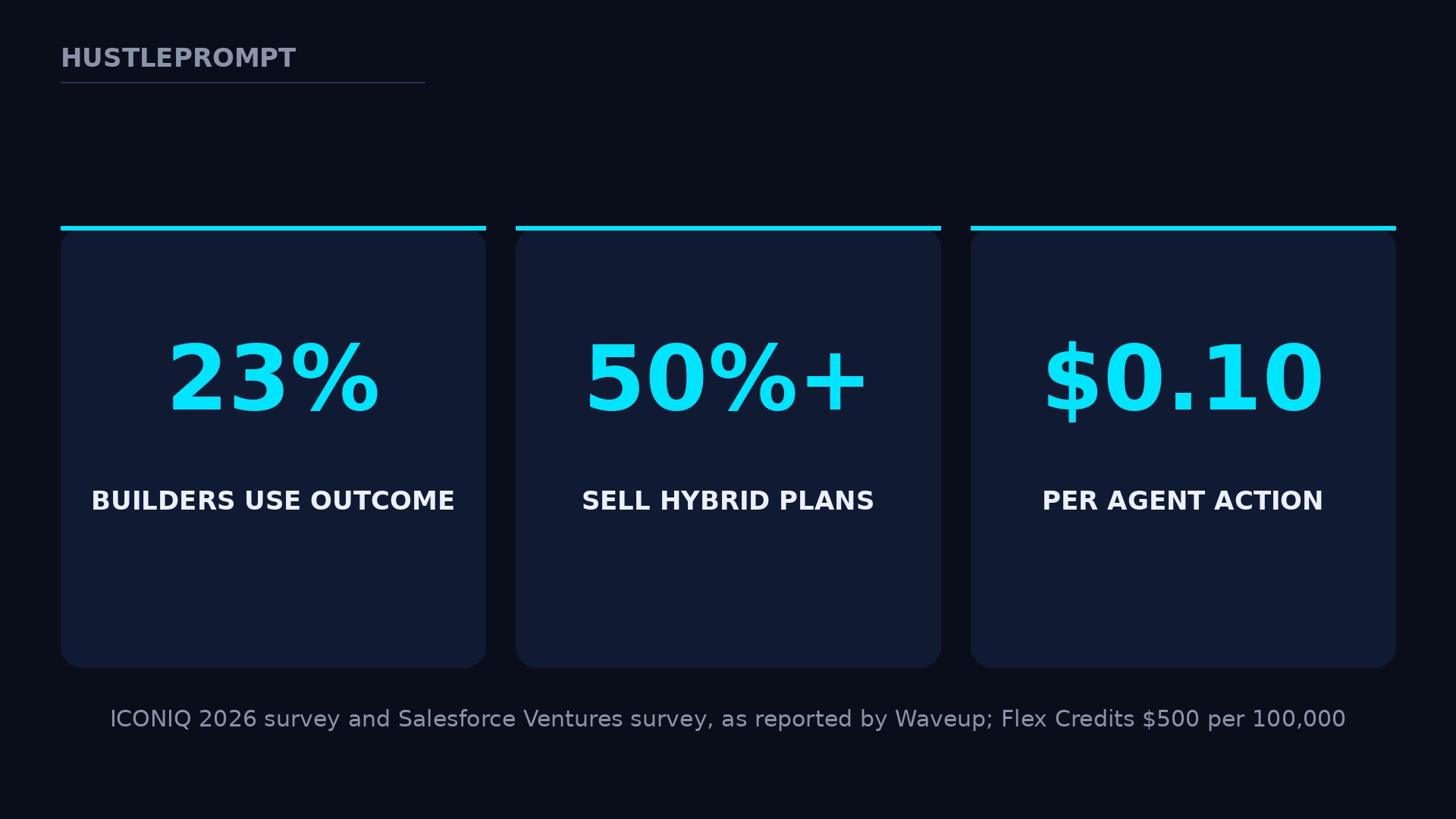
Two survey numbers show this is a market shift, not three vendors experimenting. ICONIQ found outcome pricing at 23% of AI builders in 2026. A Salesforce Ventures survey found more than half of AI sellers now charge a flat fee plus usage — the hybrid model. Outcome pricing is the minority today, but it is the direction the minority is growing in, and hybrid is the bridge most sellers actually cross on.
Here is the twist most coverage misses: Intercom’s Fin is now owned by Salesforce, which closed its roughly $3.6 billion acquisition of Intercom on September 10, 2026. The same company now sells both the $0.99 outcome unit and the $2 conversation unit. That is not confusion. It is segmentation: outcome pricing for buyers who demand proof, conversation and credit pricing for buyers already locked into the Salesforce platform. The vendor is not choosing a unit. It is selling you the unit you will accept.
The honest caveat cuts the other way too. Under outcome pricing, the vendor defines “resolved.” A worked model by Flowverify shows the trap with plain arithmetic, not measured data: at 10,000 billed resolutions for $9,900, if a human reviewer agrees with only 80% of them, the real cost per confirmed resolution is $1.24, not $0.99. At 60% agreement, it is $1.65. The unit price looks stable while the definition quietly moves. Any seller — or buyer — who does not audit the definition is negotiating blind.
Seat vs. Outcome vs. Hybrid, in One Picture
Same agent, three ways to get paid — and only one aligns your pay with the result.
Paid for access
$20 a seat, whether the agent resolves 10 tickets or 10,000. The better the agent, the fewer seats the client needs. Doomed by its own success.
Paid for results
$0.99 only when the ticket is resolved. You carry the failure risk — and you can charge for the value, not your time.
Base plus outcomes
A flat retainer for availability plus a per-result fee. The model most sellers actually land on: predictable floor, uncapped upside.
How to Profit From This Trend
Do not copy the vendors’ prices. Copy their logic. A freelancer who sells “20 hours of AI setup” is selling the seat model in miniature: paid for time, punished for efficiency. A freelancer who sells “resolved tickets,” “booked meetings,” or “qualified leads” is selling what the client actually wants — and can raise prices as the agent gets better, instead of watching hours shrink.
The bridge is the outcome audit. Most small businesses cannot switch pricing models alone because they do not know their own numbers: how many tickets, what resolution rate, what a human ticket costs. You sell them that map, then you sell the agent on top of it, priced per outcome with a floor.
Prices below are my estimates based on comparable freelance automation and support rates, not market data:

For sales and lead-generation agents, the outcome units are even clearer, and published as examples by monetization guides: $50 per qualified lead, $500 per booked meeting that actually happens, or 5% of revenue the agent generated. Those are not promises — they are the units to negotiate around. The contract must define “qualified,” the exact billable moment, no-shows, and the attribution window before the first charge, or every dispute becomes a refund.
Lead with the audit and a comparison the client can check: “Your team resolves 1,000 tickets a month at roughly $9 a ticket in human time. Fin bills $0.99 per outcome. Even if only 80% of billed resolutions hold up on review, you pay $1.24 per confirmed resolution. Here is the definition we will audit monthly.” That sentence sells the build, the care retainer, and your credibility at once.
What to Do This Week
- Pick one measurable outcome. Resolved tickets, booked meetings, or qualified leads — not “engagement” or “productivity.” If you cannot count it, you cannot price it.
- Write the definition before the price. What counts as resolved, who confirms it, and what happens on dispute. Put it in the proposal, not in a footnote.
- Price hybrid first. A small retainer for availability plus a per-outcome fee beats pure outcome pricing when you are starting out — it covers your floor while you prove the rate.
- Audit one vendor bill. Take a client’s Fin or Zendesk invoice, sample 50 billed resolutions, and count how many a human would confirm. That report is your next sales call.
Watch: why token price is not delivery cost — and how to define an “accepted result” before you price around it. Watch on YouTube.
Where This Is Heading
Outcome pricing spreads beyond support. It started in support because tickets are countable. Sales, recruiting, and lead generation are next — anywhere a result has a price tag, a vendor will eventually charge by the result. Sellers who learn the contract language now will reuse it in every niche.
The definition becomes the product. As more vendors bill per outcome, “what counts as resolved” becomes the negotiation, the audit, and the lawsuit. Expect a small industry of outcome auditors — exactly the retainer this article prices — before the vendors standardize definitions themselves.
Seats do not disappear; they become the floor. The winning model for most sellers is hybrid: a retainer for access and maintenance, outcomes for value. Pure hourly billing, though, is the model with no future in agent work. Every hour you save a client is an hour you can no longer bill — unless you reprice around the result.
Frequently Asked Questions
What is outcome pricing, in plain English?
You pay only when the AI delivers a defined result — a resolved ticket, a booked meeting, a qualified lead — instead of paying per user, per month, or per hour. If the agent fails, the outcome is not billed.
Is Intercom Fin really $0.99 per outcome?
Yes, per published October 2026 pricing: $0.99 per outcome, charged at most once per conversation, with plain handoffs free. A 50-outcome monthly minimum applies when Fin is deployed on an external help desk, per comparison coverage.
Why is Agentforce more expensive if it is the same company as Fin?
Salesforce owns both after acquiring Intercom, but they bill different units: Agentforce charges per conversation or per action, including failed attempts, while Fin charges per outcome. The unit matters more than the logo.
What is the biggest trap in outcome pricing?
The definition of “resolved.” If the vendor counts a closed conversation as resolved but a human reviewer would not, your effective price is higher than the list price. Audit billed vs. confirmed resolutions monthly.
Should a freelancer switch to pure outcome pricing immediately?
Usually not. Start hybrid: a retainer that covers your availability and maintenance, plus a per-outcome fee for value. Pure outcome pricing without a floor leaves you unpaid while you debug the agent.
What outcomes work best for pricing?
Countable, verifiable results with a clear billable moment: a ticket resolved without a human, a meeting that actually takes place, a lead that meets written qualification criteria. Avoid vague outcomes like “engagement.”