
SpaceX Starmind just got the green light for the biggest thing ever put in orbit. On November 25, 2026, the Federal Communications Commission authorized SpaceX to deploy up to one million satellites that work as data centers in space — the first US approval of an orbital data-center constellation. It turns SpaceX into a cloud provider in the sky and starts a 14-year countdown — for a fleet about 90 times Starlink’s 11,000 satellites.
What the FCC actually approved
FCC order DA 26-1273 grants the application in part. SpaceX filed on January 30, 2026; the FCC denied blocking petitions from Amazon’s Kuiper Systems, Viasat, and the American Astronomical Society.
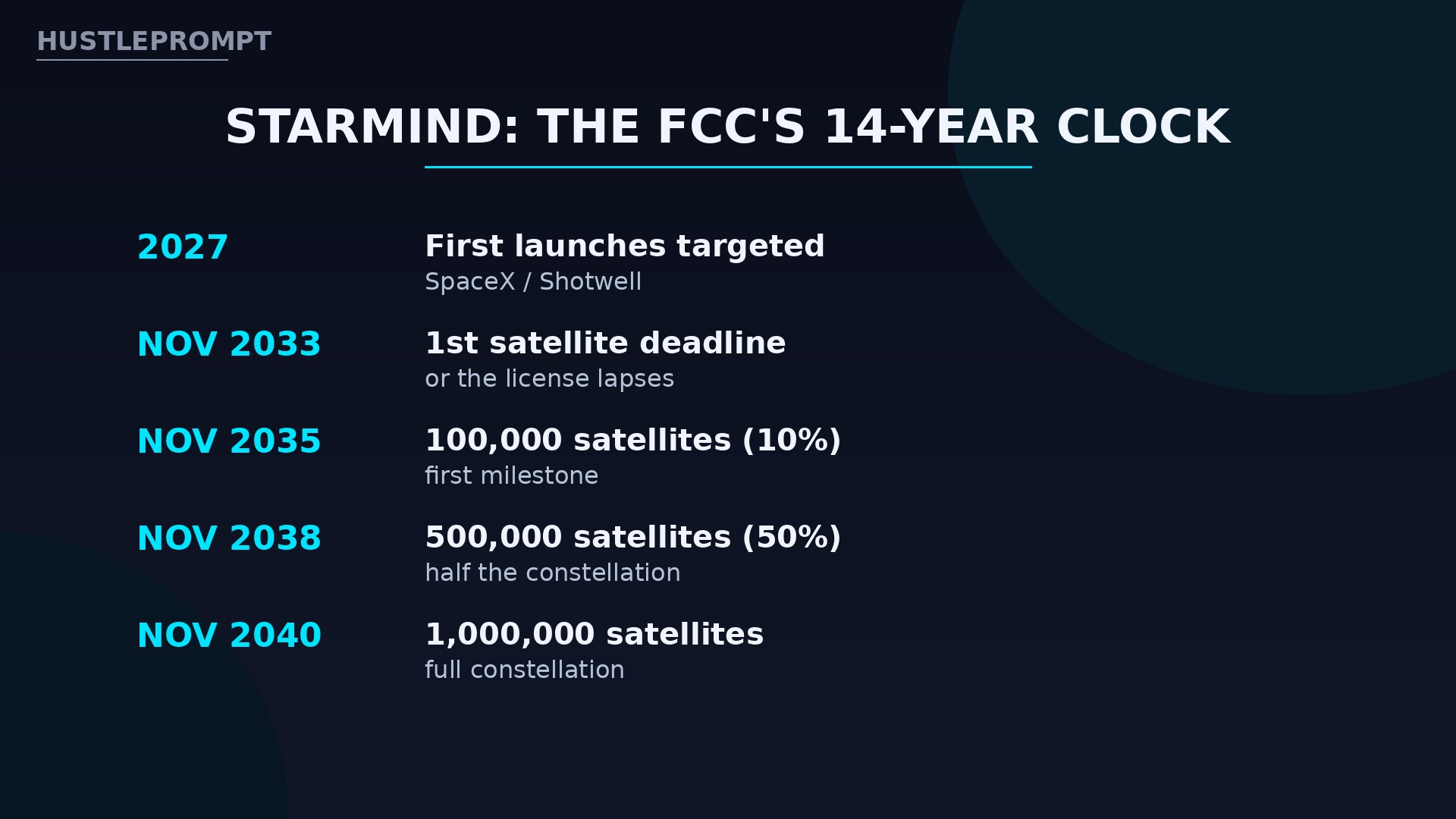
The approval comes with hard deadlines (below); the license runs 15 years from first launch.
| Approval at a glance | Detail |
|---|---|
| Satellites | Up to 1,000,000 |
| Altitude | 500 to 1,002 km, sun-synchronous and 30° shells |
| Links | Laser links first; radio only for backup and emergencies |
| First satellite | November 25, 2033 |
| 100,000 (10%) | November 25, 2035 |
| 500,000 (50%) | November 25, 2038 |
| Full constellation | November 25, 2040, or the license lapses |
Not everything was approved: the FCC deferred the request to park retired satellites above 600 km in disposal orbits, and declined to rule on optical astronomy.
Why the FCC said yes
“This action opens a bold new frontier for the computing infrastructure needed to power America’s leadership and growth.”
— Brendan Carr, FCC Chairman, November 25, 2026
What Starmind actually is
Starmind is not another Starlink. Starlink sells internet access; Starmind sells computing. Each satellite is a winged data center that runs AI workloads in orbit on near-continuous solar power and sends results back over laser links through Starlink.
The first design, AI1, is enormous: a 75-meter wingspan, 30 meters tall when deployed, a 210 kW solar array, and a 160-square-meter radiator to dump heat into space. Its compute is rated up to 250 kW at peak and 175 kW on average, using Nvidia’s Vera Rubin NVL72 system — 72 Rubin GPUs and 36 Vera CPUs per rack — announced in August 2026.
The money angle: a new business, not a new satellite
The market noticed: SpaceX shares (SPCX) rose almost 2% in Wednesday trading, according to TradingView. The deeper story is the business model: SpaceX’s AI revenue already topped Starlink’s for the first time in the third quarter of 2026, and Starmind is how that line grows — instead of selling bandwidth, SpaceX would sell raw computing capacity.
The 14-year clock reflects the build. SpaceX is building a factory nicknamed the Gigasat Factory in Bastrop, Texas, and expects to produce thousands of AI satellites there from late 2027. In November it signed a supply contract with Germany’s Singulus Technologies for more than 100 GW a year of solar-cell equipment, the first line arriving in Bastrop in early 2027 at a reported cost of over $69 million. The satellites launch on Starship, the pacing item: SpaceX needs its giant rocket flying regularly to lift a constellation this size. First launches are targeted for 2027 — Shotwell told investors in October they would start that year, and Musk put the estimate at the third quarter of 2027.
How Starmind makes money
What could still go wrong
Starmind is a 14-year promise, not a product: no satellite has flown, no customer has been announced, and no price has been published. The debris question is unresolved: the FCC has not approved SpaceX’s plan for satellites above 600 km at end of life, and astronomers’ night-sky concerns were left outside the ruling. The plan depends on Starship flying often and cheaply enough to lift a million satellites — a rate no rocket has ever sustained.
How to profit from it
- Watch the 2027 launches, not the 2040 deadline: a slip past 2027 puts the timeline in doubt.
- Follow the suppliers: Nvidia’s Vera Rubin platform and Singulus’s solar-cell equipment — both public companies.
- Learn orbital compute now: model it against ground data centers. The first customers will need people who understand both.
- Cover the beat: orbital AI infrastructure is a new industry with almost no specialist coverage.
The honest caveats
Nothing here is a product yet. The FCC approved a plan, not a service, and the first satellite is not due for seven years. No pricing, customers, or build costs have been announced. The debris and astronomy questions are unresolved, and a million satellites would change the orbital environment more than anything launched before. Treat Starmind as a 14-year option on orbital computing.
Read the FCC’s order DA 26-1273 and SpaceX’s Starmind page.
Frequently asked questions
What is SpaceX Starmind?
Up to one million solar-powered satellites working as AI data centers in orbit, each carrying Nvidia Vera Rubin hardware.
How many satellites did the FCC approve?
Up to 1,000,000, in shells between 500 and 1,002 km.
When will Starmind launch?
SpaceX targets first launches in 2027; the license requires the first satellite by 2033 and the full million by 2040.
What chips will Starmind satellites use?
Nvidia’s Vera Rubin NVL72 — 72 Rubin GPUs and 36 Vera CPUs per rack — rated up to 250 kW at peak.
Will a million satellites affect astronomy?
That is the open question: Amazon, Viasat, and the American Astronomical Society objected; the FCC denied them.
Can I invest in SpaceX or Starmind?
SpaceX shares trade as SPCX and rose almost 2% on the decision. Starmind is a SpaceX project, not a separate stock.