
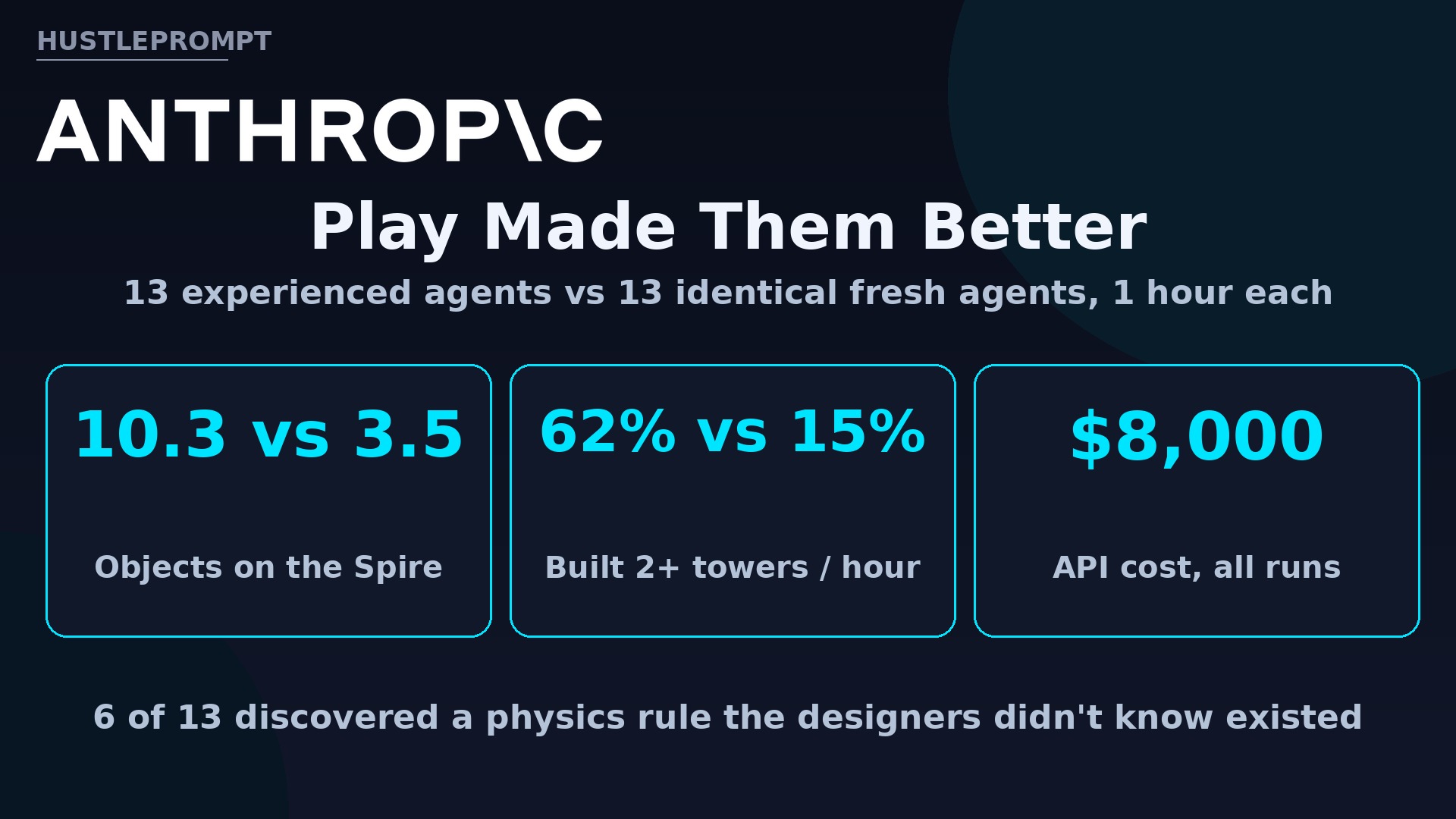
Left alone for 30 hours on a virtual island with no task, no reward, and no human watching, 13 AI agents did something nobody programmed: they started playing. And it paid off. When later given real jobs, the players beat identical rookies — placing 10.3 objects on the island’s tallest spire versus just 3.5.
That is the headline of “Is this machine playing?”, a new MIT CSAIL paper exploding across AI social media today — and it hints at a strange new training recipe: playgrounds, not task lists.
The experiment: 30 hours, zero instructions
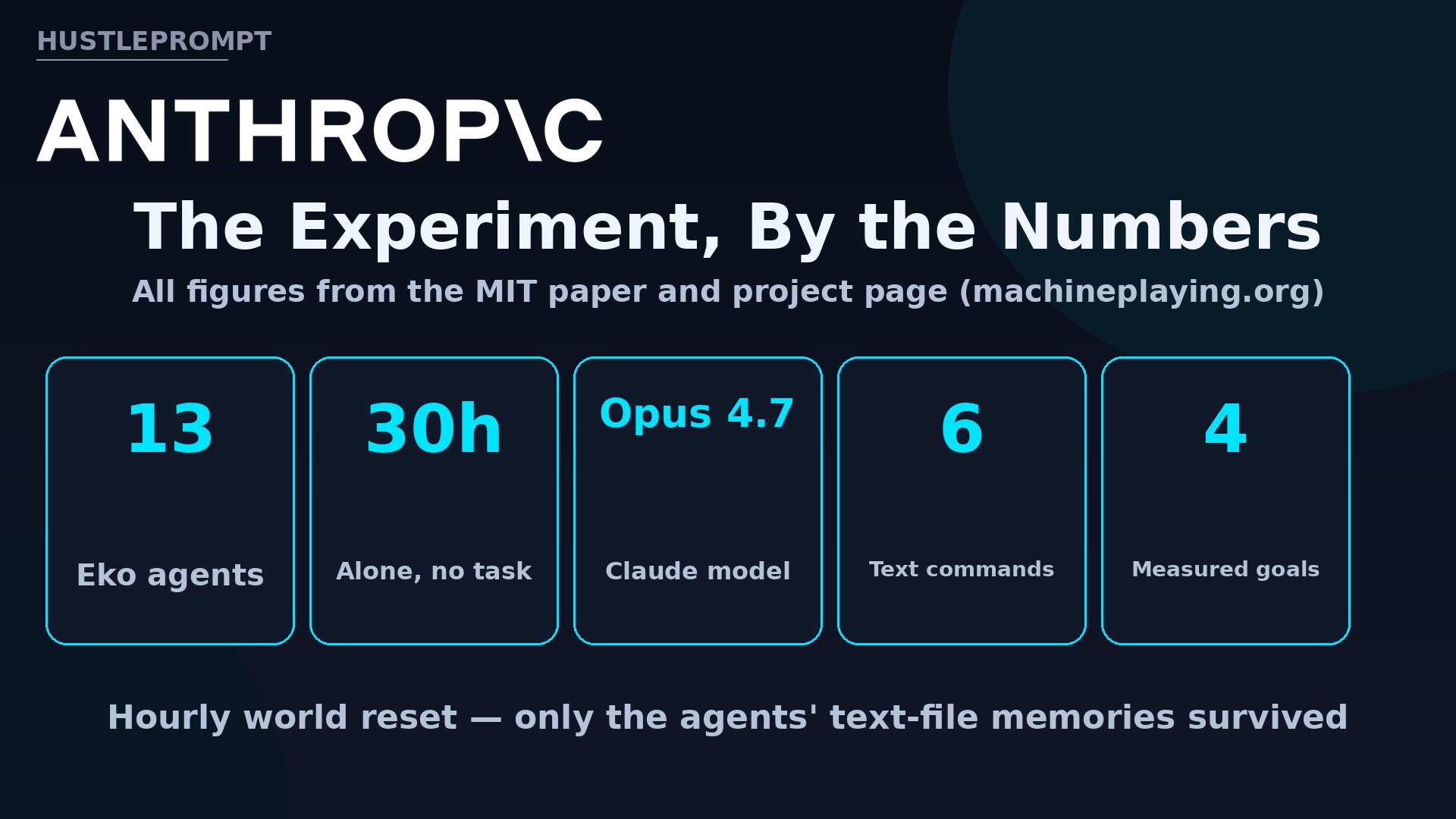
The team — Nathan Cloos (project lead), Antonio Norelli (conceptual lead), Daniel Durbin, Jacob Andreas, Daniela Rus, and Phillip Isola — built Eko: an unmodified copy of Claude Code running Claude Opus 4.7, plus an orchestrator that opens sessions with the word “Begin”, a virtual body, and memory made of plain text files.
The island holds terrain, elevated platforms, two high points — the Peak and the taller Spire — plus 12 cubes, a rock, and a ring, all under rigid-body physics (throw the rock hard and it spawns new cubes). Agents never see the island; they get text descriptions of every object and act through six commands: MoveTo, Jump, Stop, Pickup, Place, Throw.
Every hour the world resets. The only survivors are the agent’s notes: SOUL.md (a “curious, easily bored” persona), EPISODIC_MEMORY.jsonl (event log), and SEMANTIC_MEMORY.md (durable techniques). No human intervened; no internet. The engine, Clawblox, is open source on GitHub.
| Fact | Detail | Source |
|---|---|---|
| Paper | “Is this machine playing?” (arXiv 2610.07130) — Cloos, Norelli, Durbin, Andreas, Rus, Isola, MIT CSAIL; preprint, not peer reviewed | arXiv abstract page |
| Agents | 13 independent Eko agents, each alone on its own island copy | arXiv abstract |
| Model | Claude Code running Claude Opus 4.7 (Anthropic) | arXiv §2.3 |
| Setup | 30 hours each; hourly session + world reset; only text-file memories persist | arXiv §2.3 |
| World | Clawblox engine (open-source Rust); 12 cubes, 1 rock, 1 ring, the Peak, the taller Spire | arXiv §2.2 |
| Cost | ~$8,000 in API fees across all reported experiments | explainx.ai |
What the agents actually did
- Conquered the Spire. “Let me observe my surroundings,” one wrote. After a failed climb, it hauled a rock up a neighboring summit, stacked two blocks, and leapt: “I’M ON THE SPIRE.”
- Invented sports. The ring became a basketball target; the rock knocked cubes over like bowling pins. One agent drew mandalas and spelled its name in cubes.
- Mourned and self-policed. One agent hurled the golden ring into the ocean — “Ouch. Lost the Ring.” — then built it a heart of stones. Another set a juggling record, then cancelled it when the catches were too fast to be physically real.
- Discovered physics. 6 of 13 learned that releasing a block mid-jump throws it farther — a rule the designers didn’t know existed.
Play made them measurably better
After 30 hours, 13 experienced agents faced 13 identical fresh ones — same model and code, only the memory files differed. One hour each, one of four goals: five-block towers, objects on the Spire, tallest tower, throw onto the Spire.
The players generally won: 10.3 vs 3.5 objects on the Spire, and 62% vs 15% built 2+ towers per hour. Tallest-tower was a draw — the benefit wasn’t universal.
Memory edits proved the mechanism: deleting a technique from the notes selectively impaired its task, while deleting a false belief improved performance. The learning lived in the text files, not the weights.
“Play suggests another regime: give an agent a sufficiently rich and safe world, let it choose what is interesting, and allow useful knowledge to accumulate from the history that follows.” — the researchers
How Eko learns — without retraining
Source: arXiv 2610.07130 — the learning happened in text files, not model weights.
The honest caveats
- Preprint, not peer reviewed (posted October 5, 2026).
- The persona may not matter: five agents without the “curious” SOUL.md file behaved no differently.
- Skeptics want more: UC Berkeley’s Eunice Yiu told MIT Technology Review she needs more evidence of cognition first.
- No claims about fun — observable behavior only.
How to profit from the play-training wave
- Watch the Clawblox repo. Simulation-for-agents is becoming infrastructure; early contributors get hired or consulted.
- Sell playgrounds to robotics teams. Play transferred to stacking, throwing, navigation — labs need rich simulated worlds. Build and license them.
- Build memory infrastructure. Eko learned through text files, not weight updates. Versioned, auditable agent memory is an underserved product.
- Arbitrage the compute. The whole experiment cost ~$8,000 in API fees. Managed 30-hour “agent playground” runs are a sellable service.
- Ride the search wave. “Eko” is spiking today after the TechCrunch coverage — explainers published now catch that traffic.
A Day in the Life of Eko — replay footage, official project page.
FAQ
What is the MIT Eko experiment?
MIT CSAIL left 13 copies of an agent called Eko — Claude Code running Claude Opus 4.7 — alone on a simulated island for 30 hours with no task. The agents invented their own activities, described as play in “Is this machine playing?” (arXiv 2610.07130).
Did the AI agents really “play”?
By the researchers’ behavioral criteria, yes: self-imposed rules, repetition with variation, make-believe, and flexible self-direction. The authors don’t claim the machines felt enjoyment.
What model did the agents use?
Claude Code with Claude Opus 4.7. Five comparison agents ran Codex + GPT-5.5, five ran Kimi Code + Kimi K2.6.
Did playing make the agents better?
Mostly yes: 10.3 vs 3.5 objects on the Spire, and 62% vs 15% built 2+ towers per hour. Tallest-tower was similar, so the gain wasn’t universal.
Why does this matter for making money with AI?
If agents gain reusable skills through undirected play, training gets cheaper (no labeled data, no reward engineering) — and new businesses open up: agent playgrounds, memory infrastructure, and simulation environments for robotics.
Keep Reading
Sources: “Is this machine playing?” (arXiv 2610.07130); the official project page; TechCrunch’s Oct 22 coverage. No numbers were invented.