
NVIDIA’s new Nemotron image model beats GPT Image 2 on GenEval, 92.86 to 89.00. That number traveled fast across AI news feeds this week.
What traveled slower is the footnote. The 92.86 belongs to a full agentic system assisted by GPT-6, a model you cannot download, running a harness NVIDIA has not released, under a license that bans commercial use.
The model you can actually download scores 80.97. This article reads the fine print so you can decide what the release is really worth to you.
The headline score belongs to a system, not a model
NVIDIA published the weights for Nemotron-Labs-Image-30B-A3B on Hugging Face on November 24, 2026, alongside the technical report Nemotron-Labs-VisualCreation: Pixel as Code for Agentic Visual Creation (arXiv:2611.31358, submitted November 23).
The paper reports three different configurations, and the gap between them is the whole story. The standalone generator you can download scores 80.97 on GenEval. Wrap it in NVIDIA’s own agentic workflow and the score rises to 86.40. Swap in GPT-6 as the assisting agent and it jumps to 92.86.
That last configuration is the one quoted in headlines. It is also the one you cannot reproduce at home. The assisting model is GPT-6, the harness is unreleased, and the workflow adds planning, candidate selection, and repair loops that the downloadable model does not include.
The pattern repeats on every benchmark. On GenEval2, the standalone model scores 31.71, the Nemotron-agent system reaches 52.56, and the GPT-6-assisted system reaches 65.43. GPT Image 2 still leads that test at 81.00.
| Benchmark | Standalone model | + Nemotron agents | + GPT-6 agents | GPT Image 2 |
|---|---|---|---|---|
| GenEval | 80.97 | 86.40 | 92.86 | 89.00 |
| GenEval2 | 31.71 | 52.56 | 65.43 | 81.00 |
| LongTextBench | 94.30 | 97.00 | 97.98 | 96.00 |
| WISE Verified | 46.30 | 88.60 | 91.50 | Not reported |
| BizGenEval | Not reported | 64.7 | 86.0 | 83.2 |
Source: NVIDIA technical report arXiv:2611.31358, Tables 6-10, and the Hugging Face model card. The WISE jump from 46.30 to 88.60 shows how much of the system’s strength comes from the agent loop, not the image generator alone.
What you actually download
The release is a 30-billion-parameter autoregressive text-to-image model that activates only 3 billion parameters per token. It is a mixture-of-experts design built on Nemotron 3 Nano, and it generates images the way a language model writes text: one discrete visual token at a time.
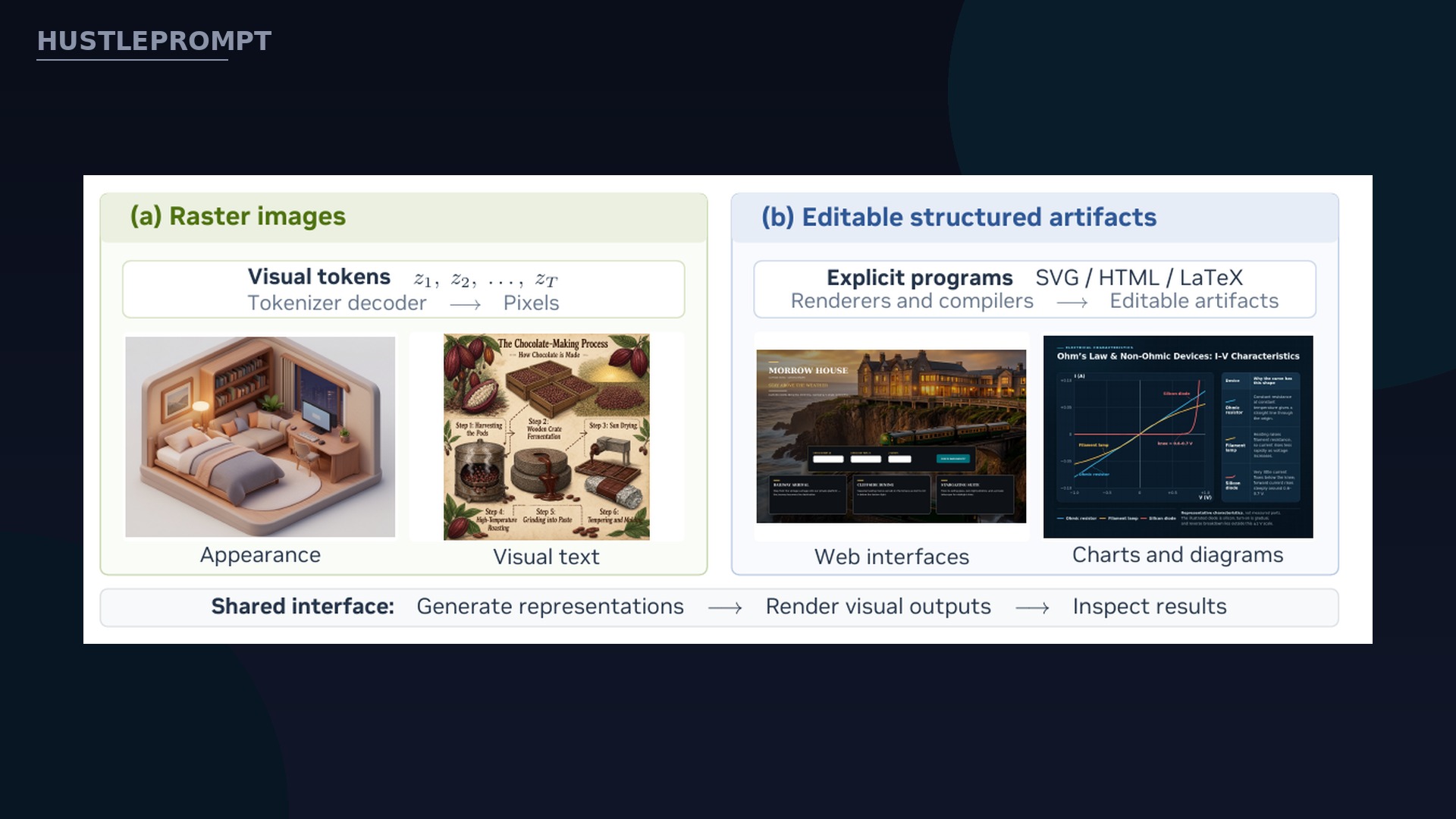
That is a real break from diffusion models such as FLUX or Midjourney, which refine noise into an image. Here, the model predicts a sequence of learned visual codes, and a bundled tokenizer decodes those codes into pixels.
The tokenizer is a serious piece of engineering on its own. It holds about 642 million parameters, works in 16-by-16-pixel patches, and uses a fixed codebook of 196,560 vectors. On roughly 178,000 test images, it reconstructs images at 29.57 dB PSNR, up from 26.08 dB for Emu3.5 IBQ, and it encodes 7.13 times faster and decodes 10.93 times faster on an A100 GPU.
| Specification | Nemotron-Labs-Image-30B-A3B |
|---|---|
| Parameters | 30B total, 3B active per token |
| Architecture | Autoregressive (not diffusion), initialized from Nemotron 3 Nano |
| Visual tokenizer | About 642M parameters, 16×16 patches, 196,560 codebook vectors |
| Context length | 262,144 tokens |
| Precision | bfloat16 |
| Download size | 133.2 GB across 32 safetensors shards |
| Reference hardware | Four NVIDIA H100 80GB GPUs |
| Runtime | vLLM 0.21.0, PyTorch 2.11.0, Python 3.12, CUDA 13.0 |
| Recommended resolutions | 1024×1024, 1184×880, 1248×832, 880×1184 |
| License | Non-commercial research and evaluation only |
Source: NVIDIA Hugging Face model card for nvidia/Nemotron-Labs-Image-30B-A3B; download size from the Hugging Face repository file listing.
The license kills the business case, for now
Here is the sentence that matters most for freelancers and small businesses. The model card states: “This model is licensed for non-commercial research and evaluation under the NVIDIA License.”
That is not open source. You can study the weights, test the model, and publish research about it. You cannot build a paid product on it, sell images made with it as a commercial service, or ship it inside a client deliverable under those terms.
Community ports have already appeared on Hugging Face, including ComfyUI integrations and quantized builds. They do not change the license. A third-party wrapper cannot grant commercial rights that NVIDIA did not grant.
So the honest money math is simple. This release saves you nothing on client work today, because you cannot legally use it for client work. What it can do is sharpen your skills for free, which is still valuable if the license ever loosens or the techniques spread to models you can use commercially.
The hardware bill: 133 GB and four H100s
The download alone is a project. The repository totals 133.2 GB across 32 weight shards, plus the tokenizer directory. On a typical home connection, that is an overnight download, not a quick pip install.
Running it is heavier still. NVIDIA’s reference setup uses four H100 80GB GPUs with vLLM, tensor parallelism set to 4, and a 6,144-token model length. The example script generates one 1024-by-1024 image with temperature 0.9 and a 4,352-token budget.
Very few freelancers own that hardware. Renting four H100s by the hour is possible on cloud GPU marketplaces, but the rental bill quickly erases the “free model” advantage for casual use. By comparison, a single high-quality 1024-by-1024 image from GPT Image 2 costs about $0.21 through OpenAI’s API at reported rates, and a low-quality one costs under a cent.
That comparison frames the real trade-off. The Nemotron model has no per-image fee, but it demands data-center hardware and forbids commercial use. The API services charge per image, but they run anywhere and their output is yours to sell.
How it works: images written like sentences
Most image generators start from noise and clean it up step by step. Nemotron-Labs-Image works like a language model. It reads your prompt, then predicts one visual token after another until the image grid is complete.
Each token stands for a 16-by-16-pixel patch, drawn from a codebook of 196,560 learned vectors. A 1024-by-1024 image becomes a 64-by-64 grid of tokens, framed by special markers that tell the decoder where the image starts and ends.
The model also writes a size header into the token stream, so the requested resolution travels with the generation itself. Width and height must be multiples of 16, and the recommended sizes top out at 1248-by-832 for landscape work.
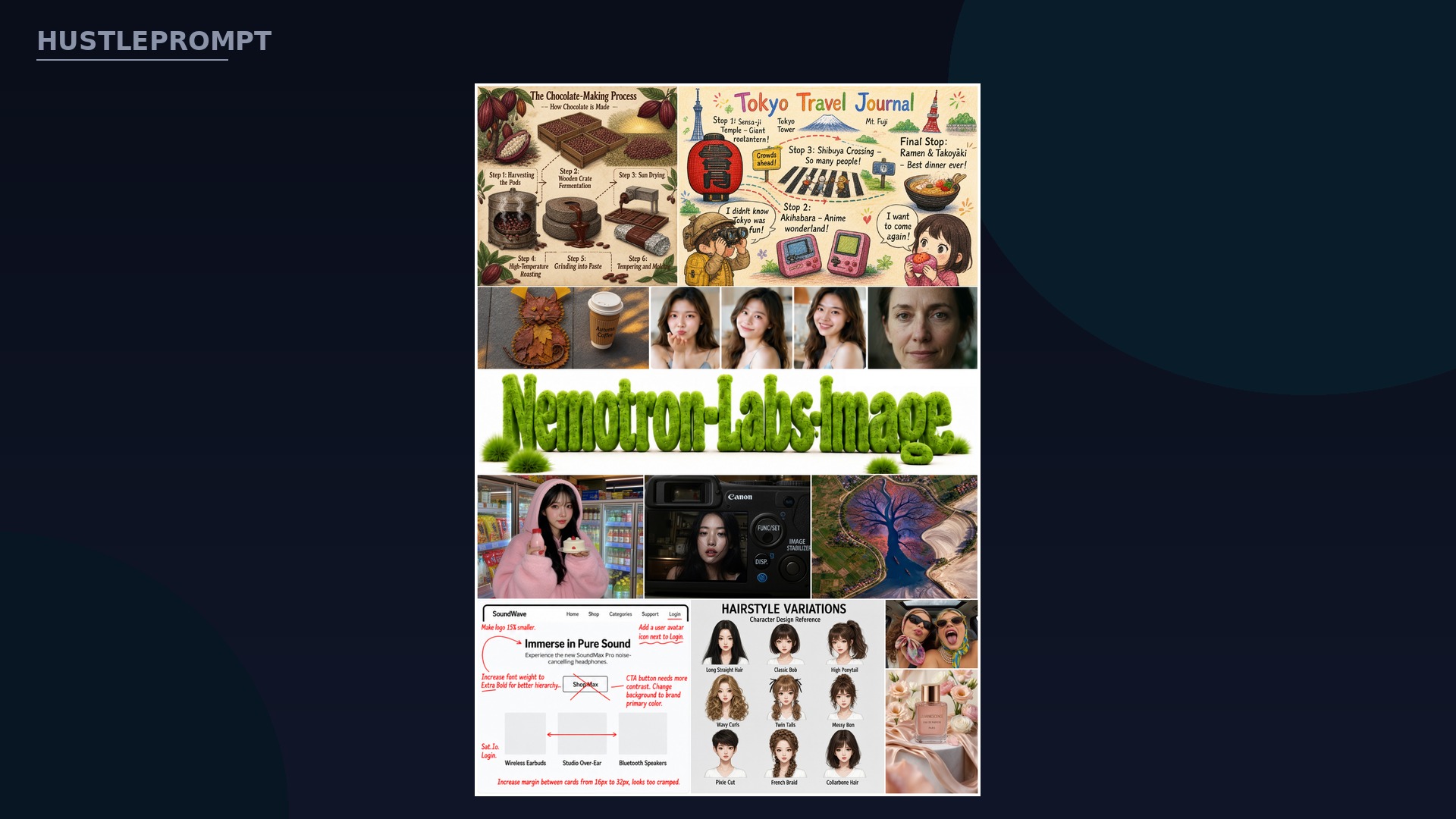
This token-based design is what makes the bigger VisualCreation idea possible. When an image is a sequence of tokens, an agent can plan it, inspect the rendered result, and repair it, the same way a coding agent fixes a broken program.
How Pixel as Code works
You describe the image, chart, slide, or webpage you want.
The harness picks raster pixels, editable code, or a hybrid of both.
The image model predicts visual tokens; VisionCode writes SVG, HTML, or charts.
The result is rendered, visually inspected, and fixed in up to three repair rounds.
The loop is the point. A one-shot generator gives you a finished picture; Pixel as Code gives you an artifact you can inspect, edit, and fix.
How to profit from it anyway
You cannot sell this model’s output, but you can still turn the release into income. The play is skill and positioning, not direct sales. Here is a practical plan.
- Study the paper first. Read arXiv:2611.31358 before touching the weights. The benchmark tables tell you exactly where the standalone model is strong (text rendering, at 94.30 on LongTextBench) and where it is weak (GenEval2, at 31.71).
- Try it on rented hardware, once. Spin up a four-H100 instance, run NVIDIA’s official example script, and generate a small test set. Measure what matters to your work: text accuracy, object counts, and spatial relationships.
- Build the agentic workflow yourself. The unreleased harness is the valuable part, and its design is fully described in the paper. A planning step, candidate generation, visual selection, and a repair loop can be rebuilt around any image model, including ones you can use commercially.
- Publish your findings. A careful, honest benchmark of the standalone model is genuinely scarce right now. A video or article showing real outputs, real failures, and real costs will attract the exact audience that hires AI consultants.
- Watch for the harness release. NVIDIA says the VisualCreation harness and the VisionCode models will be released “upon legal clearance.” No date is given, so check the model card rather than trusting rumors.
The creators who gain from this release will not be the ones who download 133 GB the fastest. They will be the ones who understand the system behind the score and rebuild its workflow around tools they are allowed to sell.
Frequently asked questions
Is NVIDIA’s Nemotron image model open source?
No. The weights are published on Hugging Face, but the license covers non-commercial research and evaluation only. That is a research license, not an open-source license, and it does not permit commercial use.
Can I use Nemotron-Labs-Image-30B-A3B for client work?
No, not under the current license. The model card restricts use to non-commercial research and evaluation. Client deliverables, paid services, and commercial products are outside those terms.
What GPU do I need to run it?
NVIDIA’s reference setup uses four H100 80GB GPUs with vLLM, and the download is 133.2 GB. Smaller or quantized community builds exist, but they are unofficial and do not change the license terms.
Does it really beat GPT Image 2?
Only in one configuration. The GPT-6-assisted VisualCreation system scores 92.86 on GenEval against 89.00 for GPT Image 2, but the downloadable standalone model scores 80.97. GPT Image 2 still leads GenEval2 at 81.00, against 65.43 for the assisted system and 31.71 standalone.
What is Pixel as Code?
It is NVIDIA’s interface for agentic visual creation. Raster images are represented as discrete visual tokens, while charts, webpages, and documents are represented as editable code. One generate, render, and inspect loop handles both, so artifacts can be checked and repaired instead of regenerated from scratch.
When will the full VisualCreation harness be released?
NVIDIA has not given a date. The model card lists the harness and the VisionCode models as “will be released upon legal clearance.” The image generator and its tokenizer are the only parts available now.
Can I run it in ComfyUI or Diffusers?
Not through Diffusers. The model card states it is not a Diffusers pipeline and is not compatible with AutoPipelineForText2Image. Community ComfyUI ports have appeared on Hugging Face, but they are unofficial.
Keep Reading
- NVIDIA Sigma: Diffusion Model Writes Text 4.2x Faster
- NVIDIA Nemotron for Science: Free AI Agents for Labs
- Best AI Tools for Freelancers (by Task) in 2026