
Your next AI assistant may not live in a data center at all. It may live on the computer already sitting on your desk — in about 4GB of video memory, with no monthly API bill and no internet connection required.
That is the promise behind two releases that landed within days of each other in late October 2026. NVIDIA shipped Nemotron 3.5 Bolt E4B 4GB, an open model built to run talking, tool-calling agents locally on GeForce RTX cards, Jetson boards, and Spark machines. And Kyutai published CADRE, a family of seven open video autoencoders that lets interactive world models run at 20 frames per second on a single H100 and react in under 230 milliseconds.
Neither release is a chatbot demo. Together they mark a shift in where AI runs — and that shift is where the money is moving for freelancers and small businesses.
What Is Actually Trending
For two years, the default answer to “where does AI run?” was “in the cloud, rented by the token.” That answer is starting to crack, for three practical reasons rather than one philosophical one.
First, latency. A cloud round trip is fine for a chat reply. It is a problem for an agent that must react to a screen, a voice, or a robot arm in real time. Kyutai’s paper makes the point with unusual clarity: a typical 8x temporal compression delays every action by at least 400 milliseconds at 20 frames per second, and humans notice their own movement lagging beyond about 230 milliseconds. CADRE was designed around that threshold, not around a benchmark leaderboard.
Second, privacy and control. A voice assistant for a law office, a clinic, or a factory floor cannot always send audio to a cloud API. A local model keeps the data on the device. That is not a niche concern anymore — it is the first question many small-business buyers now ask.
Third, cost structure. A cloud agent that never sleeps bills by the token, forever. A local agent costs hardware once and electricity after that. For always-on jobs — a receptionist voice agent, a shop-floor assistant, a game character — the math flips fast.
The Evidence: Two Releases, One Direction
NVIDIA’s Bolt E4B is the more immediately usable of the two. It is post-trained from Google’s Gemma 4 E4B using reinforcement learning only, according to NVIDIA’s launch material as reported by MarkTechPost. It holds up to 64,000 tokens of context, works in 35 languages, and has a conversational mode that keeps replies short and speech-ready, plus a thinking mode you can switch on for harder tasks or off for speed.
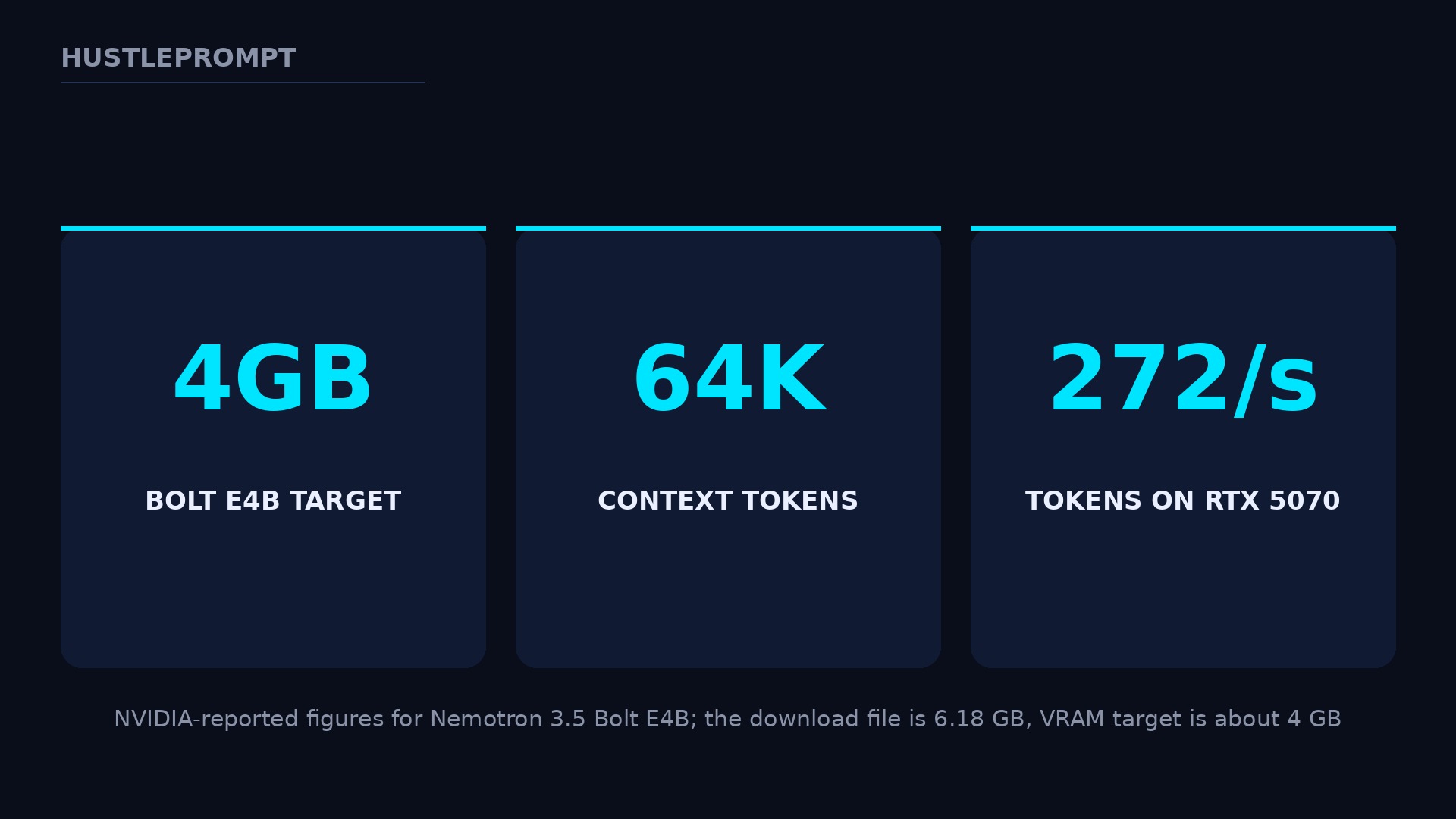
*NVIDIA-measured figures. Treat vendor benchmarks as a starting point, not a verdict — the honest check is your own workload, on your own hardware.
Sources: MarkTechPost, “NVIDIA Releases Nemotron 3.5 Bolt E4B 4GB” (Oct 23, 2026) · Kyutai, “Rethinking Video Autoencoders for Interactive World Models” (arXiv, Oct 21, 2026) · MarkTechPost, “Kyutai CADRE” (Oct 23, 2026).
The honest caveats matter, and they are part of the trend, not footnotes to it. The Bolt E4B download file itself is 6.18GB — the “4GB” is a VRAM target for the workload, not the size on disk. And an independent laptop test on an 8GB RTX 3070 Ti found the model passed 14 of 15 small checks without thinking mode and 15 of 15 with it — a small synthetic suite, not a general accuracy benchmark. Local AI is real, but it is not magic, and anyone selling it has to say so.

Why This Shift Is Different From the Last “Local AI” Wave
Local models are not new. What is new is that the local models can now act, not just chat. Bolt E4B is built for multi-turn tool calling: it can hold a conversation and call app tools across turns to get tasks done. NVIDIA’s own demo pairs it with a vision model on a Jetson Orin Nano to run a small Reachy Mini robot — Bolt handling speech replies and tool calls while another model handles vision.
That combination — small language model plus a specialist model beside it, all on device — is the architecture to watch. It means the product is not “a model.” It is a small system: speech in, tools out, running where the work happens.
The second difference is licensing and distribution. Bolt E4B ships under the OpenMDW-1.1 license and is distributed on Hugging Face, Ollama, LM Studio, Unsloth, and Jetson AI Lab, alongside NVIDIA’s NIM runtime. A freelancer can download it, test it, and ship it without negotiating an enterprise contract. That distribution is what turns a research release into a service market.
Cloud Agent vs. Local Agent, in One Picture
Same job, different bill, different risk — and a hybrid in the middle.
Rented by the token
Best model, always updated. But every call leaves the building, and an always-on agent bills forever.
Local first, cloud when stuck
Routine work on device; hard questions escalated to a frontier model. Most small businesses land here.
On your hardware, offline
Data never leaves the room. Fixed cost, instant response — but you own the updates and the limits.
How to Profit From This Trend
Do not sell “local AI” as a concept. Sell a specific job, done privately, for a fixed price. The buyers who move first are the ones with a privacy reason or an always-on cost problem: clinics, law offices, trades businesses with a busy phone, game studios, and small manufacturers with a shop-floor helper.
Prices below are my estimates based on comparable freelance setup and support rates, not market data:
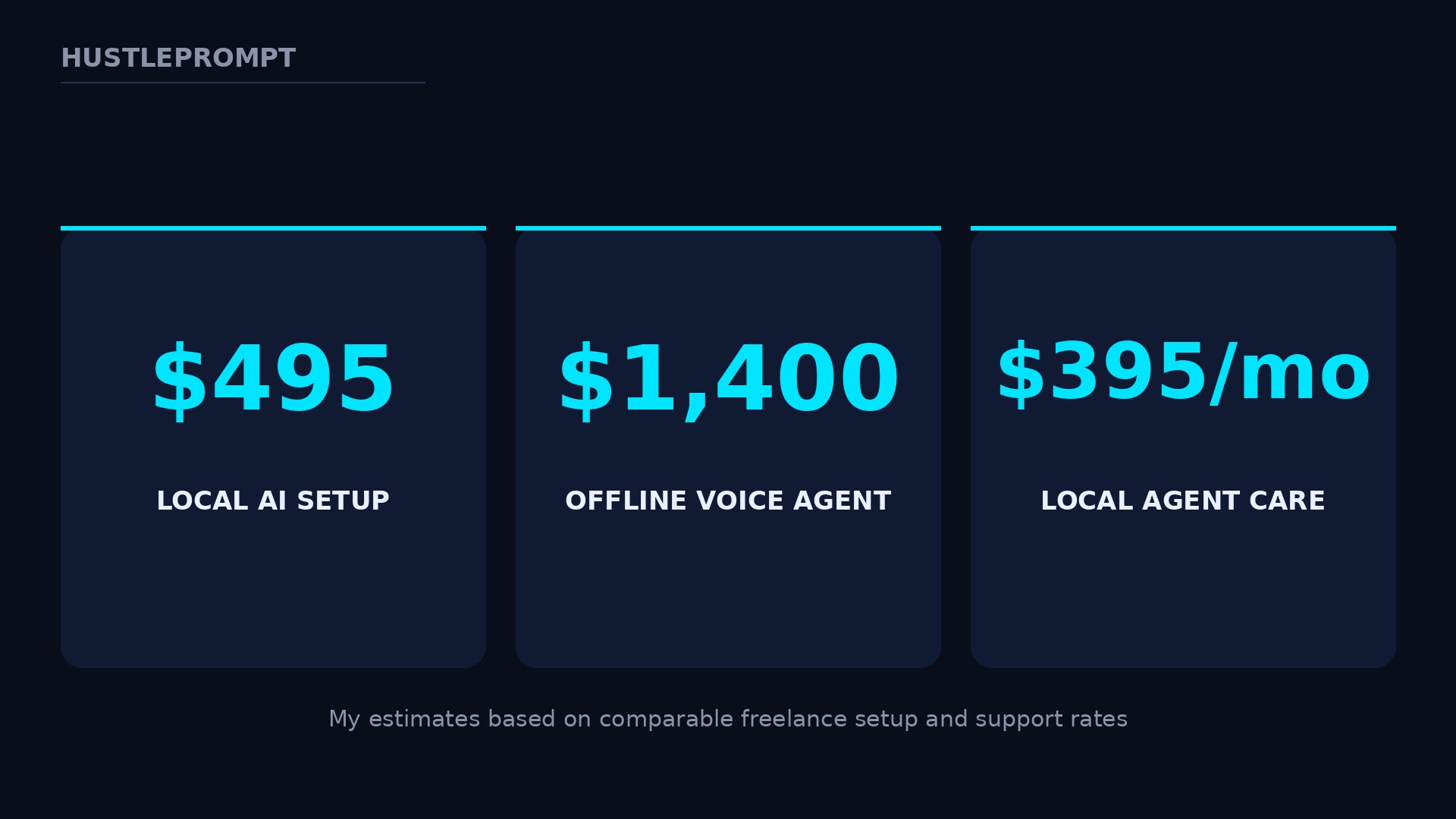
The setup is the wedge, exactly as with the cloud services: cheap enough to buy in one call, concrete enough to show on the client’s own machine. Run the demo on their hardware, with their data, in their office. A local agent that answers their own phone script beats any slide deck about privacy.
What to Do This Week
- Install Bolt E4B on hardware you already own. Ollama or LM Studio, one evening, one real workflow — file sorting, schedule organizing, or expense math, all offline.
- Measure honestly. Time it, note where it fails, and write down the failure modes. Your caveats are your credibility when you sell this.
- Pick one privacy-sensitive niche. A clinic, a law office, or a trades business with a busy phone will understand the pitch in one sentence.
- Price the hybrid, not the fantasy. Offer local-first with cloud escalation for hard tasks, and put that in writing. Clients buy the safety net, not the ideology.
Watch: an independent test of Bolt E4B on a real laptop — how it was trained, what the published benchmarks say, and where the small model actually struggles. Watch on YouTube.
Where This Is Heading
Local becomes the default for routine work. As small models get better at tool calling, the question flips: why pay per token for a job a 4GB model does well? The cloud keeps the hard, rare, and frontier work. The routine moves home.
World models become a product category, not a demo. CADRE is infrastructure: once a world model reacts in under 230 ms on one GPU, training robots, testing game characters, and simulating shop floors stop needing a data-center budget. Expect small studios to be the first commercial users.
The service layer, again, is where freelancers win. Models are free and getting smaller. Setup, integration, privacy design, and maintenance are not free — and they are exactly what a small business will pay a person for. Position yourself there before the market fills up.
Frequently Asked Questions
Can a 4GB model really replace a cloud chatbot?
For routine, well-scoped jobs — yes: answering, booking, sorting, and calling tools. For deep research, hard reasoning, or the latest knowledge, no. The winning setup is usually local-first with cloud escalation.
What hardware do I need to try Bolt E4B?
NVIDIA targets GeForce RTX cards, Jetson boards, and Spark machines. Independent testing ran it on an 8GB laptop GPU. Start with the machine you have and test one workflow before buying hardware.
Is the “4GB” claim misleading?
It is a VRAM target for the workload, not the download size — the Q4_K_M file is 6.18GB on disk. That distinction matters, and honest sellers state it upfront.
What is a world model, in plain English?
A learned simulator: given past frames and an action, it predicts the next frames. It lets robots practice, games react, and agents plan — without touching the real world each time.
Why does 230 milliseconds matter?
It is roughly the point where humans start noticing their own actions lagging. Below it, an interactive system feels responsive; above it, it feels broken, especially for driving or manipulation.
Should a small business go fully offline?
Only if the privacy or cost case demands it. Most should go hybrid: local for routine and sensitive work, cloud for the hard 10%. Audit first, then move what makes sense.