
There is now a price tag on boring computer work — and it just got cut in half. OpenAI’s GPT-6.1 Terra, released October 26, 2026, does the job every office dreads: reading the screen, clicking the right buttons, filling the forms, and writing up the result.
The headline is the price: $1 per million input tokens and $5 per million output tokens, with cached input at $0.05. That is 50% below the model it replaces, GPT-5.6 Terra, and half the price of GPT-6.1 Sol. But the real story is not the discount. It is what a halved price does to an entire category of work that was previously too expensive to automate at all.
This is an analysis of that shift: what Terra actually does, where its numbers hold up, where they quietly break down, and how to sell desktop automation now that the unit economics finally work.
What Is Actually Trending
Computer use means an AI that operates software the way a person does: it sees the screen, moves the mouse, types, and works across apps, instead of calling a clean API. For years it was a demo category — impressive on stage, ruinous on the invoice. Every screenshot, every screen re-read, every form field burned vision tokens, and frontier models charged frontier prices for each one.
Terra is OpenAI’s attempt to make that loop affordable. It is rolling out to Plus, Pro, Enterprise, and Edu users in ChatGPT Work and Codex, and to developers through the API as gpt-6.1-terra. GitHub made it generally available in Copilot the same week, aimed at everyday agentic coding and terminal work. Microsoft is integrating it into its Foundry platform for agents that process documents and navigate desktop apps.
In other words, the model is not launching alone. It is landing inside the three places office work already happens: ChatGPT, Copilot, and enterprise agent platforms. That distribution is why the price cut matters more than a cheaper API line item.
The Evidence: Price, Benchmarks, and the Fine Print
Start with the price card, because it is the only part of this story that is not a benchmark claim:
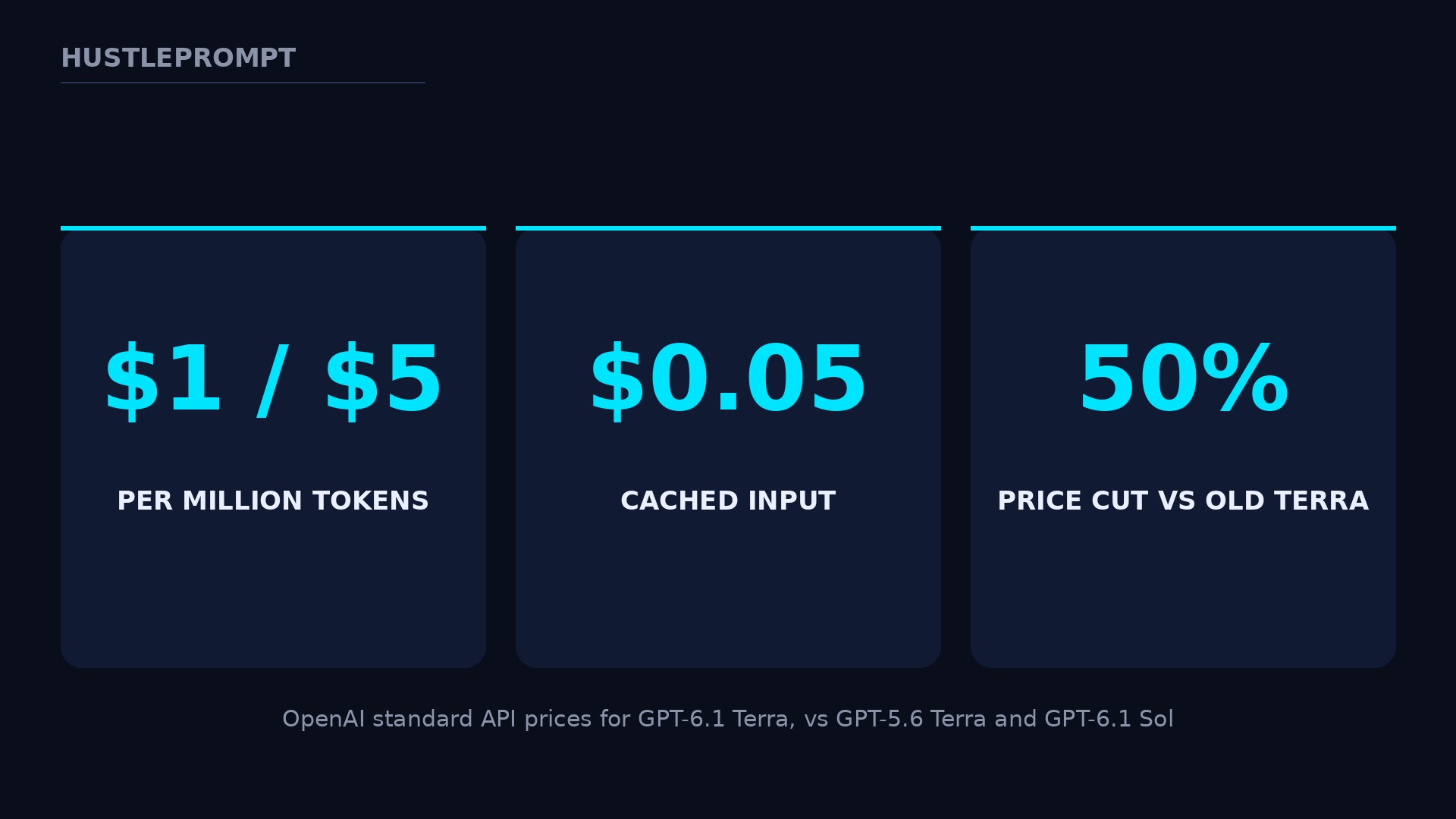
Note what fell most: output dropped from $12 to $5, and cached input fell to a quarter of its old price. That matters because agent loops resend long context and generate many action tokens — so your real bill depends on your token mix, not just the headline rate. One independent analysis worked a standard workload of 100,000 input tokens and 5,000 output tokens at $0.125 on Terra versus $0.26 before — a 52% saving, slightly better than the headline, because output was the expensive side.
Then the benchmarks — all OpenAI’s own, so read them as claims to test, not verdicts:
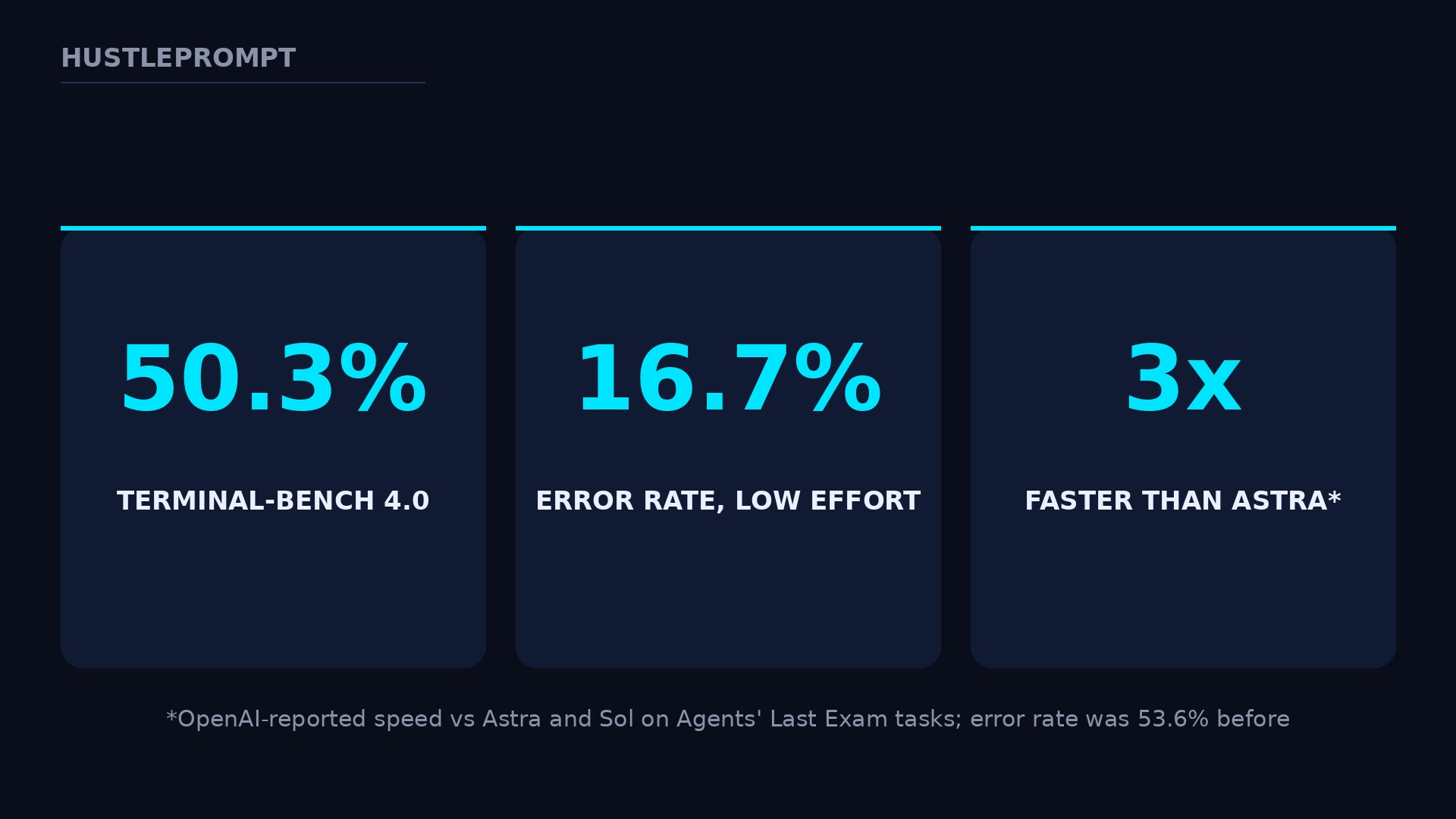
Sources: ExplainX, “GPT-6.1 Terra: $1/$5 Pricing, Benchmarks, Computer Use” (Oct 2026) · AI Affairs, “OpenAI releases GPT-6.1 Terra for computer use” (Oct 2026) · OrcaRouter, “GPT-6.1 Terra: Half the Price” (Oct 2026, independent pricing analysis).
The fine print is where the analysis earns its keep. Fast mode costs twice the standard rate — which puts Terra at exactly GPT-6.1 Sol’s standard list price, for a weaker model. If your workload needs speed and you pay the fast multiplier, the price argument over Sol disappears. And OpenAI itself says Sol and Astra remain better for the most complex coding. Terra is the worker tier, not the frontier — and pricing it like a frontier model is the first mistake a new automation seller can make.
The Expensive Loop vs. the Cheap Loop
Same desktop job, different economics — and a different sales pitch.
Frontier price per click
Every screenshot and re-read billed at frontier rates. A long desktop loop could burn $20 before finishing.
Half the rate, cached context
$1/$5 with $0.05 cached input. Repeated context — the bulk of agent loops — gets dramatically cheaper.
Per-task pricing
When a task costs cents, not dollars, you can sell automation by the completed job — and clients can finally say yes.
How to Profit From This Trend
The opportunity is not “use Terra.” It is selling the boring workflows that were previously unprofitable to automate: invoice entry, form filling, report assembly, inbox triage, and data moving between apps that never got an API. Every small business has a pile of these. Until now, automating them with a frontier model cost more than paying a person.
Prices below are my estimates based on comparable freelance automation and support rates, not market data:
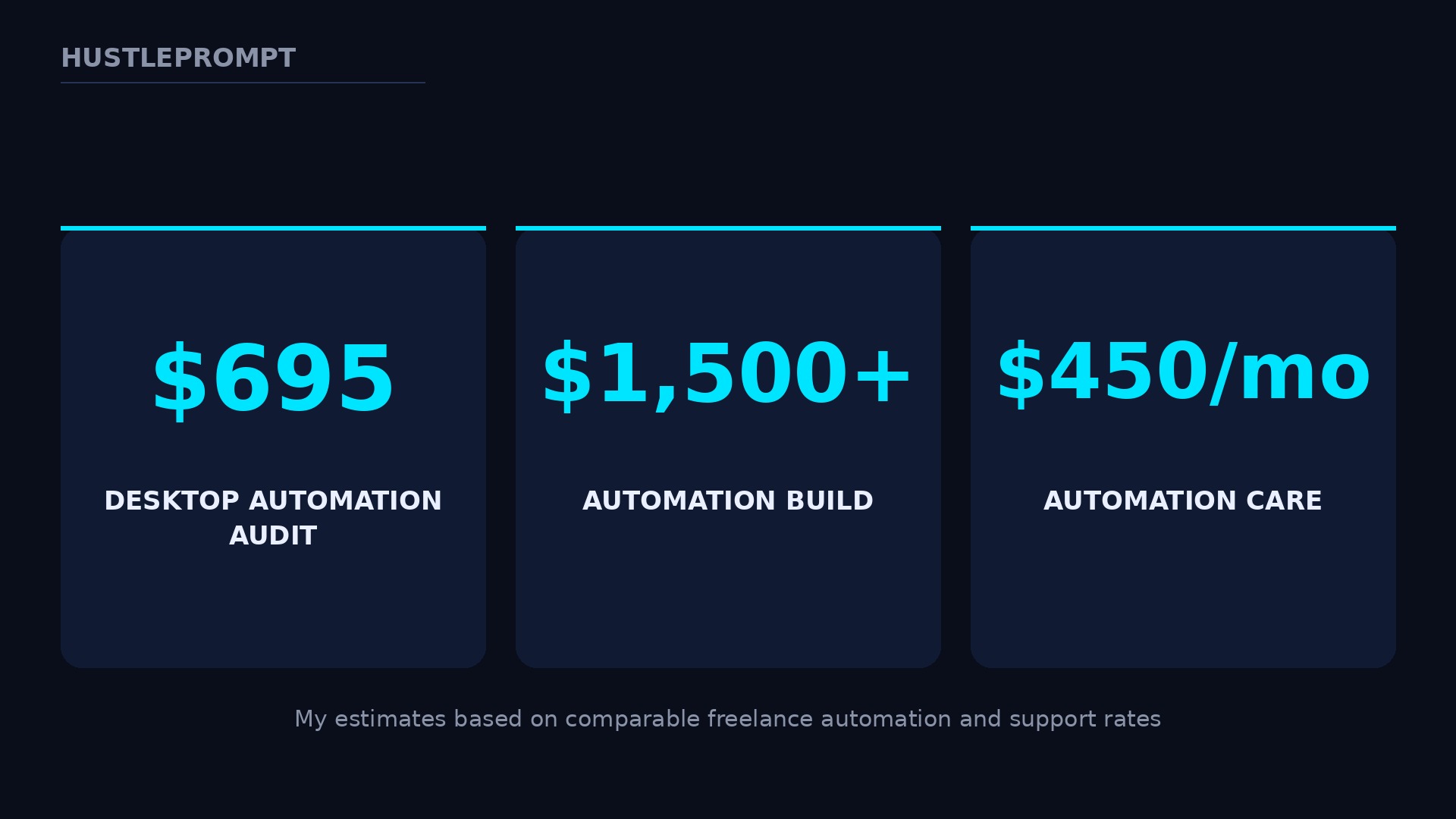
Lead with the audit, and lead the audit with a number: “This job takes your team 6 hours a week. At Terra rates, the agent run costs under a dollar. Here is the workflow, here is the approval step, and here is the stop button.” The approval step is not a feature — it is the product. Nobody hands an agent their inbox without one.
What to Do This Week
- Automate one of your own boring jobs first. Receipts into a spreadsheet, screenshots sorted by content, or a form you fill weekly. Measure the real per-task cost.
- Test at standard and batch rates before promising prices. Fast mode doubles the bill — never quote a price you tested only at standard.
- Build the approval template once. Money, external messages, and deletions always need a human. Everything else can run unattended.
- Pitch one niche with one workflow. Accountants and invoice entry, agencies and report assembly, recruiters and form triage — one workflow, one price, one demo.
Watch: a full breakdown of Terra’s pricing, benchmarks, and traps — including where the fast-mode multiplier erases the discount. Watch on YouTube.
Where This Is Heading
Per-task pricing becomes the norm. When a desktop job costs cents, vendors stop selling tokens and start selling completed tasks. Freelancers who quote per task — with the cost math shown — will beat hourly competitors.
The worker tier splits from the frontier. Terra, not Astra, becomes the default for the workday. Frontier models keep the hard 10%. The market for “good enough, fast, cheap” agents is far larger than the market for genius models.
Reliability, not price, becomes the next bottleneck. Terra’s error rate fell sharply, but 16.7% at low effort is still a human-approval problem, not a fully-autonomous one. The sellers who win in 2027 will be the ones who built the guardrails first.
Frequently Asked Questions
What is computer use, exactly?
An AI that operates software like a person: it reads the screen, clicks, types, and moves between apps, rather than calling a programming interface. It is useful precisely for the apps that never got an API.
Is GPT-6.1 Terra really 50% cheaper?
On standard API rates, yes versus GPT-5.6 Terra and GPT-6.1 Sol: $1/$5 against $2/$12. Output and cached input fell even more. But fast mode doubles the rate, and long-context jobs carry a multiplier — so check your own token mix.
Can Terra replace a human for invoice entry?
For structured, repeated invoices, with a human approval step for money movements — yes, and the per-task cost now supports it. For messy, one-off documents, keep a human in the loop.
Where is Terra available?
Through the OpenAI API as gpt-6.1-terra, in ChatGPT Work and Codex for paid plans (Plus, Pro, Business, Enterprise, Edu), and generally available in GitHub Copilot. There is no free-tier computer-use rollout described in the launch.
Is Terra better than GPT-6.1 Sol or Astra?
No — OpenAI says Sol and Astra remain better for the most complex coding. Terra wins on price, speed, and everyday computer work, not on frontier capability.
What is the biggest risk in selling Terra automation?
Quoting a price tested at standard rates, then running at fast-mode prices — or automating money and messages without an approval step. Both mistakes are avoidable, and both are visible in the first invoice.